AI Engineering Orchestrator: Getting more out of an expensive AI model in game development
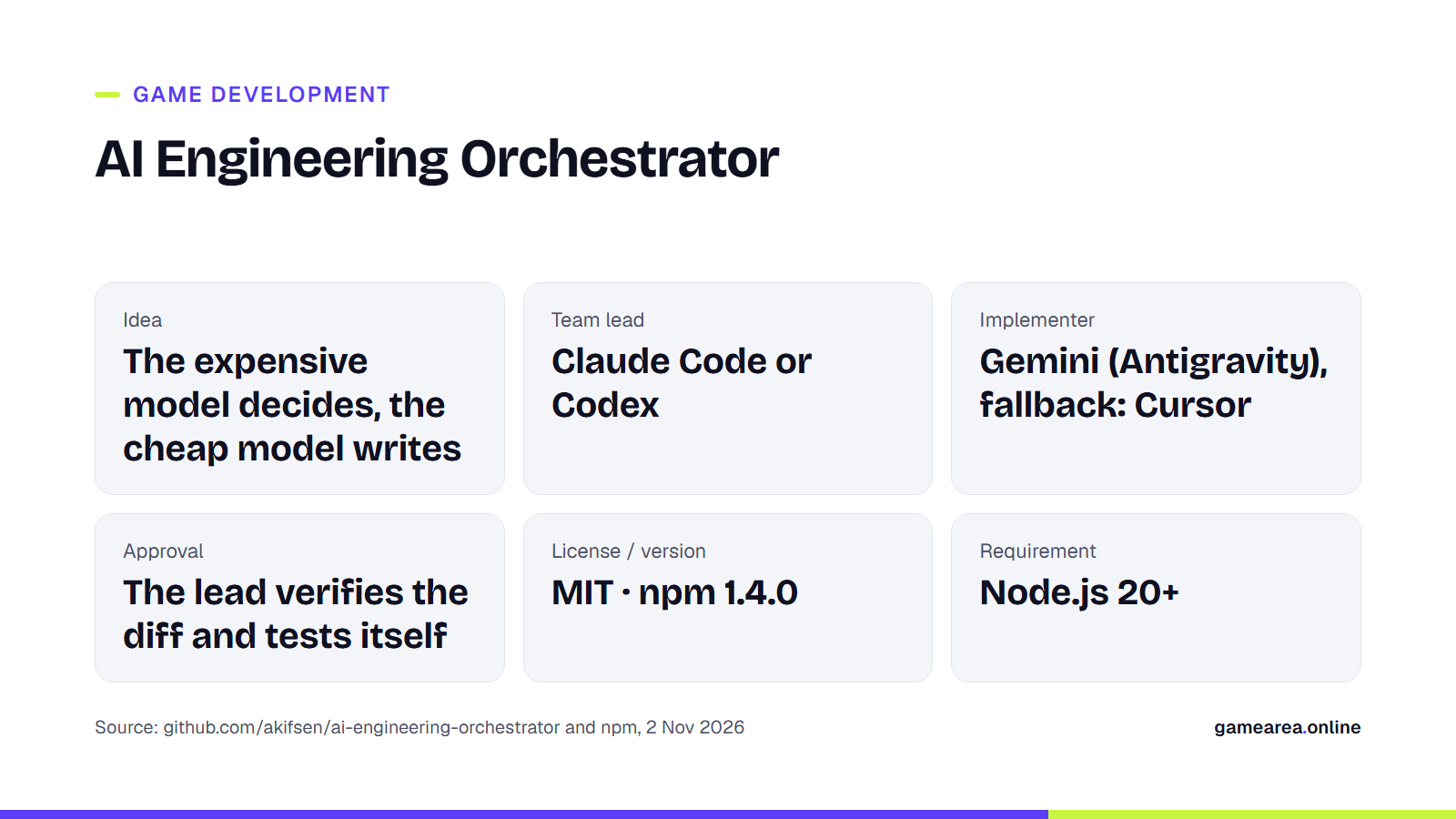
In AI-assisted coding, the scarcest resource is often your allowance on the strongest model: once you hit the limit, work stops. The open-source AI Engineering Orchestrator aims to get more done on the same allowance by reserving that expensive model for thinking, deciding and reviewing, and handing the actual coding to a model you can access more cheaply.
In short
- Claude Code or Codex acts as the "team lead"; the actual code changes are made by Gemini (through Antigravity), with Cursor as a fallback.
- The team lead hands off every task with a written implementation contract, verifies the returned code itself with git diff and tests, and then decides APPROVED or CHANGES REQUIRED.
- In the project's own measurement of a single task, the expensive model's API time fell from 8 min 54 s to 3 min 39 s; the developer states plainly that this was a single trial and that no savings are guaranteed.
- It is MIT-licensed, installs from npm with one command and only touches the settings of the project it is installed into.
What does AI Engineering Orchestrator do?
Many developers today have two kinds of AI access. The first is an expensive model with strong reasoning: it makes a real difference in architecture decisions, debugging and code review, but the subscription limit or the token bill fills up fast. The second is a model available more cheaply, sometimes sitting unused inside a plan that is already paid for. The problem is that most people have the expensive model do everything, routine coding included.
AI Engineering Orchestrator (AEO for short) tries to fix this imbalance with a division of labor. In the project's own summary, the thesis is simple: the expensive model decides, the cheap model writes. Technically it has two parts. An MCP bridge gives the team-lead model the ability to call another model, and a policy file added to CLAUDE.md or AGENTS.md defines when that ability should be used. The core idea of the tool is a distinction: a tool isn't used because it exists, but because the rules say so.
How do you get more out of an expensive model on a cheaper plan?
"Cheap" is relative here, and AEO's documentation makes a point of saying so: a model may be cheap for you because of a subscription plan, student or enterprise pricing, regional pricing, a promotion, or unused capacity in a plan you already pay for. The same model may be a poor deal for someone else. So the tool doesn't declare any particular company "the cheapest"; it simply lets you use the most suitable, sufficiently capable implementation route you have.
The flow works like this. The expensive model understands the request, examines the repository as much as it needs to and decides whether the work is trivial or a real implementation task. If it is real work, it writes a bounded contract containing the objective, constraints, acceptance criteria and the tests to run, and sends it to the implementer model. Writing the code, adding tests and handling revision rounds all happen on the cheaper model. The expensive model spends its time reading and deciding rather than writing code. For someone working within a subscription limit, that means finishing more tasks on the same limit.
If the quota runs out on the Antigravity side, the bridge first tries the other configured Gemini models; if that fails too, the policy routes the same contract to Cursor. The aim is to keep work from silently drifting back to the expensive model when the implementation channel is blocked.
How can it help game developers?
Game projects fit the division of labor AEO proposes naturally. A game's codebase contains both a small number of costly decisions (network architecture, server authority, the save system, economy rules) and a large amount of repetitive work (a new menu screen, a rule variant for a game mode, localization keys, missing tests, refactors). Following AEO's logic, the first group stays with the lead model and the second goes to the implementer.
- Small teams and solo studios: An indie developer is designer, programmer and tester all at once. Saving the expensive model's limit for architecture and debugging while handing off routine feature work reduces the risk of running out before the end of the month.
- Multiplayer and server code: For areas such as concurrency, sessions and permissions, the policy recommends bringing in an independent review agent (reviewer). Where mistakes are costly, a second pair of eyes is safer than a single model approving its own work.
- Game logic with tests: Parts such as rule engines, score calculations, matchmaking and server-side validation can be exercised with headless tests. This is where AEO's quality gate works best, because the lead model looks at tests it ran itself, not at the sentence "tests passed".
- Parallel work: You can give two tasks that don't touch each other, for example a game mode and a stats screen, to two implementers at the same time in separate git worktrees. The changes are applied to the main working tree one at a time, and only once the lead approves them.
An honest note: visual feel, animation timing and the question "is the game fun?" can't be caught by tests. AEO's quality gate verifies code against the contract; you still have to judge gameplay quality by playing. The tool's own documentation acknowledges a similar limit: if the contract itself contains a design flaw, code that faithfully implements that flaw will pass the gate.
Why does the quality gate matter?
The known risk of handing work to a cheaper model is a "done" report that doesn't reflect reality. That is why AEO treats the implementer's report as evidence, not approval. Before work starts, the lead model records a baseline with git status; when the work comes back, it inspects the diff, the changed files and the tests itself. A test the implementer couldn't run because of a permission block doesn't count as passed. The decision has two options: APPROVED or CHANGES REQUIRED. In the second case, the findings go back to the same implementer together with their evidence.
This discipline has a side benefit: thanks to the baseline, the user's own uncommitted changes are protected, and the lead doesn't touch a change whose owner it can't prove. The default permission examples also deny hard-to-undo git commands such as push, reset, rebase, merge and commit.
What does a real measurement show?
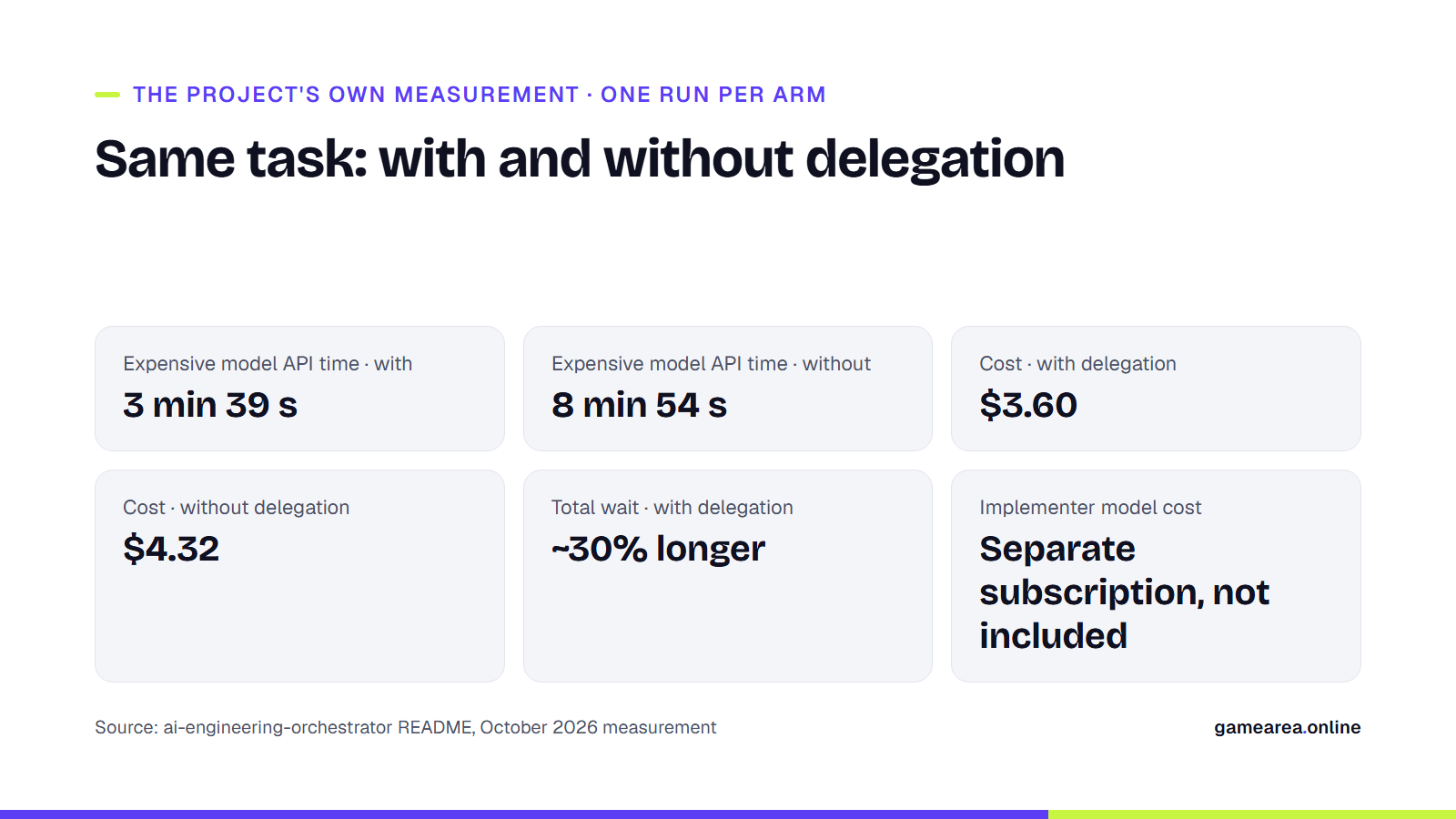
The project's README measures a fix for a refresh token bug in a Laravel API twice: once with delegation, and once as a control run with the delegation tools removed. The same commit and the same prompt were used for both.
| Metric | With delegation | Without delegation |
|---|---|---|
| Expensive model's API time | 3 min 39 s | 8 min 54 s |
| Calculated cost | $3.60 | $4.32 |
| Implementer model's cost | On a separate subscription, not added to the bill | None |
| Total wait time | About 30% longer | Shorter |
| Source | Project README, October 2026 | One run per arm (n=1) |
The developer doesn't overstate the result: the dollar difference is 17%, and it exists only because the implementer was covered by a separate subscription. The real gain is in the expensive model's usage time: about 59% less. On a usage-limited subscription, that is the binding constraint anyway. On the other hand, the task took about 30% longer because of the round trips to the implementer, and both runs produced a fix of similar quality. A single measurement doesn't give you a general savings rate; the project also provides a script and a method for measuring your own numbers.
How do you install it?
You need Node.js 20 or later, the Antigravity command-line tool (agy) signed in, and Claude Code or Codex as the team lead. Installation starts with a dry run, which shows what will change without writing any files. The command npx ai-engineering-orchestrator@latest install --target . --claude (or --codex) then adds the policy, the agent definitions and the MCP server to the project, and the doctor command checks the installation. Backups of any shared files it modifies are kept in the user folder, and global settings are only touched if you explicitly pass --global.
Disclosure: AI Engineering Orchestrator is an open-source project by Akif Şen, the developer of GAMEAREA, and it is also used in GAMEAREA's own development process. The measurement figures in this article come from the project's own documentation; they are not an independent test. We explain how we use AI on this blog on our AI principles page.
Frequently asked questions
Does AI Engineering Orchestrator cost anything?
No. The project is MIT-licensed and installs free of charge from npm. The subscription or usage fees of the AI services you use (Claude, Codex, Gemini, Cursor) apply separately.
Does it guarantee savings?
No. The project states clearly that it has not measured and does not guarantee a savings rate. Any gain depends on how cheaply you can access the implementer model on your own account.
Which game engines does it work with?
The tool isn't a game engine plugin; it works at the repository level. In principle, the same flow can be applied to any codebase the models you use can understand, whether it's Unity, Godot or a web-based game; how strong the verification is depends on the tests in the project.
What happens if the implementer model breaks my code?
The work isn't considered done until the change is approved. The lead model can review the diff and tests and answer CHANGES REQUIRED; in parallel work, changes stay in a separate worktree and are applied to the main working tree only after approval. Operations such as commit and push are forbidden by default.
Sources
- akifsen / GitHub — AI Engineering Orchestrator (README) Official source
- akifsen / GitHub — Cost-aware routing Official source
- akifsen / GitHub — Quality gate Official source
- npm — ai-engineering-orchestrator Official source
How this content was prepared
Prepared with AI assistance from the sources listed, key facts checked against official sources, not copied verbatim. Our AI principles
GAMEAREA Editörlüğü