Special moves in chess: the rules of castling, en passant, pawn promotion and stalemate
There are three special moves in chess: castling, en passant and pawn promotion; stalemate, meanwhile, is a special position that ends the game in a draw. The rule for each of the four is written in a few sentences in the FIDE Laws of Chess, and most arguments arise because the small conditions in those sentences are not known.
In short
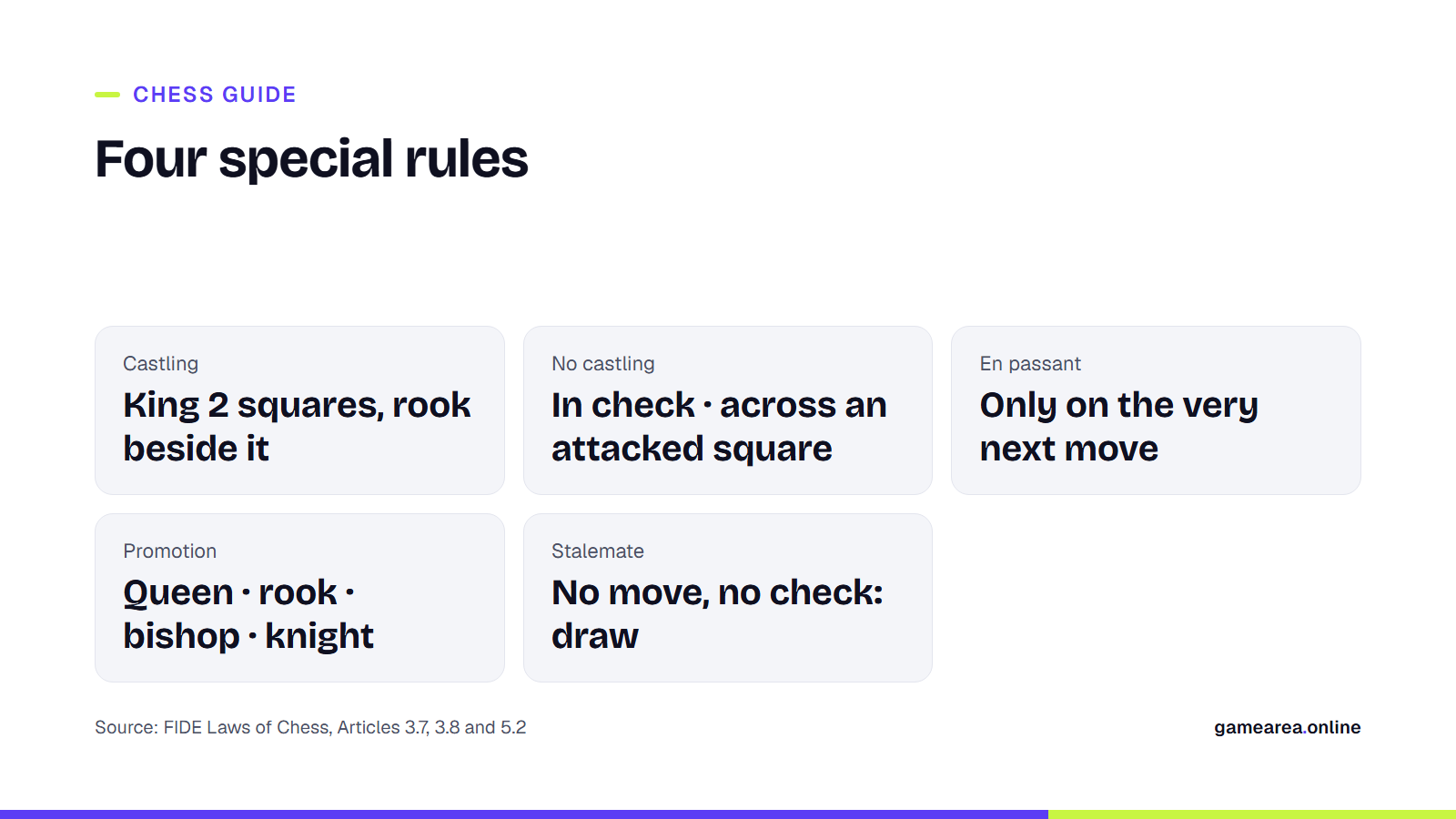
- Castling: the king moves two squares towards the rook, and the rook goes to the square the king crossed. If the king or that rook has already moved, the right is lost for good.
- En passant: you capture an enemy pawn that advanced two squares as if it had advanced only one; it is only available on the very next move.
- Promotion: a pawn that reaches the last rank must turn into a queen, rook, bishop or knight on that same move; the choice is not restricted to pieces that have been captured.
- Stalemate: if it is your turn, you are not in check and you have no legal move, the game ends in a draw.
How do you castle, and when is castling not allowed?
Castling is the only case in which two pieces move in one turn, and in the FIDE Laws it counts as a move of the king (Article 3.8.2). The king moves two squares from its starting square towards the rook, and the rook lands on the square the king has just crossed. Castling on the king's side is called short (kingside) castling, and castling on the queen's side is called long (queenside) castling; the rule is the same for both.
The Laws restrict the right to castle under two separate headings. The first is permanent: if the king has already moved, you cannot castle on either side, and if a rook has moved, you cannot castle with that rook. Bringing the piece back to its original square later does not restore the right.
The second is temporary; once the obstacle is gone, castling becomes possible again:
- If the square the king stands on is attacked, that is, if the king is in check.
- If the square the king has to cross is attacked by enemy pieces.
- If the square the king would land on is attacked.
- If there is any piece between the king and the rook.
Two situations that are not on this list are often misunderstood. The rook being under attack does not prevent castling. In queenside castling, an attack on the b-file square the rook passes over is no problem either, because the conditions are written only for the squares the king stands on, crosses and arrives at. Having been in check earlier does not end the right on its own either; if the king has not moved from its square, castling is still possible.
Castling over the board: which piece do you touch first?
In a tournament, castling is done with one hand and by touching the king first. Under Article 4.4.2 of the FIDE Laws, a player who deliberately touches the rook first and then the king may not castle on that side on that move and has to move the rook they touched. Online play does not have this problem: when you drag the king two squares, the rook moves into place by itself. GAMEAREA Chess works this way too.
What is en passant, and when can you play it?
En passant is the only move in which a pawn captures another pawn without going to the square it stands on. The rule is defined in Article 3.7.3.1: if your opponent's pawn has advanced two squares in one move from its starting square and landed on the same rank as your pawn and on an adjacent file, you may capture it as though it had advanced only one square. Your pawn moves diagonally, and the enemy pawn is removed from the board.
Example: your white pawn stands on e5. Black pushes the pawn on d7 to d5. On your next move you can play your pawn to d6 and capture the black pawn on d5.
All three conditions must be met together:
- The enemy pawn must have advanced two squares at once on that move.
- Your pawn must stand on the same rank and on an adjacent file. That means the 5th rank for White and the 4th rank for Black.
- The capture must be made on the very next move. If any other move comes in between, the right is lost (Article 3.7.3.2).
En passant is not compulsory; most of the time it is an option. The single exception arises when it is the only legal move you have: then you must play it, because there is no stalemate while you have a legal move.
How does pawn promotion work, and what can a pawn turn into?
A pawn that reaches the rank furthest from its starting rank must be exchanged, as part of the same move, for a new queen, rook, bishop or knight of its own colour (Article 3.7.3.3). It cannot stay a pawn, and it cannot become a king. The effect of the new piece is immediate: the promoted piece can give check straight away, or even deliver checkmate.
The most common misconception is that only pieces that were captured earlier can come back. The rule plainly says the opposite: the choice is not restricted to pieces that have been captured (Article 3.7.3.4). You can make a second or even a third queen while your queen is still on the board. On paper, if all eight pawns promote, you would have nine queens on the board.
Why choose a knight or a rook instead of a queen?
Promoting to a piece other than a queen is called underpromotion, and there are two practical reasons for it. The first is the knight: with the L-shaped move the queen cannot make, it can give check with a fork or deliver checkmate at the moment of promotion. The second is avoiding stalemate: if making a queen would cover all of the opponent's squares and end the game in a draw, making a rook does the same job while leaving the opponent one square.
What is stalemate, and how is it different from checkmate?
Stalemate is when the player whose turn it is has no legal move left while their king is not under attack. The game ends in a draw at that moment (Article 5.2.1). In checkmate, by contrast, the king is under attack and there is no move that saves it; the player who delivers mate wins the game. The only difference between them is whether the king is in check, yet the result differs by as much as a full point versus half a point.
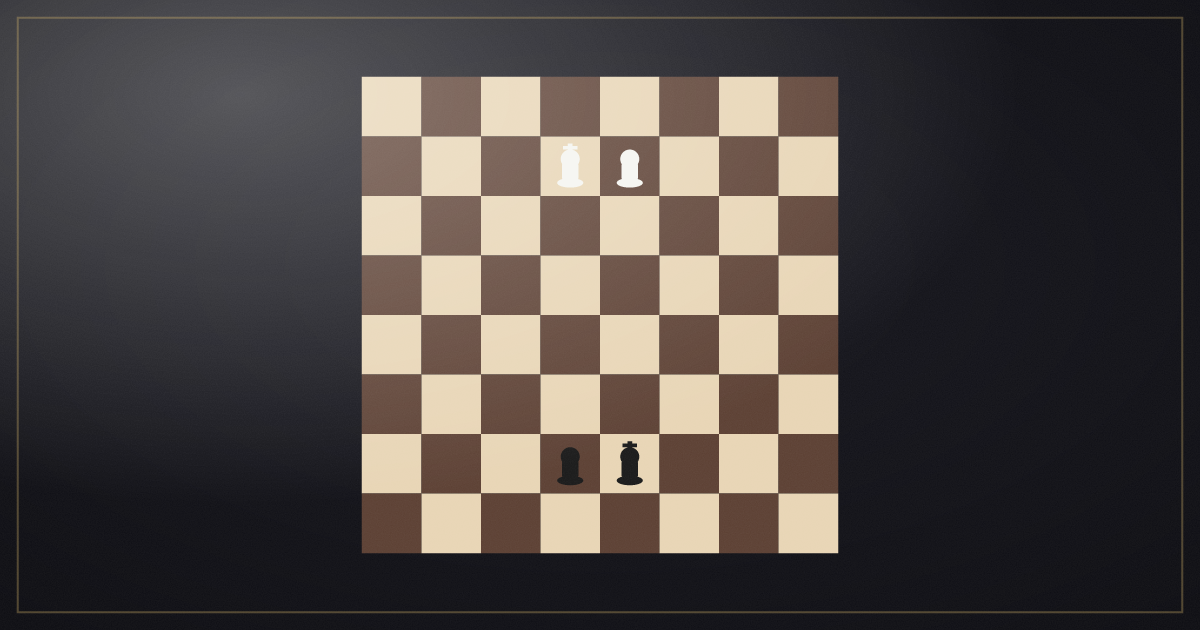
A typical example: white king on f7, white queen on g6, black king on h8, and Black to move. The black king is not in check, but the squares g8, g7 and h7 are all controlled. If Black has no other piece either, the game is a stalemate and White, a queen up, has to settle for half a point.
If you are the stronger side, check before every move that your opponent is left with at least one legal move. If you are behind, stalemate is a way out: sacrificing your last pieces that can still move and leaving your king without a move can force the draw. These traps appear most often in queen and rook endgames; in our guide to the basic checkmates we show step by step how to deliver mate without falling into stalemate.
How do the four rules look in one summary?
| Rule | When it is possible | Most common mistake | FIDE article |
|---|---|---|---|
| Castling | The king and that rook have never moved, nothing stands between them, the king's three squares are not attacked | Castling while in check or across an attacked square | 3.8.2 |
| En passant | When an enemy pawn advances two squares and lands beside yours, on the very next move | Waiting a move and then trying to capture | 3.7.3.1, 3.7.3.2 |
| Promotion | When the pawn reaches the last rank, on the same move | Thinking only captured pieces can be chosen | 3.7.3.3 – 3.7.3.5 |
| Stalemate | Your turn, no check, no legal move | Leaving the opponent without a move in a winning position | 5.2.1 |
| Source: FIDE Laws of Chess (FIDE Handbook E.01), the text in force since January 1, 2023. | |||
Once you know these rules, the next step is using them at the right time.
Frequently asked questions
Can you castle after being checked?
You cannot castle while in check; you have to get out of check first. If you got out of check without moving the king, for example by interposing a piece or capturing the checking piece, you keep the right to castle on later moves. If you got out by moving the king, the right is lost for good, even if the king returns to its original square.
Is en passant compulsory?
No, it is an option, and it can only be used immediately after the move in which the enemy pawn advanced two squares. If you do not use it, the right is lost for that pawn. The only case in which it is compulsory is when there is no other legal move you can play.
Can you make a second queen when a pawn promotes?
Yes. The FIDE Laws state plainly that the choice is not restricted to pieces that have been captured. You can make a new queen while your queen is still on the board. If there is no spare queen at the table, the FIDE Laws (Article 6.11.2) allow you to stop the clock and ask the arbiter for the piece.
Who wins when it is stalemate?
Nobody wins; the game ends in a draw and each player gets half a point. The material advantage on the board does not matter. That is why stalemate is a missed win for the winning side and a rescued half point for the losing side.
What happens if time runs out but the opponent cannot possibly checkmate?
Normally the player whose time runs out loses. Article 6.9 of the FIDE Laws makes one exception: if the position is such that the opponent cannot checkmate by any series of legal moves, for example if the opponent has only a king left, the game is a draw.
Sources
- FIDE — FIDE Laws of Chess taking effect from 1 January 2023 Official source
- FIDE Rules Commission — FIDE Laws of Chess Official source
How this content was prepared
Prepared with AI assistance from the sources listed, key facts checked against official sources, not copied verbatim. Our AI principles
GAMEAREA Editörlüğü