International draughts strategy: The center, tempo and turning forced captures into traps
Learning the rules of 10×10 international draughts takes an evening, but what wins games isn't the rules, it's where your pieces stand. This guide explains why you want the center, how to keep your pieces connected and how to turn forced capture against your opponent.
In short
- For White, squares 27, 28 and 24 are the strategic squares; the side that holds the center pushes its opponent to the edges.
- Advance your pieces in groups that protect each other, not one at a time; an isolated piece becomes a target for your opponent's combinations.
- The obligation to capture the most pieces is a tool for dragging your opponent onto a square of your choosing: you can give up a piece and take more in return.
- Crowning a king isn't always urgent; first check whether your opponent can use that square to force your new king into a capture sequence.
Why does the center matter so much in international draughts?
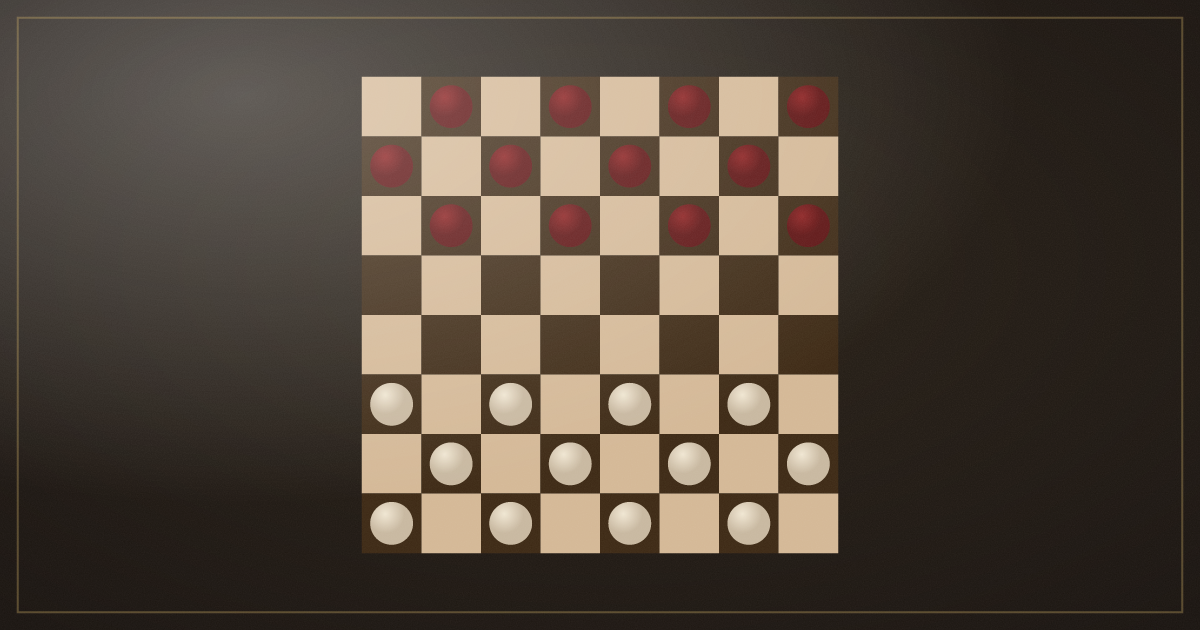
To talk strategy, you first need names for the squares. International notation uses only the 50 dark squares, numbered 1 to 50. White's pieces start on squares 31–50 and Black's on 1–20; the two middle rows are empty. If you'd like the rules in detail, see our article on the rules of 10×10 international draughts; here we focus only on what those rules mean in play.
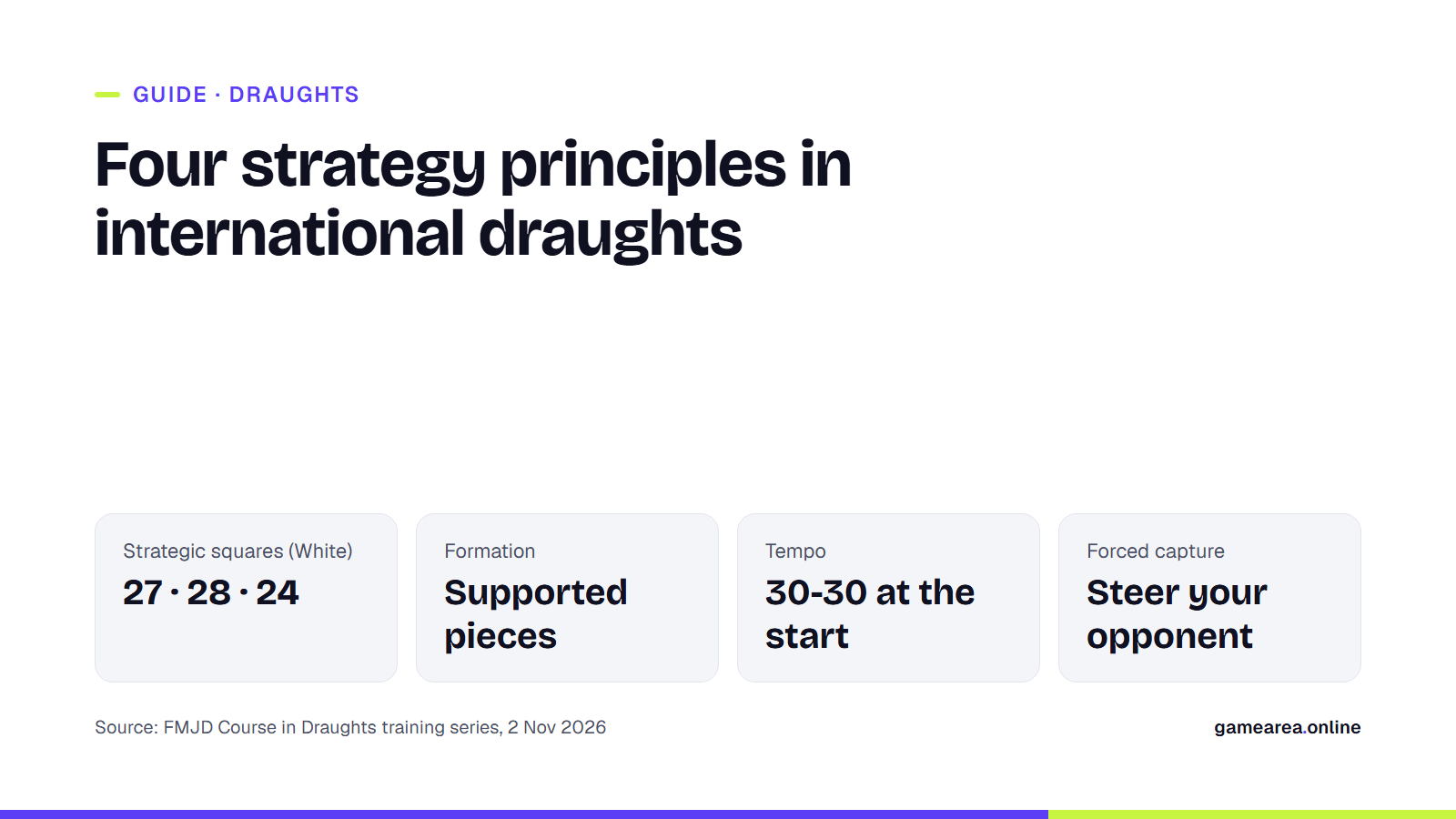
"Course in Draughts", the free training series of the World Draughts Federation (FMJD), treats strategic squares as a separate topic in its list of features to look at when judging a position. From White's point of view, these are squares 27, 28 and 24. A piece on 28 controls the center, and a piece on 27 the left flank. A well-supported piece settled on 24 acts as an outpost: it pins the opponent's pieces on 15 and 25 against the edge of the board. For Black, the same logic applies to the symmetrical squares in the other half of the board.
Why is holding the center an advantage? Because a piece in the center can intervene on both flanks, while a piece on the edge faces only one way. When your opponent is pushed out of the center, their pieces pile up on the edges, their room to move shrinks, and eventually they run out of good moves. Since the side that can't move loses in draughts, a loss of space can turn directly into a lost game over time.
What's the point of keeping your pieces in formation?
The FMJD course calls groups of pieces that work together "formations" and names them as the first criterion of a good position. The logic is simple: your opponent can't capture a piece that has a supporting piece behind it without being captured back. A piece with nothing behind it can be lost to a one-move exchange, or even a combination.
In practice, watch for the following:
- Don't empty the back: Leaving the square diagonally behind a forward piece empty gives your opponent a landing square to jump into.
- Use both flanks evenly: If you gather all your pieces on one flank, the other can get locked. The course's examples include positions where the side with a locked flank has almost a single move left.
- Question your edge pieces: According to the course, an edge piece sometimes restricts the opponent's space and sometimes becomes a ready-made target for the opponent's combination. A piece on 16 is rarely strong.
What does counting tempo tell you about a position?
One of the course's most useful tools is the tempo count. Each piece scores as many points as the number of rows it has advanced from its starting row: for White, squares 46–50 count as zero, 41–45 as one, 36–40 as two and 31–35 as three tempi. That way both sides start with a total of 30. Exchanges upset this balance: the side that gives up an advanced piece and recaptures with a back piece loses tempo, and the opponent gains it.
The tempo difference shows who holds more space. But the course adds an important warning: being ahead in tempo is good in open positions but can be dangerous in closed classical positions. In a closed structure, the side that has advanced too far may, after a while, find no safe move to play. So there is no "the further, the better" rule; advance only as fast as the pieces behind can follow.
| Principle | What it means | How to apply it at the board |
|---|---|---|
| Strategic squares | 27, 28 and 24 for White (their mirror squares for Black) | Take 28 early and with support; settle on 24 only once the back is ready |
| Formation | Groups of pieces that protect each other | Don't leave the square diagonally behind a forward piece empty |
| Tempo | The total advance of the pieces from their starting rows | Gain tempo in open play; keep a reserve of moves in closed play |
| Lock | The pieces on one flank becoming unable to move | Keep playable moves available on both flanks |
| Combination | Giving up pieces to take more through forced capture | Before attacking an opposing piece, remember that you are giving your opponent a free move |
| Source: FMJD "Course in Draughts" training series and GAMEAREA Checkers rules; summary and adaptation: GAMEAREA. | ||
How does forced capture become a trap?
In draughts, capturing isn't optional, and if there is more than one route, you must take the one that captures the most pieces. That is why, at the GAMEAREA Checkers table, the game engine limits legal moves to the routes that capture the maximum number of pieces. In the hands of a good player, this rule is a way to steer the opponent: when you give up a piece, you know in advance which piece will capture it, by which route, and where it will land. The square it lands on is the one you prepared.
The skeleton of a combination usually works like this: you sacrifice one or two pieces, your opponent is forced to capture, and their pieces end up lined up exactly where you wanted them; then you jump along that line in a chain with a single piece. Because captured pieces are only removed from the board once the move is complete, and the same piece can't be jumped twice, you have to count carefully which squares stay occupied during long chains.
The tactics section of the FMJD course highlights one of the most critical moments in the search for combinations: when you attack one of your opponent's pieces, you give them a "free move". Your opponent can use that move for a shot instead of defending. The course also describes a sneakier method than the direct shot: first a move that forces the opponent to respond to a threat, then the real combination. Ask yourself the same question on your own turn: "After this move, which capture can my opponent force me into?"
When should you crown a king?
A piece becomes a king if it ends its move on the last row. A piece that touches the last row in the middle of a capture sequence and jumps back out does not become a king. This detail matters, so that you don't assume "my piece gets crowned when it arrives there" while calculating combinations.
A flying king is very strong because it can move from one end of the board to the other and capture from a distance, but it is also bound by the majority capture rule. That is why your opponent can lure a newly crowned king onto a line of their choosing by giving up pieces. The FMJD course stresses that shots in positions with kings differ from those in ordinary positions and need to be studied separately. A practical rule: before you crown, check whether your opponent can force you into a capture on the square where your king will land. The idea the course calls "the way to the king" ties into this: a capture sequence sometimes opens a diagonal path to the last row for one of your pieces. Spotting such a path for your opponent is as important as opening one for yourself.
Frequently asked questions
What should I focus on in the first moves of international draughts?
Developing toward the central squares and advancing your pieces with support. A piece that rushes ahead on its own can be the target of an early combination.
Does the majority capture rule treat kings and ordinary pieces differently?
No, what counts is the number of pieces captured. Whichever piece you capture with, you have to play the longest sequence.
Is giving up a piece always bad?
No. Thanks to forced capture, a sacrificed piece draws your opponent onto a particular square; if you take more pieces in return, that's a combination.
Can the game end in a draw?
The official rules define draw situations, such as the same position occurring for the third time. In GAMEAREA Checkers, the game ends when one side loses all its pieces or has no moves left.
Sources
- GAMEAREA — Dama Oyna — 10×10 Uluslararası Dama Official source
- FMJD (World Draughts Federation) — Course in Draughts 2 — S1. Judging positions Official source
- FMJD (World Draughts Federation) — Course in Draughts 2 — S2. Centre play Official source
- FMJD (World Draughts Federation) — Course in Draughts 2 — S6. Edge pieces Official source
- FMJD (World Draughts Federation) — Course in Draughts 3 — S1. Using tactics as a weapon Official source
- Wikipedia — International draughts
How this content was prepared
Prepared with AI assistance from the sources listed, key facts checked against official sources, not copied verbatim. Our AI principles
GAMEAREA Editörlüğü