Pawn endgames in chess: The opposition and the rule of the square
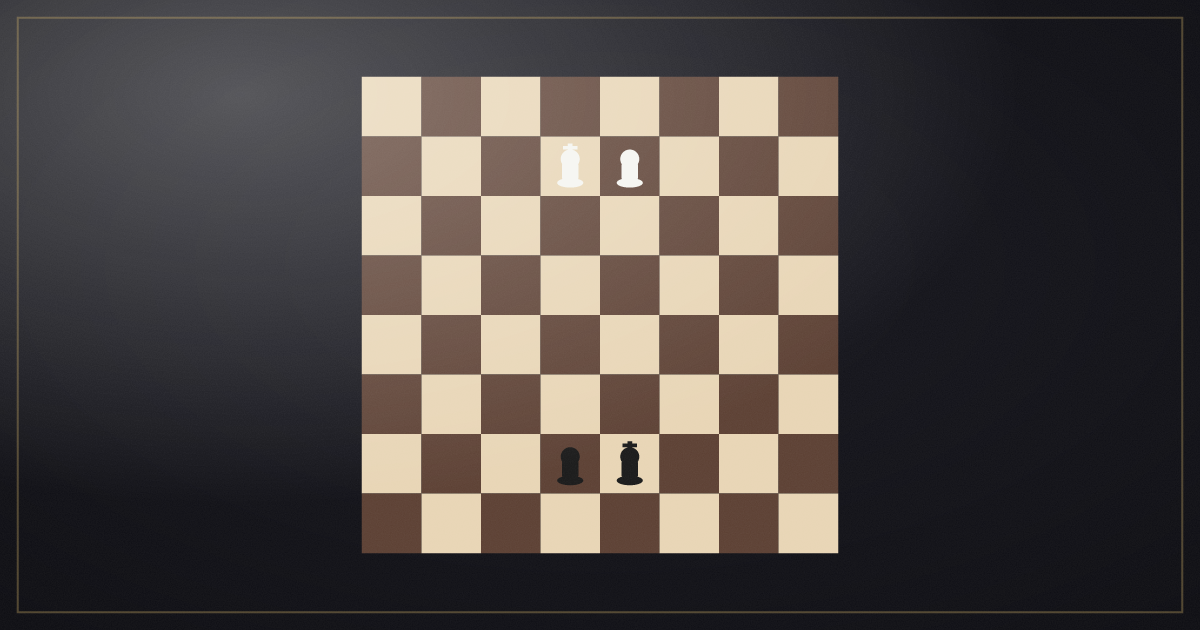
When only two kings and a pawn are left on the board, the result often hinges on a single tempo: the same position is either won or drawn depending on whose move it is. A player who knows the rule of the square, the opposition and key squares sees the difference in seconds, without calculating.
In short
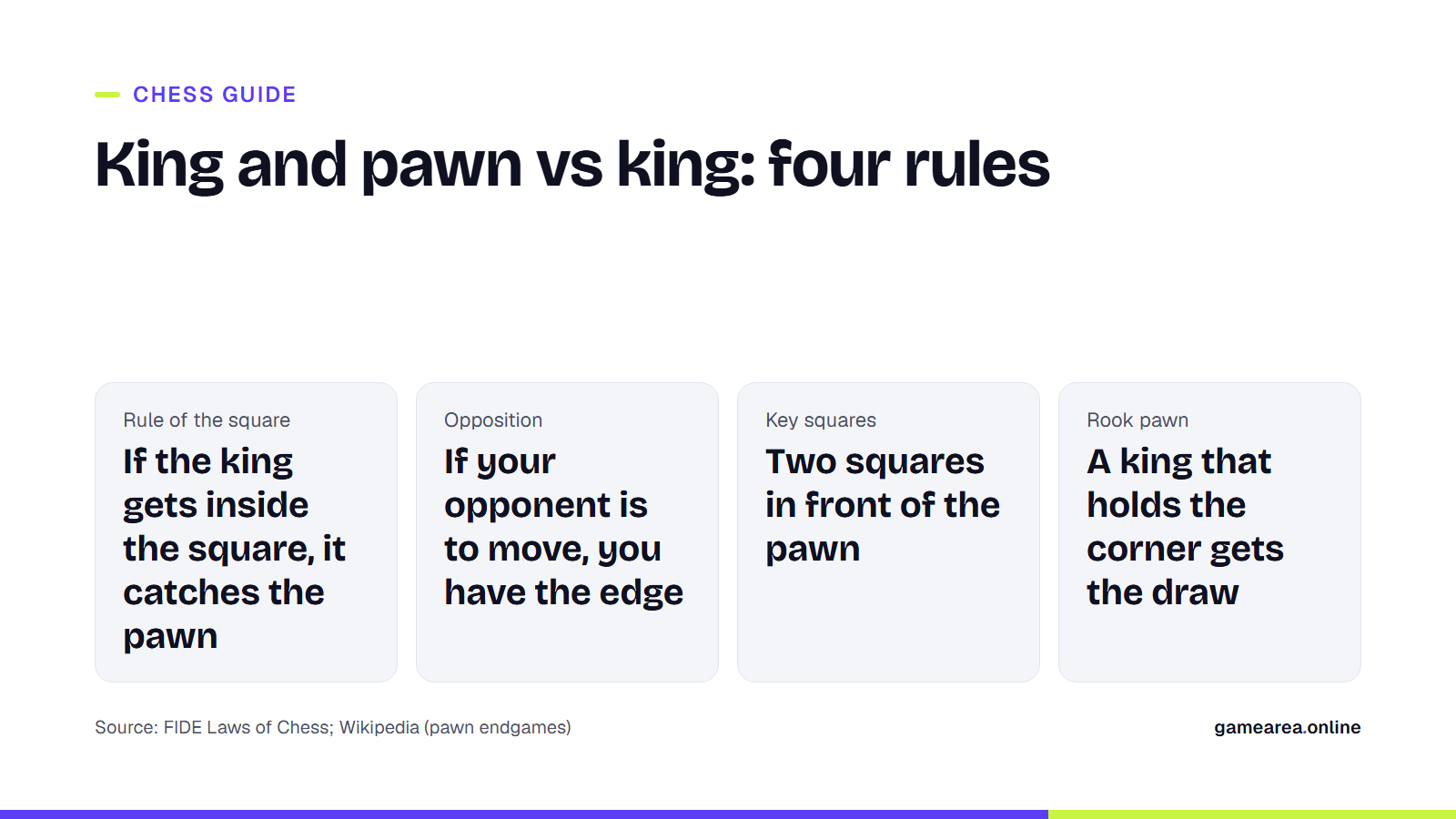
- The rule of the square tells you, without counting moves, whether the defending king can catch the pawn on its own.
- The opposition is when the two kings face each other on the same file or rank with one square between them; the side that is not to move has the advantage.
- The real goal is not the opposition itself but getting your king onto one of the key squares in front of the pawn.
- Winning with an edge pawn (on the a- or h-file) is much harder; if the defending king reaches the corner, the game is drawn.
Why is knowing pawn endgames so important?
Every exchange in the middlegame simplifies the game a little more. When the rooks or bishops are finally traded and only kings and pawns remain, everything comes down to where the kings stand. A player who knows before the exchange whether the resulting king and pawn endgame is a win or a draw can accept or decline the trade with confidence. The techniques in our guide to checkmating with two rooks, a queen or a rook come into play once the pawn has queened; this article explains how to get there.
Two points in the rules are decisive. Under the FIDE Laws of Chess, a pawn that reaches the last rank is exchanged for a queen, rook, bishop or knight of the player's choice, and the new piece takes effect immediately. The same Laws call it stalemate, and the game is drawn, when the player to move has no legal move and their king is not in check. Stalemate is the defender's greatest weapon.
According to the calculation by Levy and Newborn cited in the sources, in won king and pawn positions it takes at most 19 moves with perfect play to promote the pawn, and at most 9 more to deliver mate. In other words, the technique is short, but it has to be executed without mistakes.
How do you apply the rule of the square?
Start with the simplest question: can the pawn promote without help from its own king? To find out, count the distance from the pawn's square to the promotion square (including the promotion square) and picture a square with sides of that length. One corner of the square is the pawn, the adjacent corner is the promotion square. A practical shortcut: draw a diagonal from the pawn toward the last rank; that line is the diagonal of the square.
Then look at just one thing: can the defending king step inside this square when it is its turn to move? If it can, it catches the pawn. If it can't, the square shrinks by one with every pawn step and the king loses the race. That is why, in the same position, whose move it is changes the result: if the pawn starts one step ahead, the square narrows and the king no longer fits inside.
One detail needs attention: a pawn on its starting rank. Because the rules let a pawn advance two squares on its first move, for a white pawn on the second rank you have to draw the square as if it started one square further up, on the third rank. Also, the rule of the square only measures a pure race: the stronger side's king can block the defending king's path and keep it out of the square. In the famous Réti study, on the other hand, a king outside the square gains a tempo by heading for two targets at once and saves the draw.
What are key squares?
If the defending king is inside the square, the pawn can't get through on its own; its king has to escort it. Here the most useful concept is the key square: once the stronger side's king reaches one of these squares, the pawn queens by force, no matter where the opposing king is and no matter whose move it is. Key squares lie in front of the pawn; as Averbakh put it, the king doesn't push the pawn ahead of it, it clears the way by walking in front of it.
| Rank of the white pawn | Number of key squares | Example: pawn on the e-file |
|---|---|---|
| 2nd, 3rd or 4th rank | 3 squares, two ranks ahead | Pawn on e4: d6, e6, f6 |
| 5th or 6th rank | 6 squares, on the two ranks ahead | Pawn on e5: d6, e6, f6, d7, e7, f7 |
| 7th rank | Squares on the 7th and 8th ranks touching the pawn | Pawn on e7: d7, f7, d8, e8, f8 |
| Rook pawn (a/h) | 2 squares | b7 and b8 for an a-pawn; g7 and g8 for an h-pawn |
| For Black, the same rules apply in the opposite direction. Source: the classification by Müller and Lamprecht, via Wikipedia. | ||
What is the opposition, and who wins?
The two kings can never stand on adjacent squares. When they face each other on the same file or rank with a single empty square between them, neither can advance. This is called direct opposition, and the side that has it is the one that is not to move: the king that has to move must step aside and let its opponent through. In chess, positions where the obligation to move becomes a disadvantage are called zugzwang.
A concrete example: white king on e5, white pawn on e4, black king on e7. The kings face each other on the e-file with e6 between them. If Black is to move, the black king has to retreat to d7 or f7; the white king steps the other way, to f6 or d6, and lands on one of the key squares of the e4 pawn. The game is won.
With White to move in the same position, the result is a draw. For example, after 1.Kf5 Kf7 2.e5 Ke7 3.e6 Ke8! 4.Kf6 Kf8 5.e7+ Ke8 6.Ke6, Black has no legal move left and the game ends in stalemate. With 4...Kf8 it is Black who takes the opposition; White never managed to get the king onto a key square.
Averbakh's warning matters here: the opposition is a means, not an end. If your king can step straight onto a key square, don't bother with the opposition, just go there. A key square can also be reached by more than one route, including by going around the other side of the pawn.
Which rules separate a win from a draw?
For any pawn other than a rook pawn, two practical rules are worth remembering:
- The defender's rule: If the defending king reaches the square directly in front of the pawn, or the one in front of that, it secures the draw, with a single exception. By shuttling between these two squares, it keeps the stronger king away from the key squares.
- The attacker's rule: The side with the pawn wins if at least two of these three conditions are met: its king is in front of the pawn, it has the opposition, and its king is on the sixth rank (the third rank for Black).
In the example above, the white king was in front of the pawn but not on the sixth rank, and with White to move the opposition had been lost. One condition wasn't enough, so the game was drawn. Had the king been on e6, it would have been both in front of the pawn and on the sixth rank, and the win would follow no matter whose move it was.
One more warning: with your king on the sixth rank, don't push the pawn to the seventh with check. If the pawn gives check, the opposition changes hands and the win turns into a draw.
Why is the rook pawn a special case?
A pawn on the a- or h-file has only one neighboring file. If the defending king reaches any square in front of the pawn, it can't be driven out, because there is no other side for the stronger king to push it toward. That is why, against an a-pawn, the defending king reaching c8 (f8 against an h-pawn) is usually enough for a draw. An advanced rook pawn has only two key squares: b7 and b8 for an a-pawn. One more detail: be careful when playing a b- or g-pawn against a king trapped in the corner, too; a pawn move in the wrong order stalemates the opponent.
Reading about these endgames in theory is one thing; applying them with the clock running is another. Trying the rule of the square and the opposition a few times against the bot at the GAMEAREA Chess table, and setting up the positions yourself, is the fastest way to make the rules stick.
Frequently asked questions
Does the rule of the square always give the right answer?
It only measures the pure race between king and pawn. The stronger side's king may block the way, or the defending king may find a maneuver that gains a tempo; in those cases you have to calculate move by move.
Who has the opposition?
When the kings face each other with one square between them, the side that is not to move has it.
Does king and pawn always beat a lone king?
No. If the defending king reaches the square in front of the pawn or the one in front of that, it secures a draw, with a single exception. Against a rook pawn, the draw is even easier.
Should you always choose a queen when a pawn promotes?
The rules allow a queen, rook, bishop or knight. In most cases the queen is the right choice, but in the rare positions where a queen would give stalemate, a rook is preferred.
Sources
- FIDE — FIDE Laws of Chess (2023) Official source
- Wikipedia — King and pawn versus king endgame
- Wikipedia — Opposition (chess)
- Wikipedia — Key square
How this content was prepared
Prepared with AI assistance from the sources listed, key facts checked against official sources, not copied verbatim. Our AI principles
GAMEAREA Editörlüğü