Keeping groups alive in 9×9 Go: Two eyes, false eyes and basic life-and-death shapes
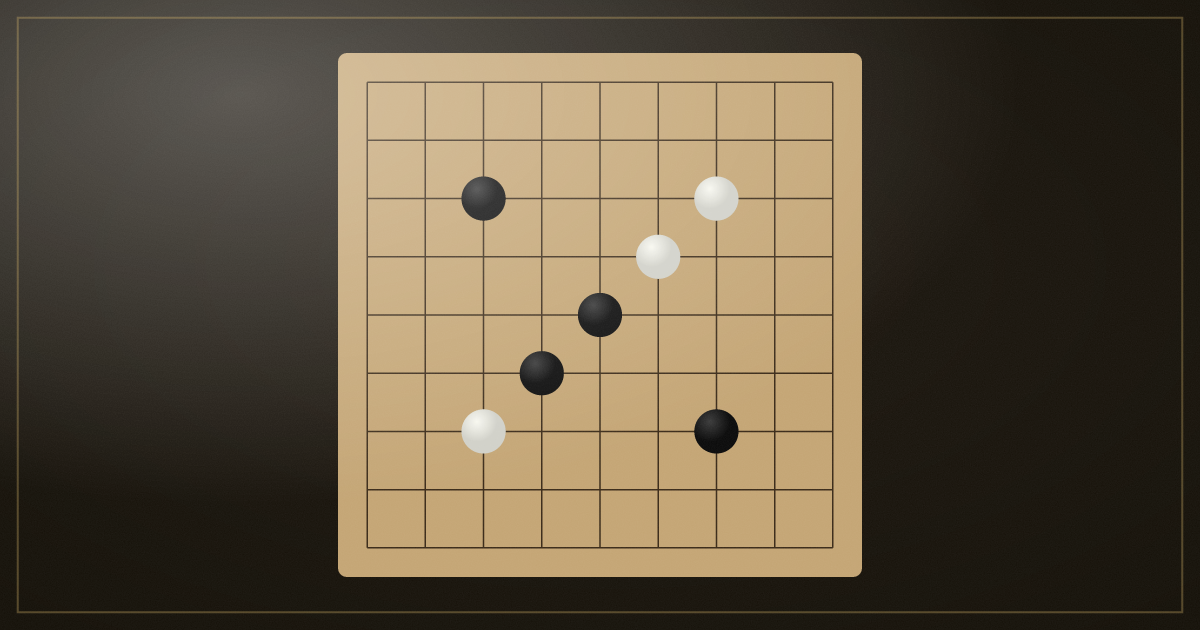
In Go, what keeps a group safe isn't the number of stones but two separate empty points the opponent can't fill. On a 9×9 board, every group either finds two eyes within a few moves or is wiped off the board; this guide shows you how to tell at a glance which shapes live and which die.
In short
- A group with one eye is captured sooner or later; two separate eyes make a group permanently safe.
- Not every space that looks like an eye is one: if one of the stones around it can be put in atari, the eye is false.
- Small eye spaces such as the straight three and the bent three have a single vital point; whoever plays there first decides the outcome.
- If neither of two groups dares to fill their shared liberties, both live; this is called seki.
Why does a group with one eye die?
An empty point inside a group is called an eye. Under the rules, stones with no liberties are removed from the board, and placing a stone on a point with no liberties is legal only if it captures opposing stones. For the full basic rules, see the 9×9 Go beginner's guide; what matters here is what these two rules mean together.
If a group has only one eye, the opponent first fills its outside liberties one by one. In the end, only the inside of the eye is left. When the opponent plays there, their stone has no liberties of its own, but because the same move also takes your group's last liberty, it doesn't count as suicide: your stones come off, theirs stays on the board. In other words, one eye only delays death.
With two separate eyes, the picture changes. If the opponent plays in one of the eyes, the stone captures nothing, because the group's other eye is still empty. The move would be suicide, so it can't be played. Since the opponent can't play in both eyes at once, the group can't be captured. The key word is "separate": two adjacent empty points count as a single eye, and when the opponent fills one, the other comes under threat too.
How do you spot a false eye?
Some spaces are not eyes even though your stones surround them on all four sides. If one of the stones around the eye isn't firmly connected to the rest of the group, the opponent puts that stone in atari from outside. You are forced to play inside the eye to connect, and the eye disappears; if you don't connect, the stone is captured and again no eye remains. This kind of space is called a false eye.
In practice, the place to look is the eye's diagonal corners. For an eye in the middle of the board, if the opponent holds two of its four diagonals, the eye is usually false. On the edge or in the corner there are fewer diagonal points, so even a single opposing stone on a diagonal can be enough to ruin the eye. Checking these diagonals before you pass, sure that your group "has two eyes", saves the groups most often lost on 9×9.
Which eye-space shapes live, and which die?
When more than one empty point remains inside a group, the question to ask is: can this space be split into two separate eyes whatever the opponent does? The table below summarizes the most common shapes. All of them assume that the wall around the space is solid, meaning there are no cutting points or outside liberty problems.
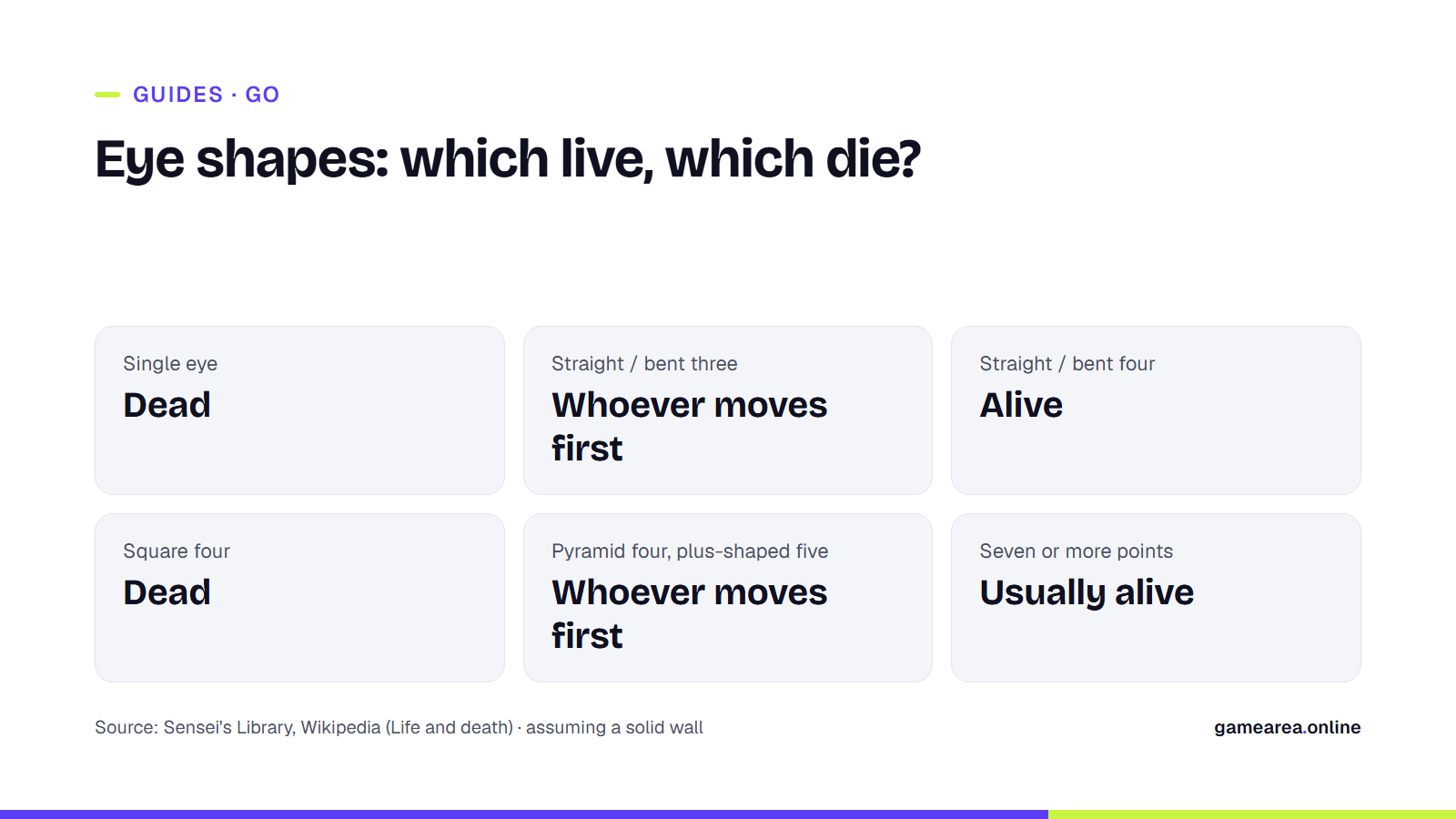
| Eye space | Empty points | Status | Key point |
|---|---|---|---|
| Single point | 1 | Dead (one eye) | None |
| Two adjacent points | 2 | Dead | None, the space can't be split |
| Straight three | 3 | Whoever moves first decides | The middle point |
| Bent three (L) | 3 | Whoever moves first decides | The point at the bend |
| Straight four and bent four | 4 | Alive | The two inner points back each other up |
| Pyramid four (T) | 4 | Whoever moves first decides | The middle point |
| Square four (2×2) | 4 | Dead | Not saved even if the defender moves first |
| Plus-shaped five, bulky five | 5 | Whoever moves first decides | The central point touching the most points |
| Assuming a solid wall. Source: Sensei's Library and Wikipedia (Life and death). The bent four in the corner is a special case. | |||
The logic of the table rests on one idea: such an eye space has a point where, if the defender plays, the space splits in two, and if the attacker plays, any chance of splitting it is gone. In the straight three, that point is the middle. If Black plays there, two separate eyes remain at the two ends; if White plays there, what's left is a space that can't be split. In the straight and bent fours, there are two candidate points on the inside: if the opponent takes one, you take the other. That is also why the square four is dead: whichever point you play, the remaining three points form a bent three, and the opponent takes its key point.
Why do you play the vital point first?
The key points above are called vital points. When the attacker plays a stone on this point inside the group, making the eye space impossible to split, it's called nakade (killing from the inside). The stone left inside is often captured, but after the capture what remains is still a space that makes only one eye.
Two practical lessons follow. First, if your own group's eye space has three or five points and the opponent hasn't played there yet, take the vital point yourself when it's your turn; waiting for another move can cost you the group. Second, if your opponent's group has one of these shapes, don't waste time filling outside liberties; play the vital point first. If you want to shrink the group further, reducing the space from the edge (hane) and then playing the vital point is the classic sequence.
What is seki, and who wins?
Sometimes two groups become entangled with shared liberties between them. Whoever plays first on one of these points also reduces their own group's liberties and gives the opponent a chance to capture. As a result, nobody plays on those points and both groups stay on the board. This mutual life is called seki; even groups without eyes can survive thanks to seki.
Nobody wins a seki: the shared empty points touch both colors, so they count as nobody's territory. Seki is often a rescue for the owner of a group that looked doomed; for the attacker, the fallback of "if I can't kill it, at least I'll force a seki" is sometimes better than losing.
How do you use this on 9×9?
- Count the eye space early. Knowing how many empty points are inside a group and what shape they form tells you whether you need to spend another move on it. A straight space of four points is enough; a space of three is not.
- Don't fill your own eye. Playing your own stone inside a two-eyed group turns it into a one-eyed group.
- Close your cutting points. Most false eyes come from a connection gap in the wall.
- Actually capture dead stones before you pass. 9×9 Go on GAMEAREA ends after two consecutive passes, and the score is calculated from the final position on the board; dead stones are not removed automatically at the end of the game. If your opponent's dead group is still on the board, the empty points around it don't count as your territory.
Frequently asked questions
How many eyes does a group need to live?
Two separate eyes. A single eye is captured once the opponent has filled the outside liberties; seki is the exception, a way to live without eyes.
Why can my opponent play inside my eye?
Playing on a point with no liberties is legal if the move captures opposing stones. If the last liberty of a one-eyed group is the inside of its eye, a stone played there captures the group.
Does a straight three live?
It depends on who moves first. If the defender plays the middle point, the group makes two eyes; if the attacker plays there, the group dies.
Why is the square four always dead?
Whichever point is played, a bent three remains, and the opponent takes its vital point, reducing the space to a single eye.
Who gets the empty points in a seki?
Nobody. The shared liberties touch both colors, so they don't count as territory; both groups stay on the board.
Sources
- GAMEAREA — Go Oyna — 9×9 Bölge Oyunu Official source
- GAMEAREA — 9×9 Go Başlangıç Rehberi: Kurallar, Komi, Skor Official source
- Wikipedia — Life and death
- Sensei's Library — Two Eyes
- Sensei's Library — False Eye
- Sensei's Library — Seki
How this content was prepared
Prepared with AI assistance from the sources listed, key facts checked against official sources, not copied verbatim. Our AI principles
GAMEAREA Editörlüğü