How to Play Tavla (Backgammon): Complete Rules for Beginners
Tavla is the Turkish table for the game the rest of the world usually calls backgammon: two players, fifteen checkers each, two dice, and a race to bear off first. The rules are small enough to learn in one sitting and deep enough that you will still be arguing about a roll a year from now. This guide covers the legal moves you need for a first match on GAMEAREA — setup, movement, hitting, re-entry, and bearing off — without the folklore that often gets mixed into kitchen-table house rules.
On GAMEAREA, turns are server-verified. You cannot “accidentally” skip a forced re-entry or bear off a checker that is still outside your home board. That matters: once you trust the engine, you can spend attention on the dice instead of policing the board. If you want the social history behind the table, read the cultural history of tavla and okey after this rules pass. If you already know how checkers move and want tactics, jump to tavla strategy tips.
The board, the points, and the starting position
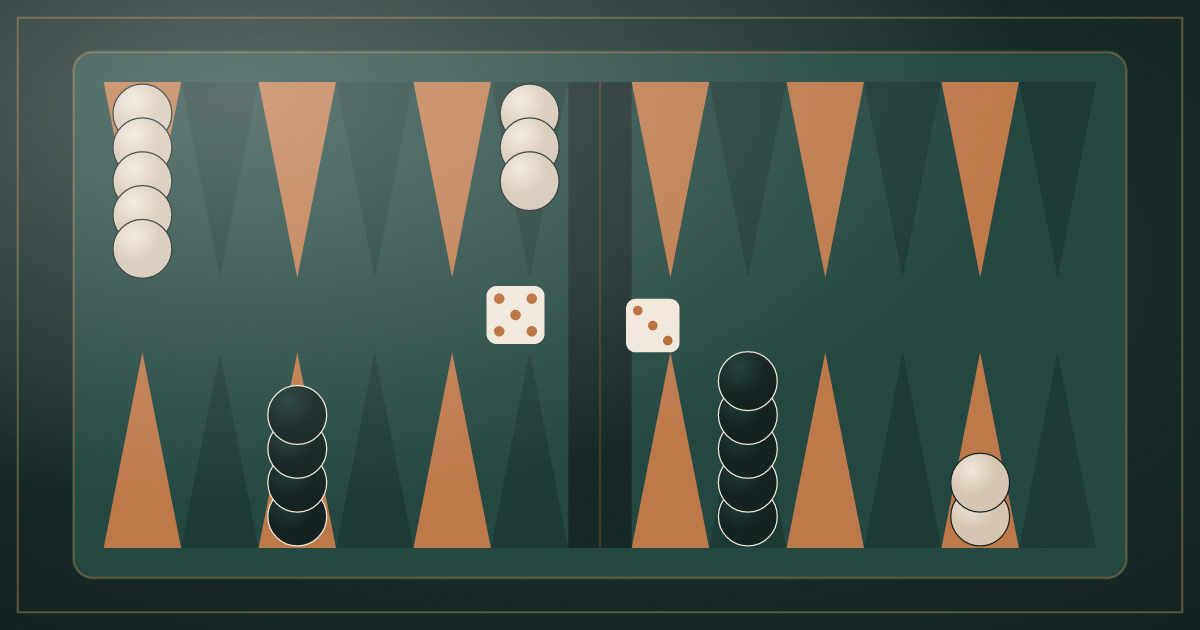
The board is a strip of twenty-four triangular points, grouped into four quadrants of six. Each player has a home board (points 1–6 from that player’s perspective) and an outer board. You and your opponent move in opposite directions, so “my 6-point” is not the same physical triangle as “your 6-point.”
The standard starting setup is fixed. From your own 1-point looking toward the far end of the board, you place:
- 2 checkers on your 24-point (deep in the opponent’s home board)
- 5 checkers on your 13-point (the midpoint stack)
- 3 checkers on your 8-point
- 5 checkers on your 6-point (already in your home board)
Your opponent mirrors that arrangement. If a board is set up any other way, you are not playing standard tavla. Online, the position is placed for you; the useful skill is naming the points so you can talk about a move without waving at the screen.
A point can hold any number of your own checkers. Two or more of yours on a point make it a made point: the opponent cannot land there. A single checker is a blot — legal to occupy, and legal for the opponent to hit.
Dice, turns, and how checkers actually move
On your turn you roll two dice. Each die is a separate move. A 6 and a 3 means you must play a 6 and a 3 if both are legal — not a 9 unless you choose to use both numbers with the same checker, one after the other, landing on an intermediate point that is open.
You may:
- Move two different checkers, one for each die
- Move one checker twice, playing the two numbers in either order, provided each landing square is legal
You cannot land on a point occupied by two or more opposing checkers. You can land on an empty point, a point you already own, or a blot. If only one of the two numbers is playable, you play that one. If both numbers are playable but not both together, you must play both if there is any legal sequence that does so. If neither number is playable, the turn is skipped.
Doubles
Doubles explode. Roll 4-4 and you play four 4s, not two. That is why a double in the opening can feel like a different game: you suddenly have four construction moves instead of two. You still have to land legally on each step. Four 4s that would require hopping a closed point are not a free pass; unused pips are simply lost if no legal play remains.
Worked example: a 6-5 opening roll
You are moving from the 24-point toward home. A common 6-5 split in the opening is to run one of the two back checkers: 24/18 with the 6, then 18/13 with the 5, parking on your 13-point stack. The intermediate 18-point must be open (it is, on the first roll). You have used both numbers with one checker, brought a runner into the outfield, and left one blot: the back checker that stayed alone on the 24-point.
An alternative 6-5 is 24/18 and 13/8, splitting the numbers across two checkers. That makes the 8-point stronger (you already had three there) and leaves blots on the 18-point and the 24-point. Both plays are legal. The rules do not prefer one; they only require that each die is used on an open landing. Strategy — whether you want contact or a quieter race — belongs in the strategy article. The rules lesson is: name the start point, name the landing, and confirm the landing is not a closed opposing point.
Hitting, the bar, and re-entry
Land exactly on an opposing blot and you hit it. That checker comes off the point and sits on the bar (the ridge down the middle of the board). Hitting is not optional once you choose that landing; the blot is removed as part of the move.
While you have a checker on the bar, you may not move any other checker. Your entire turn is spent trying to re-enter. Re-entry happens in the opponent’s home board. Die 1 enters on their 1-point, die 6 on their 6-point. If that point is closed (two or more of their checkers), that die cannot enter. If both dice fail, you dance: the turn ends, and the checker stays on the bar.
Once a checker re-enters, leftover dice may be used with that same checker or with others, as usual — but only after the bar is clear. Two checkers on the bar means you must enter both before anything else happens, which is why getting closed out of a strong home board is so costly.
Bearing off
You may start bearing off only when all fifteen of your checkers are in your home board (points 1–6). Checkers still on the bar or anywhere outside home block bearing off completely.
To bear off, you play a number that matches a checker’s point: a 4 bears a checker off the 4-point if one is there. If you roll a number higher than your highest occupied point, you bear off from that highest point (a 6 with checkers only on 5 and 4 bears off a 5). You may also move a checker within the home board instead of bearing off, which is sometimes safer if the opponent still has a checker that can hit you.
If you are hit while bearing off, the checker goes to the bar. You must re-enter in the opponent’s home and walk all the way around again before you can resume bearing off. The first player to bear off all fifteen checkers wins the match.
What GAMEAREA enforces for you
Over the board, arguments start at exactly these edges: did you have to play both numbers, was that re-entry legal, did someone bear off with a checker still on the 8-point. Tavla on GAMEAREA uses server-verified turns, so illegal landings never apply. You get quick matchmaking when you want a stranger, private rooms when you want a named opponent, and bot practice when you want to drill re-entry without wasting a friend’s evening.
The same table sits next to other live classics. If you like race-and-block dice, you will probably also like the tile-matching pressure of draw domino. If you want a four-seat table instead of a duel, Okey 101 is the flagship open-table tile game on the same platform.
A first-match checklist
- Confirm the starting stacks: 2-5-3-5 from the 24-point inward.
- Play both dice when both are legal; doubles mean four moves.
- Never land on a closed opposing point.
- A blot you land on is hit and goes to the bar.
- Bar checkers re-enter first, in the opponent’s home, or you lose the turn.
- Bear off only with all fifteen home; highest-point rule applies for oversized rolls.
Play two casual games with that list on the table, then stop reading rules and start noticing pip count and home-board strength. Those are strategy, not legality. When you want a real board without downloading a client, open the Tavla page and start a match — guest play is available, and a free account unlocks ranked queues when you are ready. For a criteria-based look at what “good online tavla” even means, see how to choose where to play tavla online.
Frequently asked questions
Is tavla the same game as backgammon?
Yes in the core rules you will use online: 24 points, 15 checkers, two dice, hitting, the bar, and bearing off. “Tavla” is the Turkish name and table culture; “backgammon” is the international name. GAMEAREA’s live title is Tavla with those standard movement rules, ranked matchmaking, private rooms, and bot practice.
Do I have to use both dice?
If both numbers can be legally played, you must play both. If only one number is legal, play that one. If neither is legal, the turn passes. Doubles give four moves of that number, still subject to legal landings.
Can I bear off a checker while another is still outside my home board?
No. All fifteen checkers must be in your home board, and none on the bar, before any checker may come off. Getting hit during bear-off sends that checker to the bar and pauses bearing off until it walks home again.
What happens if I roll a 6 and my highest checker is on the 4-point?
Once you are bearing off, a roll larger than your highest occupied home point bears a checker off that highest point. A 6 with checkers only on 4 and 3 takes a checker off the 4-point, not a phantom 6-point.
Where should I play a first game?
Use GAMEAREA’s Tavla page for a rules-legal board in the browser. Warm up against a bot if you want, then take a casual or ranked seat. You do not need a download; a guest session is enough to learn the clicks, and an account is only required when you want ranked results and synced progress.