Reversi strategy: why corners, mobility and X-squares decide the game
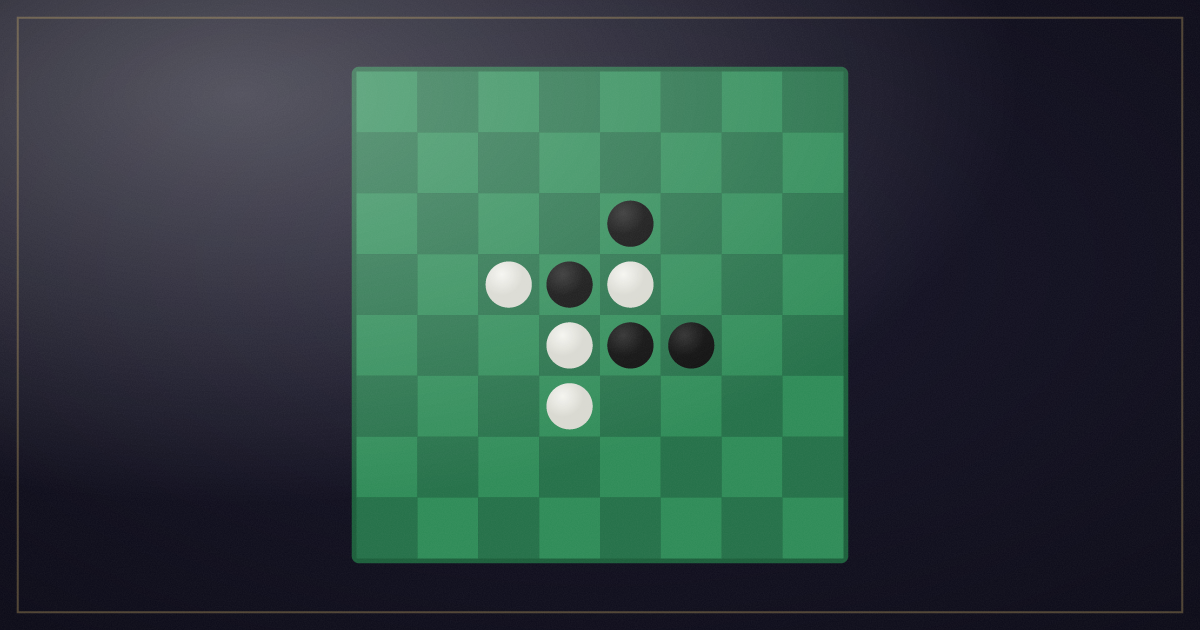
The rules of Reversi take two minutes to learn, yet most beginners fall into the same trap: flipping as many discs as possible on every move. This guide explains five strategy principles that follow directly from the official rules: why corners can never be lost, why collecting discs early costs you the game, and why you can work out from the start who will make the last move.
In short
- To flip a disc you need a disc on both sides of it; a corner has no two sides. A disc placed in a corner stays yours until the game ends.
- Having fewer discs in the first half of the game is usually an advantage: if your opponent has many discs, you have many moves and they have few.
- The X-square diagonally next to a corner and the C-square beside it on the edge are the most common ways to hand an empty corner to your opponent.
- There are 60 empty squares and, if nobody passes, White makes the last move. Who places the last disc in each remaining region decides the endgame.
Why does flipping many discs lose in Reversi?
Reversi is played on an 8×8 board with 64 discs; each player takes 32, the game starts with four discs in the centre and Black moves first. To move, you must outflank at least one opposing disc, meaning the line you trap has one of your discs at each end. If you have a move you may not pass; if you have none, the turn goes to your opponent. The game ends when neither player can move, and whoever has more discs on the board wins. The full rules are in our Reversi rules guide.
The first lesson from these rules is that the score is counted only at the very end. Owning half the board on move 20 wins nothing; in fact, it creates two problems. First, every disc you flip opens new outflanking lines for your opponent: the more discs you have, the more they can trap. Second, your own options shrink, because you must outflank your opponent's discs and there are few of them on the board. That is why computer programs and strong players measure mobility in the midgame, not disc count.
How do you manage mobility and frontier discs?
Mobility is the number of legal moves you have when it is your turn. The goal is to keep your own mobility high and your opponent's low. When your opponent is down to one or two moves, you can force them into a bad one, often a move that gives you a corner.
What determines mobility is the frontier: discs adjacent to an empty square. Your frontier discs create the squares your opponent can play on. The practical rule is to keep your discs in an "interior" cluster surrounded by your opponent's discs and not touching empty squares. Discs facing open space hand moves to your opponent.
- Prefer the quiet move. A move that flips one disc and touches no new empty square is better than one that flips five and opens up the board.
- Stay surrounded. Discs sitting behind your opponent's discs are hard to outflank.
- Do not open new regions. The first player into an empty region usually gives the moves in that region to the opponent.
Why are corners gold, and why are X and C squares traps?
A corner disc is stable as a natural consequence of the rules: there are no two ends to trap it with, so it can never be flipped. Edge discs connected to the corner become stable step by step too: an unbroken line of your discs running from a corner along the edge cannot be outflanked and is permanent. It is these permanent discs that get counted at the end.
The value of a corner explains the danger of its neighbours. The square diagonally next to a corner is known as the X-square (b2 for the a1 corner), and the two squares next to the corner along the edges are C-squares (a2 and b1). Play an X-square early and your opponent can outflank that disc along the diagonal and take the corner. The C-square is similar: a disc that can be trapped along the edge opens the line to the corner. These squares are not forbidden; they get played in the endgame or when the corner is already yours. But placing a disc next to an empty corner in the midgame usually means giving that corner away.
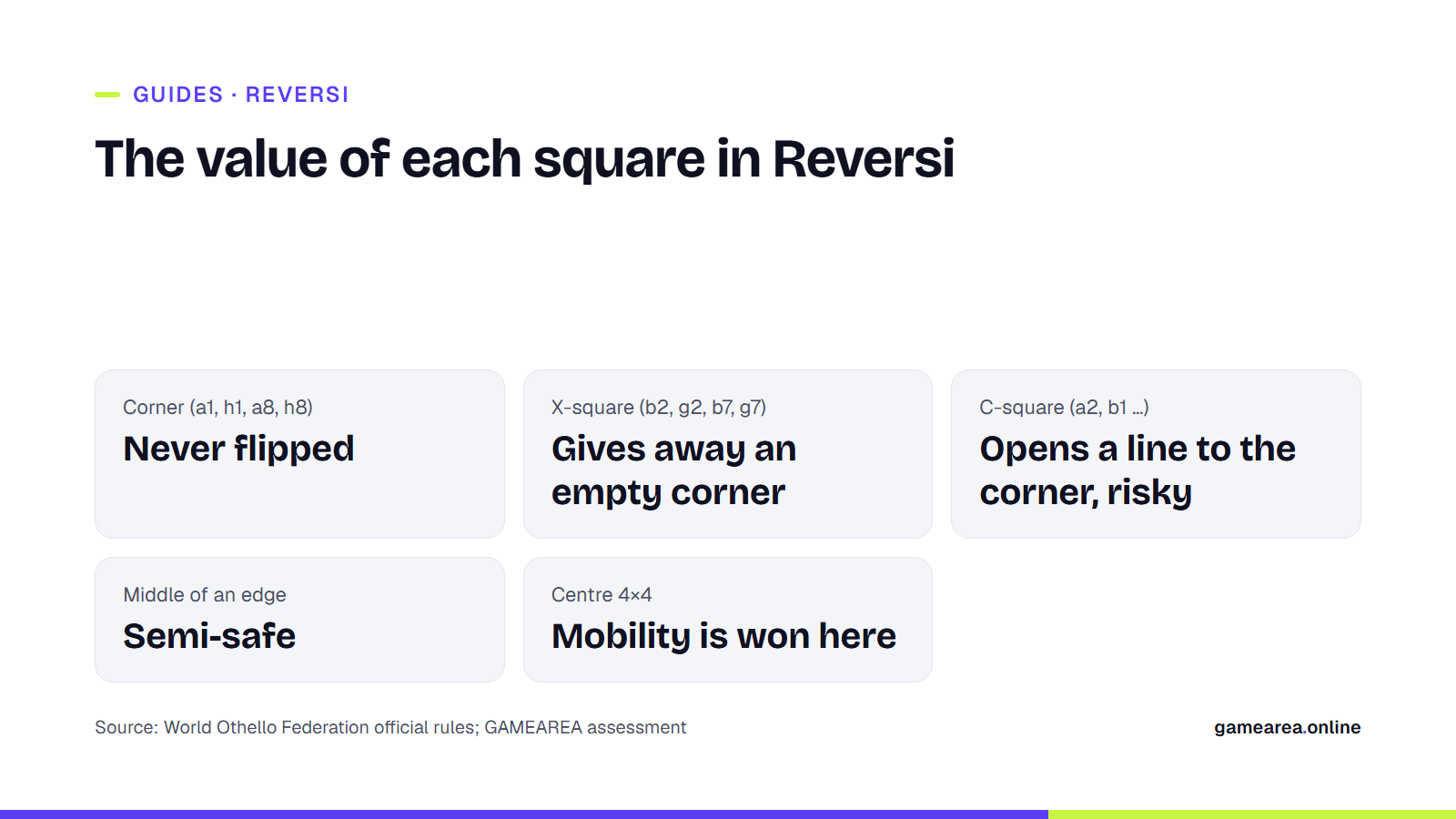
| Square | Position | Strategic value |
|---|---|---|
| Corner | a1, h1, a8, h8 | Never flipped; produces permanent discs along the edges |
| X-square | b2, g2, b7, g7 | Gives diagonal access to an empty corner; not played early |
| C-square | a2, b1, g1, h2, a7, b8, g8, h7 | Opens a line to the corner along the edge; risky |
| Edge (middle) | c1–f1 and equivalents | Semi-safe; unbalanced edge structures can backfire |
| Centre (inner 4×4) | c3–f6 | Mobility is won here; your discs stay "inside" |
| Source: GAMEAREA assessment derived from the World Othello Federation's official rules; square names follow common usage in Othello literature. | ||
Who makes the last move? Counting parity
The board has 64 squares, four of which are filled at the start, so at most 60 discs are placed. If nobody passes, Black makes moves 1, 3, 5 and so on, while White makes moves 2, 4 and the 60th. In the endgame there are usually a few empty regions of a few squares each. The player who places the last disc in a region makes the discs they outflank there permanent, with no chance for the opponent to take them back. That is why your endgame goal is to make the last move in every empty region.
The player who enters a region with an odd number of empty squares also makes the last move there, provided the opponent does not answer inside it. A move that forces your opponent to pass flips the parity: a pass breaks the turn order and can hand you the last move. The counting routine is this: in the last 10 to 12 moves, split the empty squares into regions, note whether each region has an odd or even count, and try not to be the first to enter a region with an even number of empty squares.
What do you play in the opening?
Black's four first moves (c4, d3, e6, f5) are symmetrical; they all lead to the same position. The real split comes with White's reply, and there are three main openings: if White plays diagonally to Black's disc it is the diagonal opening, at a right angle the perpendicular opening, and alongside it the parallel opening. Computer analysis shows balanced continuations in the diagonal and perpendicular openings, while the parallel opening is rarely chosen at the top level. A 2023 preprint, not yet confirmed in a peer-reviewed journal, claims the 8×8 game ends in a draw with perfect play on both sides. That does not mean the game is solved in practice: in human games the margin comes from mobility and corner discipline.
The Reversi table on GAMEAREA highlights legal moves on the board, which makes counting mobility easier. Even playing casually against the bot, asking "how many new options does this move give my opponent" before each move pays off faster than counting discs.
Frequently asked questions
Who moves first in Reversi?
By the official rules, always Black. There are four legal squares for the first move and all four are symmetrical, so they lead to the same position.
Is the best move the one that flips the most discs?
No. In the first two thirds of the game, "quiet" moves that flip few discs and open no new moves for your opponent are usually better. Disc count only matters at the end.
Should you never play next to a corner?
You can, but timing matters. If the corner is already yours, or you are closing a region in the endgame, X and C squares can be safe. In the midgame, a disc next to an empty corner usually gives that corner away.
Can the game end before all 64 squares are filled?
Yes. By the official rules the game ends when neither player can move, and the discs are counted as they stand. The game also ends if one side has no discs left.
Is there a difference between Reversi and Othello?
Reversi on GAMEAREA is played with the fixed centre opening known from Othello and follows the same logic as the World Othello Federation's official rules. The name difference is historical; the strategy principles are the same.
Sources
- World Othello Federation — Official rules for the game Othello Official source
- GAMEAREA — Play Reversi — Othello strategy game Official source
- GAMEAREA — How to play Reversi (Othello): rules and guide Official source
- Wikipedia — Computer Othello
How this content was prepared
Prepared with AI assistance from the sources listed, key facts checked against official sources, not copied verbatim. Our AI principles
GAMEAREA Editörlüğü