How to read and write chess notation: squares, piece letters, symbols and game records
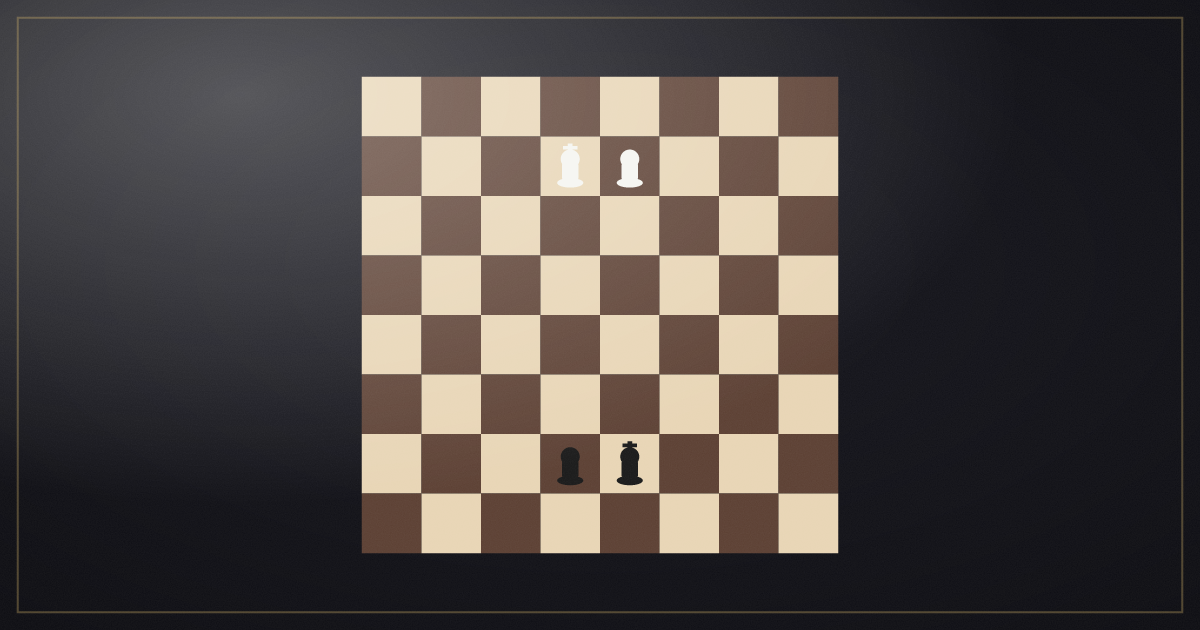
Chess notation gives every square on the board a name made of one letter and one number, then writes each move with that name: Nf3 means “a knight went to f3”, and e4 means “a pawn moved to e4”. This algebraic notation is the only system FIDE accepts in its own events, and to read it you only need the square names, five piece letters and a few symbols.
In short
- Files run a to h from left to right and ranks 1 to 8 starting from White's side, so every square has one fixed name such as e4.
- In English, pieces are written K (king), Q (queen), R (rook), B (bishop) and N (knight); pawns get no letter.
- x means a capture, + check, # mate, O-O short castling and O-O-O long castling.
- Marks like !, ? and !! are not part of the rules; they record an annotator's opinion of a move.
How are the squares on a chessboard named?
Look at the board from White's side. The vertical columns, called files, are labelled with small letters a, b, c, d, e, f, g, h from left to right. The horizontal rows, called ranks, are numbered 1 to 8 from bottom to top. A square's name is simply its file letter followed by its rank number, which gives each of the 64 squares a unique and permanent label.
In the starting position White's pieces stand on ranks 1 and 2 and Black's on ranks 7 and 8. The white king starts on e1 and the black king on e8; the queens begin on d1 and d8. For the player sitting behind the black pieces the letters run right to left and the numbers top to bottom, but the names never change: e4 is the same square for both players. The chessboard on GAMEAREA prints the letters and numbers along its edges, and when you play Black the board turns toward you, so they appear in reverse order.
Which letters stand for the chess pieces?
Each piece is shown by the capital first letter of its name. FIDE's rules use the English letters as their example, but they explicitly let players use the piece names common in their own country. That is why a German book writes S for the knight and a French one writes F for the bishop.
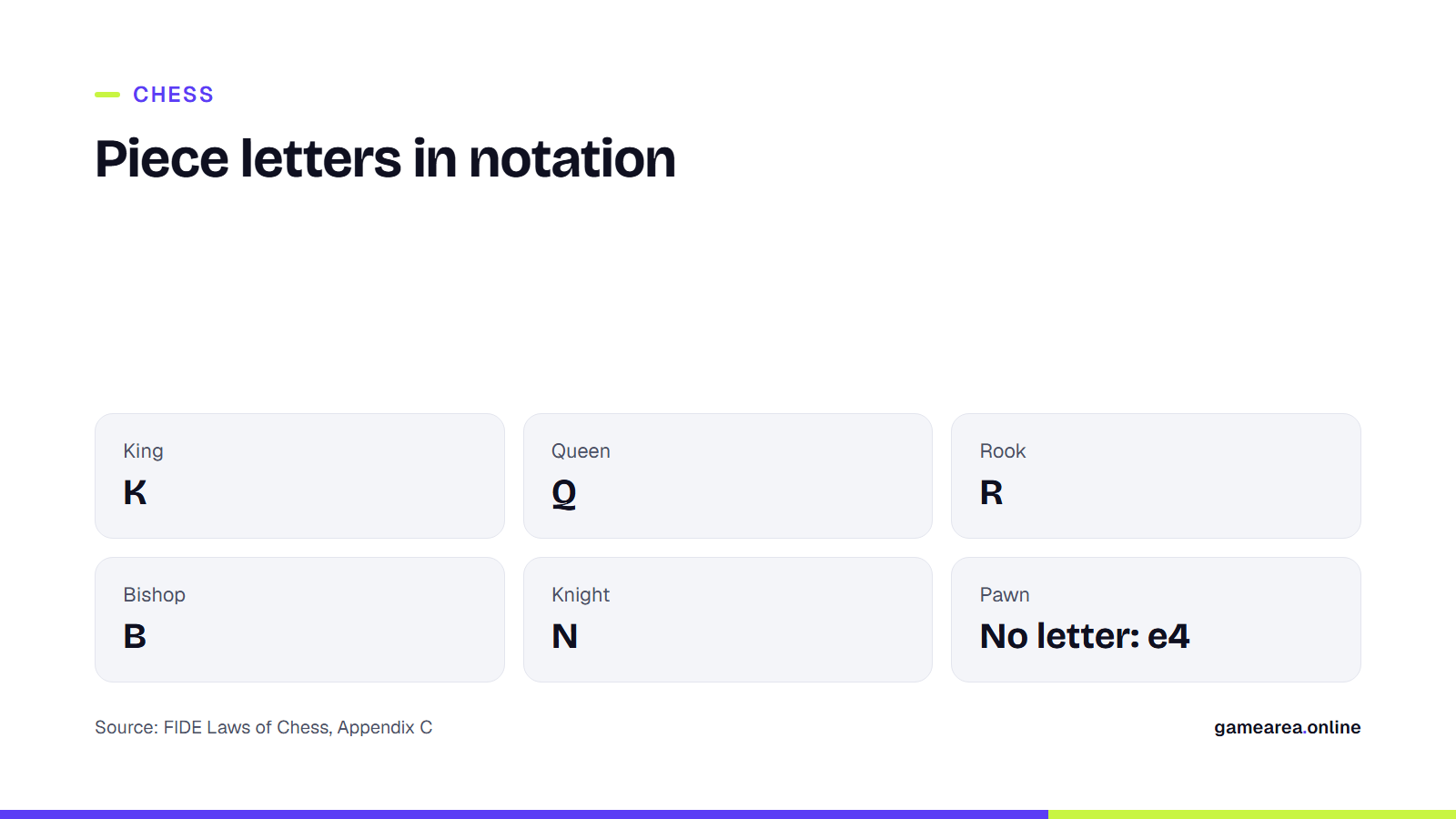
| Piece | English letter | Example move |
|---|---|---|
| King | K | Kg1 |
| Queen | Q | Qh5 |
| Rook | R | Rd1 |
| Bishop | B | Bc4 |
| Knight | N | Nf3 |
| Pawn | No letter | e4 |
| Source: FIDE Laws of Chess, Appendix C | ||
The knight is the odd one out: it uses N because K is already taken by the king. Pawns never get a letter in any language, so the correct form is “e4”, not “Pe4”. Many modern books replace the letters with small piece drawings called figurines; you read them exactly the same way, the symbol simply stands where the letter would be.
How do you write a chess move?
The basic pattern is the piece letter followed by the destination square. Bc4 says a bishop arrived on c4, Qh5 that the queen went to h5. There is no hyphen between the letter and the square. For pawn moves only the destination is written: d4, c5. A longer form that also names the starting square (Ng1f3, e2e4) is allowed by the rules, but the short form is far more common on scoresheets and in books.
Captures and the x sign
When a piece takes something, an x can be placed between the letter and the square: Bxe5, Nxf3. When a pawn captures, its starting file must always be shown, so dxe5 means the pawn on the d-file took on e5. For an en passant capture you may add “e.p.” at the end, as in exd6 e.p. Under FIDE's rules the x, +, # and e.p. marks are all optional, which is why older scoresheets sometimes show forms like “ed4” without an x.
When two pieces can reach the same square
If two pieces of the same type can move to the same square, you must show which one moved. When they stand on the same rank, add the file they leave from: with knights on b8 and f8, the one from b8 going to d7 is Nbd7. When they share a file, add the rank number instead: with rooks on e1 and e3, the rook from the first rank moving to e2 is R1e2. If the pieces share neither rank nor file, the file letter is preferred. A capture still takes its x: Nbxd7.
How are check, mate, castling and promotion written?
Other guides cover the rules for these moves; here is just how each one looks on paper:
- Check: add + after the move. Qe3+ means the queen moved to e3 and gave check.
- Checkmate: written # or ++. PGN files accept only #.
- Castling: 0-0 is castling short with the h-rook, 0-0-0 castling long with the a-rook. The FIDE text uses the digit zero; PGN files and most software use the capital letter O, as in O-O and O-O-O.
- Promotion: in FIDE style the new piece's letter follows the pawn move directly: d8Q, exf8N. PGN inserts an equals sign: e8=Q.
- Draw offer: marked on the scoresheet as (=).
What do !, ?, !! and ?! mean in chess?
These marks describe someone's judgement of a move, not the move itself, and they are not part of FIDE's notation rules. The PGN standard defines six of them and stores them in the file as numeric codes $1 to $6:
- ! a good move, !! a very good, brilliant move.
- ? a poor move, ?? a very poor move, in other words a blunder.
- !? a speculative, interesting try; ?! a questionable, dubious move.
Check and mate signs are different: they state a fact about the position rather than an opinion, so they do not belong in this group.
How do you read a game score or a PGN line?
Moves are numbered, and each number holds White's move first and Black's reply second. Take this line: 1. e4 e5 2. Nf3 Nc6 3. Bc4 Bc5. On move one both sides push the king's pawn two squares. On move two White brings a knight to f3, attacking the e5 pawn, and Black defends it with a knight on c6. On move three both players develop a bishop to the c-file. The ideas behind these moves are covered in our guide to chess opening principles.
When a comment interrupts the moves, Black's move is resumed with three dots after the number: “3... Bc5”. A PGN file starts with tags in square brackets for the event, site, date, round, both players and the result. The moves in these files always use the English letters so that every program can exchange them, and the record ends with 1-0, 0-1 or 1/2-1/2. Once you can read notation, following annotated games and puzzles becomes much easier, and you can play chess on GAMEAREA to try the lines yourself.
Frequently asked questions
Why is the knight written N instead of K?
Because K already stands for the king. English notation needs a different letter for the knight, so FIDE and the PGN standard both use N to avoid any confusion. Other languages avoid the clash in their own way: German uses S for Springer and French uses C for cavalier.
Why do pawns not have a letter in chess notation?
FIDE's rules identify a pawn by the absence of a letter. Any move that does not start with a piece letter is a pawn move, such as e4, d5 or a6. When a pawn captures, the file it came from is added in front, so cxd5 means the c-pawn took on d5.
Is there a difference between 0-0 and O-O?
Not in meaning: both stand for short castling, just as 0-0-0 and O-O-O both stand for long castling. FIDE's rule text uses the digit zero, while the PGN standard requires the capital letter O, which is why chess software and databases usually show O-O. On a handwritten scoresheet either form is understood.
Do you have to write down your moves in a tournament?
In standard (classical) tournament games, yes: FIDE's rules require each player to record their own and their opponent's moves in algebraic notation. In rapid and blitz you do not have to. Even in classical play, a player with under five minutes left and no increment of at least 30 seconds may stop recording for the rest of that period.
Sources
- FIDE — FIDE Laws of Chess, Appendix C: Algebraic Notation Official source
- Steven J. Edwards — Portable Game Notation Specification and Implementation Guide
How this content was prepared
Prepared with AI assistance from the sources listed, key facts checked against official sources, not copied verbatim. Our AI principles
GAMEAREA Editörlüğü