How is Elo rating calculated in chess? Expected score, K-factor and the 400-point rule, with a worked example
A chess Elo rating is calculated by taking the gap between the score you were expected to make in each game and the score you actually made, then multiplying it by the K-factor: new rating = old rating + K × (result − expected score). FIDE does this under the rating regulations in force since 1 March 2024; K is 40, 20 or 10 depending on the player, and for anyone rated below 2650 a rating gap counts as no more than 400 points.
In short
- The expected score is read from FIDE's conversion table using the rating difference: a player 200 points higher is expected to score 0.76.
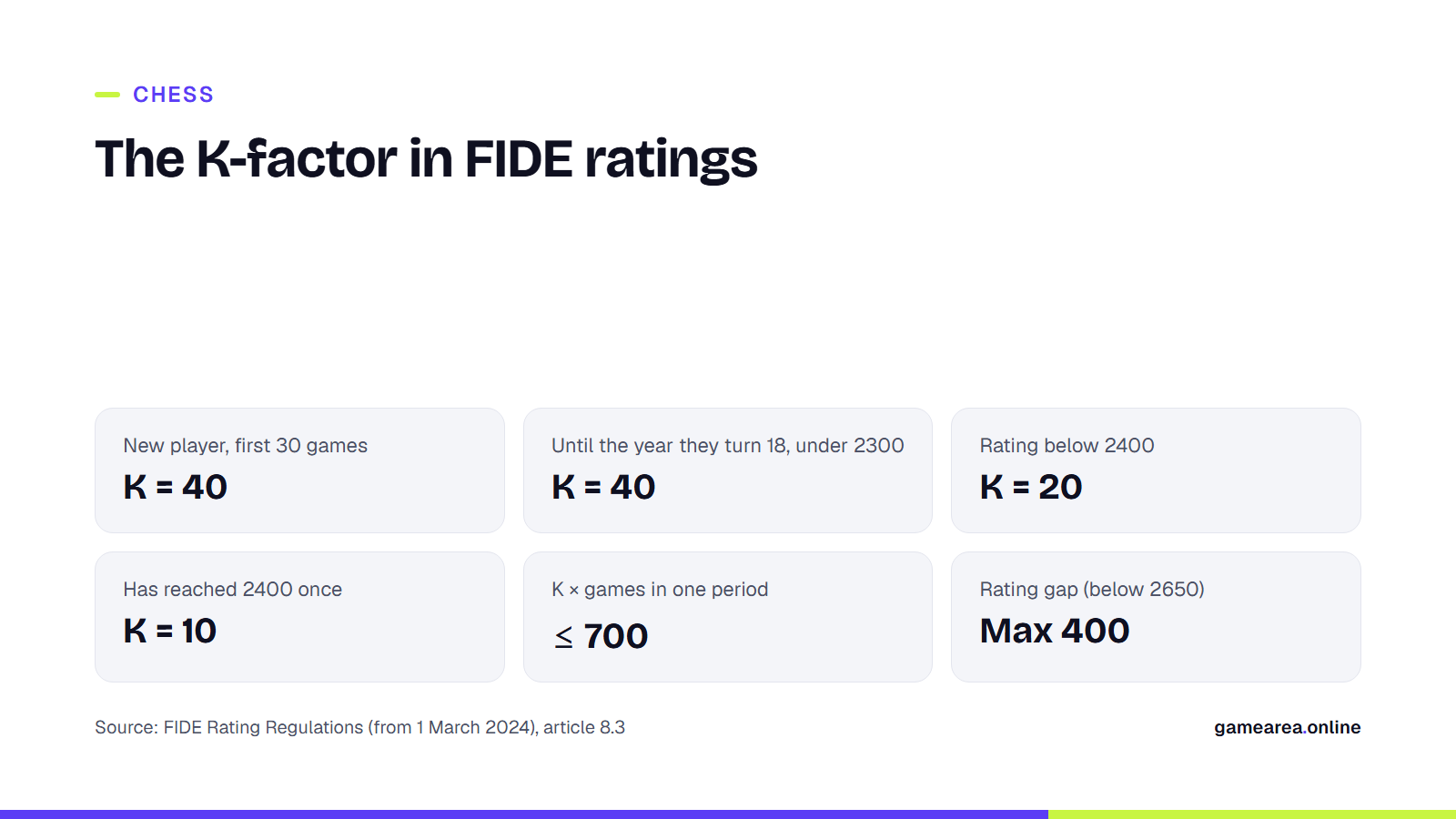
- K = 40 for new players (first 30 games) and for juniors under 2300 until the end of the year they turn 18, K = 20 below 2400, and K = 10 once a player has reached 2400.
- A first FIDE rating needs at least 5 games against rated opponents, and the result must land between 1400 and 2200.
- Lichess and Chess.com use Glicko-based systems rather than Elo, so their numbers cannot be compared directly with a FIDE rating.
What is an Elo rating in chess?
An Elo rating is an estimate of playing strength built from a player's past results, named after the physicist and chess master Arpad Elo who devised it. The US Chess Federation started using his method in 1960; FIDE published its first rating list in 1971, with Bobby Fischer on top at 2760.
The number is a comparison tool rather than an absolute scale. What matters is the difference between two players: the wider it is, the more the stronger side is expected to score. Beat that expectation and you gain points, fall short and you lose them, match it exactly and you stay put. FIDE keeps separate lists for standard, rapid and blitz chess; the rules below cover the standard rating, while rapid and blitz have their own regulations.
How is Elo rating calculated?
Article 8.3 of the FIDE regulations sets out four steps. First, find the rating difference (D) for each game. Second, convert that difference into a scoring probability (PD) using table 8.1.2. Third, subtract that probability from the result of the game (1 for a win, 0.5 for a draw, 0 for a loss). Finally, add up those differences for every game in the rating period and multiply the total by K. The result is rounded to the nearest whole number, with an exact 0.5 rounded away from zero.
That is why a FIDE rating moves period by period rather than game by game. A new list is published on the first day of every month, and tournaments that finish at least three days before that date are included. If you play three events in one month, all of them go into the same calculation and all are rated from the rating you held on that period's list.
What is the expected score formula?
FIDE does not print a closed formula; it uses two tables. The logistic formula found in most calculators, E = 1 / (1 + 10^(−D/400)), lands very close to the table: for a 100-point gap it gives 0.640 against the table's 0.64, and for 200 points 0.760 against 0.76. The two drift apart at the extremes: at 400 points the formula gives 0.909 while the FIDE table says 0.92. Official calculations use the table, so the examples below do too.
A few table values are worth remembering: a gap of 0–3 points gives 0.50, 69–76 points 0.60, 146–153 points 0.70, 198–206 points 0.76 and 392–411 points 0.92. The weaker player's expectation is always 1 minus the stronger player's.
What is the K-factor and when does it change?
The regulations call K the "development coefficient": it decides how far a single result moves your rating. There are four rules:
- K = 40: for a player new to the list, until they have completed events totalling at least 30 games.
- K = 40: for every player until the end of the calendar year of their 18th birthday, as long as the rating stays under 2300.
- K = 20: while the rating is below 2400.
- K = 10: once a published rating has reached 2400; K stays at 10 even if the rating later drops below 2400.
There is also a volume cap: the number of games in a period (n) multiplied by K may not exceed 700. If it does, K becomes the largest whole number that keeps K × n at or below 700. A junior with K = 40 who plays 20 rated games in one month would hit 40 × 20 = 800, so for that month K drops to 35, because 35 × 20 = 700.
Worked example: a five-round tournament
Take a player rated 1650 with K = 20 who plays five rated games in one month. Each row shows the opponent, the expectation read from the table and the gap between result and expectation:
| Opponent | Difference (D) | Expectation (PD) | Result | Result − PD |
|---|---|---|---|---|
| 1720 | 70 points below | 0.40 | Win (1) | +0.60 |
| 1580 | 70 points above | 0.60 | Draw (0.5) | −0.10 |
| 1810 | 160 points below | 0.29 | Loss (0) | −0.29 |
| 1500 | 150 points above | 0.70 | Win (1) | +0.30 |
| 2100 | 450 points below, counted as 400 | 0.08 | Draw (0.5) | +0.42 |
| Total: +0.93. Source: FIDE Rating Regulations, table 8.1.2 and article 8.3 | ||||
The total comes to +0.93. With K = 20 that is 0.93 × 20 = 18.6, which rounds to +19, so the new rating is 1669. A junior with K = 40 posting the same results would gain 37.2, or +37; a player with K = 10 would move 9.3, or +9. Scoring 3 out of 5 says little by itself; what counts is who you scored it against. Here the most valuable result is the draw against the 2100-rated opponent.
What is the 400-point rule?
Under article 8.3.1, in force since 1 October 2025, any rating difference above 400 points is treated as 400 when the player is rated under 2650. At 2650 or higher, the real gap always applies. The table shows what the cap does: a 400-point gap gives 0.92/0.08, whereas a 500-point gap would give 0.96/0.04.
Example: a 2000-rated player draws with a 1500. With the cap, the stronger side loses 0.42 × 20 = 8.4, so 8 points; without it the loss would be 0.46 × 20 = 9.2. The rule stops a strong player from shedding too many points through one bad result against a much lower-rated opponent. The 2022 regulations had the same cap, but a player could benefit from it only once per tournament, in the game with the largest gap; the current text has no such restriction.
How do you get a first rating, and what is the minimum?
There is no fixed starting rating on the FIDE list. An unrated player's first rating comes from at least 5 games against FIDE-rated opponents. They need not be in one tournament: results from consecutive rating periods spanning no more than 26 months are pooled. A zero score in the first event is ignored.
The calculation adds two hypothetical opponents rated 1800 to the average of the real opponents, and the games against them count as draws. The percentage score is then converted into a rating difference (dp) with table 8.1.1, and the first rating is the average plus dp. Example: a player scores 5 out of 6 against opponents rated 1450, 1500, 1550, 1600, 1650 and 1700. With the hypothetical opponents the average is (9450 + 3600) / 8 = 1631.25. The score is 6/8, or 0.75, which the table converts to +193. The first rating is 1631.25 + 193 = 1824.25, rounded to 1824.
Two limits apply: a first rating can be no higher than 2200 and must be at least 1400. The list itself also has a 1400 floor; a player who drops below it is shown as unrated on the next list and is treated like any other unrated player from then on. Under the 2022 regulations the floor was 1000 and there were no hypothetical 1800 opponents.
Why are online ratings different?
A FIDE rating is calculated only from tournaments that federations register with FIDE. Games on Lichess or Chess.com do not change it, and both sites use Glicko-based systems rather than Elo. Lichess says it uses Glicko-2, developed by Mark Glickman: a new account starts at 1500 ± 1000, and when the deviation is above 110 a question mark next to the rating marks it as provisional. Chess.com uses Glicko as well; its rating deviation (RD) grows when you stop playing for a while, so your next games move the rating more sharply. Lichess states in its FAQ that, because of different player pools and different systems, its ratings should not be compared directly with those of other organisations.
If you want to practise without any rating at stake, the GAMEAREA chess page lets you play a bot without creating an account, and those games do not affect a FIDE rating either. What actually lifts a rating is chess knowledge: our guides to chess openings for beginners and basic chess tactics are good places to start.
Frequently asked questions
What is the starting Elo rating in chess?
FIDE has no fixed starting rating. A first rating is calculated from at least 5 games against rated opponents plus two hypothetical draws against 1800-rated players, and the result must fall between 1400 and 2200. Online sites such as Lichess start new accounts around 1500 with a large margin of uncertainty.
What is the most Elo you can gain from one game?
Because the gap counts as no more than 400 for players below 2650, the lowest possible expectation is 0.08. A win from there brings 0.92 × K: about 37 points with K = 40, 18.4 with K = 20 and 9.2 with K = 10. Rounding is applied to the monthly total, not to each game.
When is the FIDE rating updated?
The FIDE rating list is published on the first day of every month. Tournaments that finish at least three days before the list date are included; those finishing later go into the following month. All rated games within a period are calculated together, using the rating from that period's list.
What happens if a rating drops below 1400?
Under the current FIDE rules 1400 is the floor. A player whose rating falls below it is shown as unrated on the next list and from then on is treated like any other unrated player, so a new first rating, based on at least 5 games against rated opponents, is needed to return to the list.
Sources
- FIDE — FIDE Rating Regulations effective from 1 March 2024 Official source
- FIDE — FIDE Rating Regulations effective from 1 January 2022 till 29 February 2024 Official source
- FIDE — Anniversary of Arpad Elo – rating system that changed chess world Official source
- Lichess — Lichess Frequently Asked Questions: Lichess ratings Official source
- Chess.com — How do ratings work on Chess.com? Official source
How this content was prepared
Prepared with AI assistance from the sources listed, key facts checked against official sources, not copied verbatim. Our AI principles
GAMEAREA Editörlüğü