Turkish backgammon dice names: yek, dü, se, cihar, penç, şeş and all 21 rolls
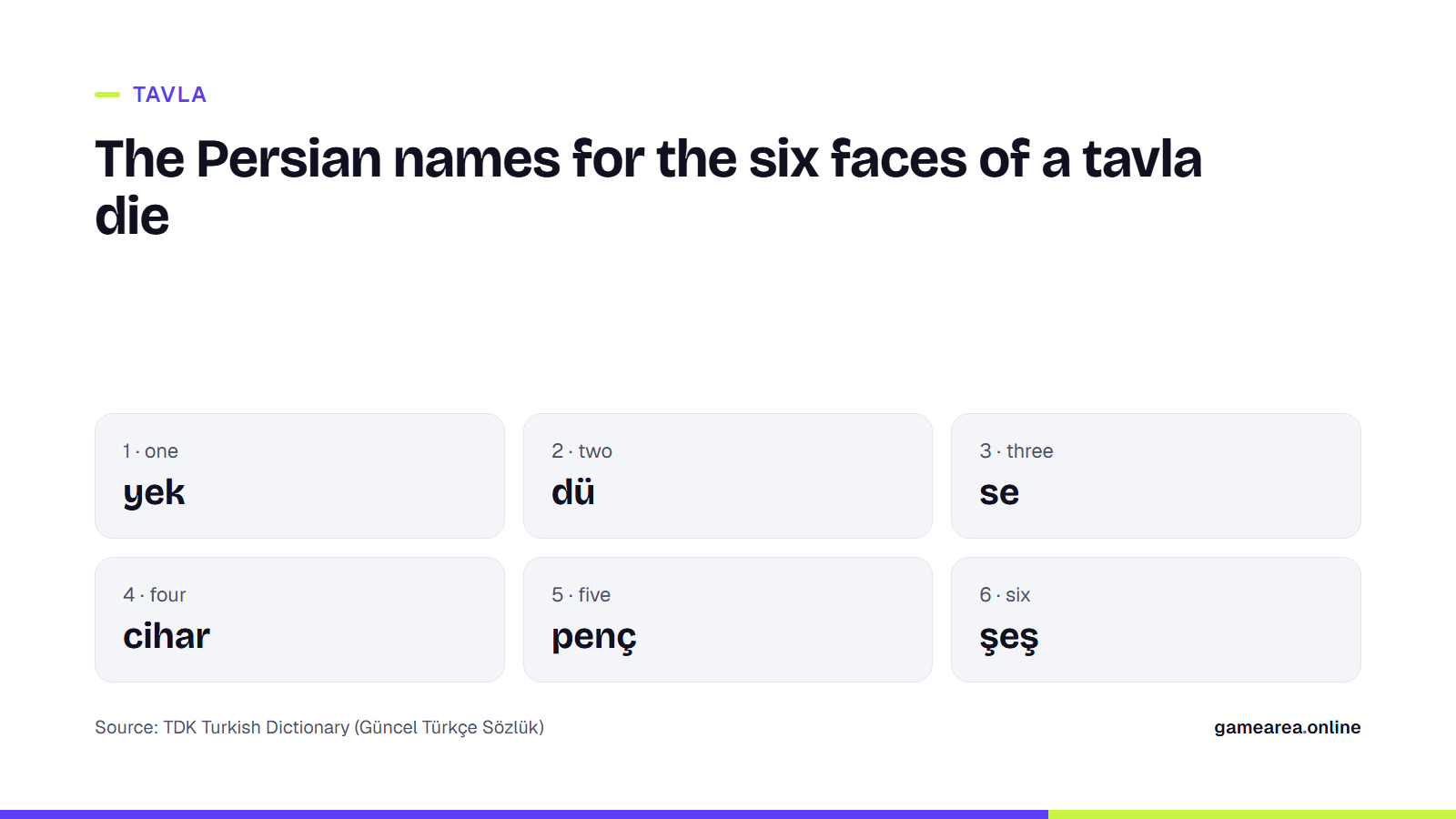
Turkish backgammon (tavla) players name the dice in Persian: 1 is yek, 2 is dü, 3 is se, 4 is cihar, 5 is penç and 6 is şeş. Doubles have names of their own (1-1 hepyek, 2-2 dubara, 3-3 düse, 4-4 dörtcihar, 5-5 dübeş, 6-6 düşeş), and for two different numbers the higher one is said first, so 6-5 is şeşbeş and 5-1 is pencüyek.
In short
- All six number names are listed in the Turkish Language Association's (TDK) dictionary, each marked as Persian in origin.
- 16 of the 21 possible rolls have their own dictionary entry; 3-2, 4-1, 4-2, 4-3 and 5-4 do not.
- A double means four moves: düşeş moves 24 pips in total, hepyek just 4.
- The dictionary writes the names as one word (hepyek, şeşbeş), but split spellings such as "hep yek" or "şeş beş" are just as common at real tables.
What are the Turkish names for backgammon dice?
At a Turkish tavla table you rarely hear the everyday Turkish numbers. Each face of the die is called by its Persian name instead. The TDK's Güncel Türkçe Sözlük lists all six as separate headwords and points each one to the Turkish number: yek means one, dü two, se three, cihar four, penç five and şeş six. The dictionary records the roots too: cihar comes from Persian çehār, dü from dū and penç from penc. Under the ordinary Turkish word for four, dört, the dictionary still lists cihar as a synonym.
Pronunciation is simpler than the spelling suggests. In Turkish, ş sounds like English "sh", ç like "ch" and ü like the German ü, so şeş is roughly "shesh" and penç is "pench". If you play Turkish opponents online, these are the words you will see in chat.
Why are the names Persian?
The dictionary traces every one of the six number words to Persian, and outside dice games Turkish speakers simply use their own numerals. The name of the game has a different story: the TDK links "tavla", meaning the two-sided board game played with fifteen checkers each, to the Italian tavola. So the board's name points to the Mediterranean while the dice speak Persian. Even the word for a checker, pul, is recorded with a Persian root, pūl.
What are the names of the doubles?
Each of the six doubles has its own dictionary entry:
- Hepyek (1-1): from Persian hep and yek. The dictionary defines hep as "all, whole", so the name means roughly "all ones".
- Dubara (2-2): from Persian dū and bāre. The word has a second dictionary sense as well: a trick or deception.
- Düse (3-3): dū plus se, literally "two threes".
- Dörtcihar (4-4): a mixed form that puts Turkish dört next to Persian çehār.
- Dübeş (5-5): Persian dū with the Turkish beş, not penç.
- Düşeş (6-6): dū plus şeş. The dictionary also gives it a figurative sense, an unexpected stroke of luck, so the strongest roll in the game has become everyday slang for good fortune.
Why do most doubles start with dü?
In düse, dübeş and düşeş the leading dü works as "twice": two threes, two fives, two sixes. In hepyek the word hep does that job, and in dörtcihar it is the Turkish dört. This patchwork tells you the names grew out of coffeehouse tables over a long time rather than out of a grammar rule. The dictionary records the settled forms; it does not impose one correct way to say every roll.
How do you say mixed rolls?
When the two dice differ, the higher number comes first. Some dictionary forms put a linking ü sound between the numbers (şeşüdü, pencüyek), others join them directly (şeşyek, şeşcihar, şeşbeş). For 2-1 the dictionary accepts both yekdü and düyek. In the table below, rolls that have a dictionary entry use the TDK spelling; the rest are shown as players build them from the number names.
| Roll | Turkish name | TDK headword |
|---|---|---|
| 1-1 | hepyek | Yes |
| 2-1 | yekdü / düyek | Yes (both) |
| 2-2 | dubara | Yes |
| 3-1 | seyek | Yes |
| 3-2 | se dü | No |
| 3-3 | düse | Yes |
| 4-1 | cihar yek | No |
| 4-2 | cihar dü | No |
| 4-3 | cihar se | No |
| 4-4 | dörtcihar | Yes |
| 5-1 | pencüyek | Yes |
| 5-2 | pencüdü | Yes |
| 5-3 | pencüse | Yes |
| 5-4 | penç cihar | No |
| 5-5 | dübeş | Yes |
| 6-1 | şeşyek | Yes |
| 6-2 | şeşüdü | Yes |
| 6-3 | şeşüse | Yes |
| 6-4 | şeşcihar | Yes |
| 6-5 | şeşbeş | Yes |
| 6-6 | düşeş | Yes |
| Source: TDK Güncel Türkçe Sözlük, checked 24 November 2026. "No" means the dictionary has no entry for that roll. | ||
One word or two?
The dictionary writes every name as a single word: hepyek, şeşbeş, dörtcihar. In everyday writing and on game sites you will also see "hep yek", "şeş beş" and "dört cihar". The penç and pencü difference is part of the same flexibility: the number on its own is penç, but the compounds are spelled pencüyek, pencüdü and pencüse. For rolls with no entry, such as 3-2, the wording can change from table to table, so treat forms like "se dü" or "cihar yek" as names built on the usual pattern, not as fixed spellings. Watch out for one near-collision: düse is 3-3, while se dü is 3-2.
How many moves do you get with a double?
A double lets you play the number four times. Düşeş moves four sixes, 24 pips in total; hepyek moves four ones, 4 pips. You can use one checker for all four steps or spread them over several, and every step counts as its own move, so each landing point along the way has to be open. The general dice rule still applies: you must use as many of the four moves as the position allows. If only two or three can be played, you play those and the rest are lost.
A note for English speakers: "double" also refers to the doubling cube, which multiplies the stake. Throughout this article, a double means two dice showing the same number; offering the cube is a separate decision that has nothing to do with the names above.
On the GAMEAREA tavla table, the server-side game engine queues a double as four separate dice and will not pass the turn while a playable move remains. The opening follows the standard rule as well: each player rolls one die, ties are re-rolled, and the higher roller starts with those two dice. That is why the first move of a game can never be a double; hepyek or düşeş can first appear on the second turn.
The odds are worth knowing too. Out of 36 possible outcomes, any specific double such as düşeş appears once, a chance of 1/36 or about 2.8 percent. A mixed roll like şeşbeş can come in two orders, so it has a 2/36 chance, about 5.6 percent. Rolling some double is 6/36, one in six.
Other tavla terms you will hear
- Pul: a checker; the dictionary describes it as the flat round piece used in tavla. Each player has fifteen.
- Kapı: a point made by stacking two checkers, which the opponent can no longer land on. Making points is the core of tavla strategy.
- Kırık: a checker that has been hit and taken out of play. A player with a kırık checker must bring it back into the opponent's home board before moving anything else.
- Gele: in the dictionary's words, a roll by a player who has a hit checker that does not let the game continue, meaning every entry point is closed. We worked through those numbers in backgammon dice odds for hitting and bar entry.
- Mars: winning two points by bearing off all your checkers before the opponent has started bearing off; in English, a gammon. Our guide what is a gammon in backgammon explains how it differs from katmerli mars.
Frequently asked questions
What is 6-5 called in Turkish backgammon?
A 6-5 roll is called şeşbeş. The TDK dictionary writes it as one word and defines it as one die showing six and the other five. Interestingly, five appears here as the Turkish beş rather than the Persian penç. You will also often see it written as two words, "şeş beş".
What does dubara mean?
Dubara is the 2-2 roll, both dice showing two. The TDK traces it to Persian dū, meaning two, and bāre. The dictionary lists a second meaning as well, a trick or deception. A player who rolls dubara moves two pips four times, eight pips in total.
What is 4-4 called, dört cihar?
Yes. The dictionary name for 4-4 is dörtcihar, which combines the Turkish dört with the Persian çehār and is written as one word. Writing and saying it as two words, "dört cihar", is also common. Dörtcihar moves four fours, 16 pips in total.
Do you play a double four times in tavla?
Yes. With a double you play the number on the dice four times: four sixes with düşeş, four twos with dubara. The moves can all use one checker or be split between several. If not all four can be played, you play as many as the position allows and lose the rest.
Sources
- Türk Dil Kurumu (TDK) — Güncel Türkçe Sözlük: yek, dü, se, cihar, penç, şeş, hepyek, dubara, düse, dörtcihar, dübeş, düşeş, şeşbeş, gele, mars, kapı, pul, kırık Official source
- GAMEAREA — Play Tavla Online — Turkish Backgammon | GAMEAREA Official source
How this content was prepared
Prepared with AI assistance from the sources listed, key facts checked against official sources, not copied verbatim. Our AI principles
GAMEAREA Editörlüğü