Backgammon dice odds: how often each roll comes up and how exposed a blot really is
What separates a strong backgammon player from a lucky one is knowing how often the dice will bring what. Once you understand the 36 possible outcomes of two dice, you can see in seconds which move is safest when you leave a blot, build a point or bring a checker in from the bar.
In short
- Two dice have 36 outcomes; the chance of a specific number showing on at least one die is 11/36, about 31%.
- The chance of rolling doubles is 6/36 (16.7%), and doubles are played four times.
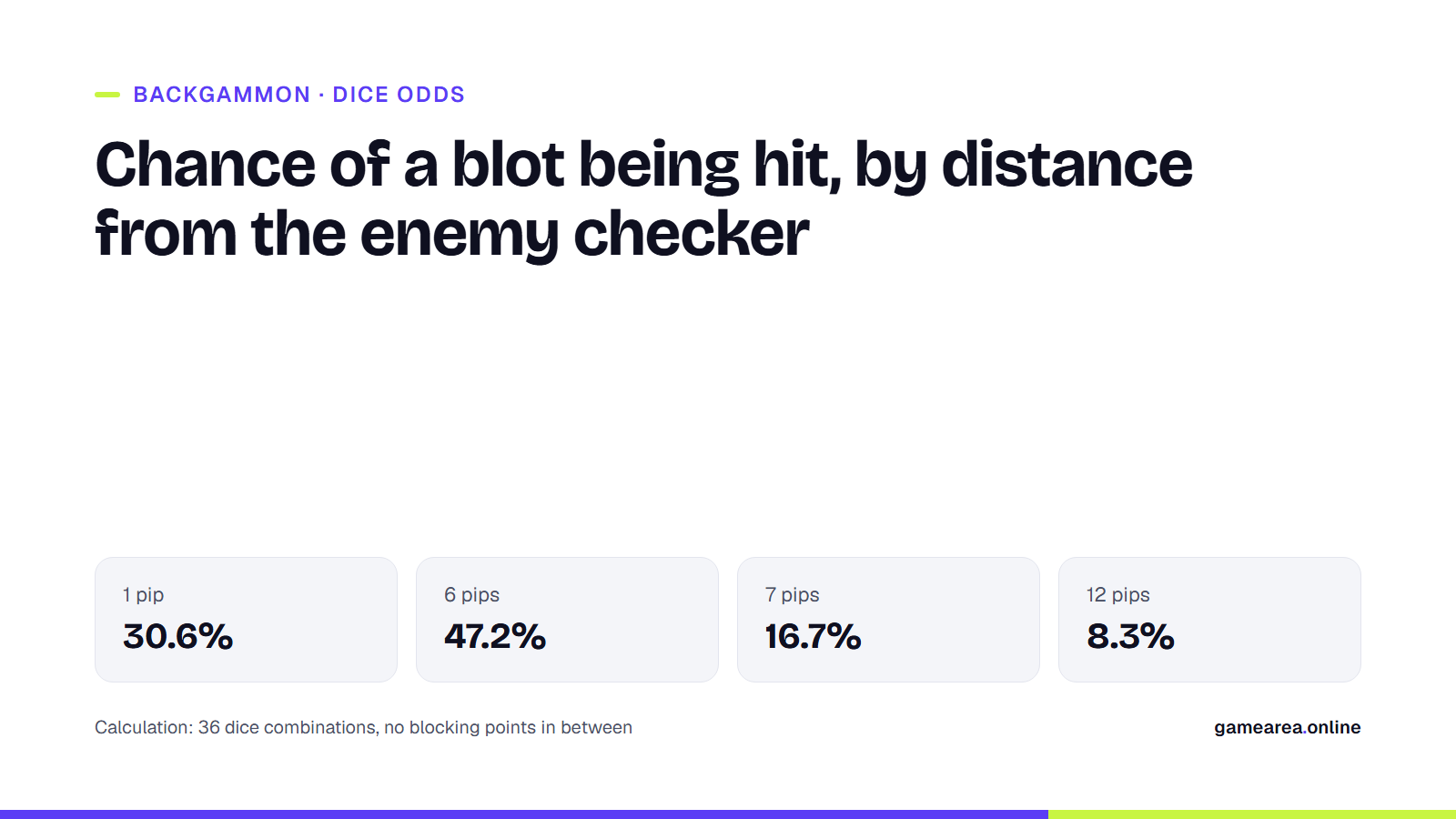
- A blot is most exposed six pips away from an enemy checker (47.2%); from seven pips on, the risk drops sharply.
- An average roll moves 8.17 pips, which is useful when you count a race.
Which rolls come up, and how often?
Each die has six faces, so two dice give 6 × 6 = 36 outcomes. Order matters: 6-5 and 5-6 are two different outcomes, which is why a specific mixed roll such as 6-5 has a chance of 2/36 (5.6%). A specific double such as 6-6 comes up only 1/36 of the time (2.8%). The six doubles together make 6/36, one roll in six.
The most common question is the chance of rolling a particular number. If you need a six, there are six outcomes with a six on the first die and six with a six on the second, but 6-6 must not be counted twice. The answer is 11/36, about 30.6%. If any of two numbers will do (say a 4 or a 2), the chance rises to 20/36; with three numbers it is 27/36, with four 32/36 and with five 35/36.
Will my blot be hit? Risk by distance
A checker standing alone is hit when an enemy checker lands exactly on it and goes to the bar. Within 1 to 6 pips it can be hit by a single die or by the sum of both, so the risk grows with distance. From seven pips on a single die is not enough; only sums and doubles can hit, and the risk falls sharply. The table below assumes there are no blocking points in between.
| Distance (pips) | Hitting rolls | Probability |
|---|---|---|
| 1 | 11 / 36 | 30.6% |
| 2 | 12 / 36 | 33.3% |
| 3 | 14 / 36 | 38.9% |
| 4 | 15 / 36 | 41.7% |
| 5 | 15 / 36 | 41.7% |
| 6 | 17 / 36 | 47.2% |
| 7 | 6 / 36 | 16.7% |
| 8 | 6 / 36 | 16.7% |
| 9 | 5 / 36 | 13.9% |
| 10 | 3 / 36 | 8.3% |
| 11 | 2 / 36 | 5.6% |
| 12 | 3 / 36 | 8.3% |
The practical lesson: if you have to leave a blot, putting it seven or more pips away from the enemy checker cuts the risk to roughly a third. If your opponent holds blocking points in between, some combination rolls cannot be played and the real risk is lower than the table shows; the chance of a direct hit with one die does not change.
What are the chances of entering from the bar?
With a checker on the bar you must first bring it into your opponent’s home board. It enters if either die shows an open point. The more points your opponent has closed, the lower your chance:
- 1 point closed: 97.2%
- 2 points closed: 88.9%
- 3 points closed: 75.0%
- 4 points closed: 55.6%
- 5 points closed: 30.6%
- 6 points closed: no entry, the turn passes
That is why getting hit against four or five closed points is so costly, and why building points in your own home board is the strongest way to keep your opponent’s hit checkers out of play.
How do doubles change the game?
A player who rolls doubles plays that number four times instead of twice, so 6-6 means 24 pips in a single turn. This rule also pushes the average up: across all 36 outcomes, a roll moves 8.17 pips on average. When the game turns into a race, comparing both sides’ pip counts with this average gives you a rough idea of how many rolls you need to bear off.
The fastest way to learn these numbers is at the board while you play backgammon on GAMEAREA. For the basics, see our backgammon rules guide, and for game plans our five core backgammon strategies.
Frequently asked questions
What are the odds of rolling doubles in backgammon?
Any double comes up 6/36 of the time, or 16.7%; a specific double such as 6-6 has a chance of 1/36.
Why is the chance of a specific number not 50%?
With two dice it is tempting to think 2/6, but a double cannot be counted twice. The correct figure is 11/36, about 30.6%.
How far from the enemy should I leave a blot?
Seven pips or more if you can. Six pips is the most dangerous distance (47.2%); at seven pips the risk drops to 16.7%.
My opponent has closed five points. What are my chances of entering?
Only one point is open, so the chance is 11/36, about 30.6%.
Sources
- United States Backgammon Federation — Backgammon Basics: How to Play Official source
- bkgm.com — Basic Probability (Jacoby & Crawford)
How this content was prepared
Prepared with AI assistance from the sources listed, key facts checked against official sources, not copied verbatim. Our AI principles
GAMEAREA Editörlüğü