Okey 51 strategy: Which melds reach 51, when to open and how to manage the okey
Because the threshold in Okey 51 is low, getting down on the table looks easy; the real difficulty starts after the first opening. The escalating rule, the order in which you lay off tiles and when to keep the okey tile in hand decide the difference between two players holding the same rack.
In short
- The first opening needs runs and sets worth at least 51 points, or four pairs; every later opening must beat the last run total by at least one point, or the last pair count by at least one pair.
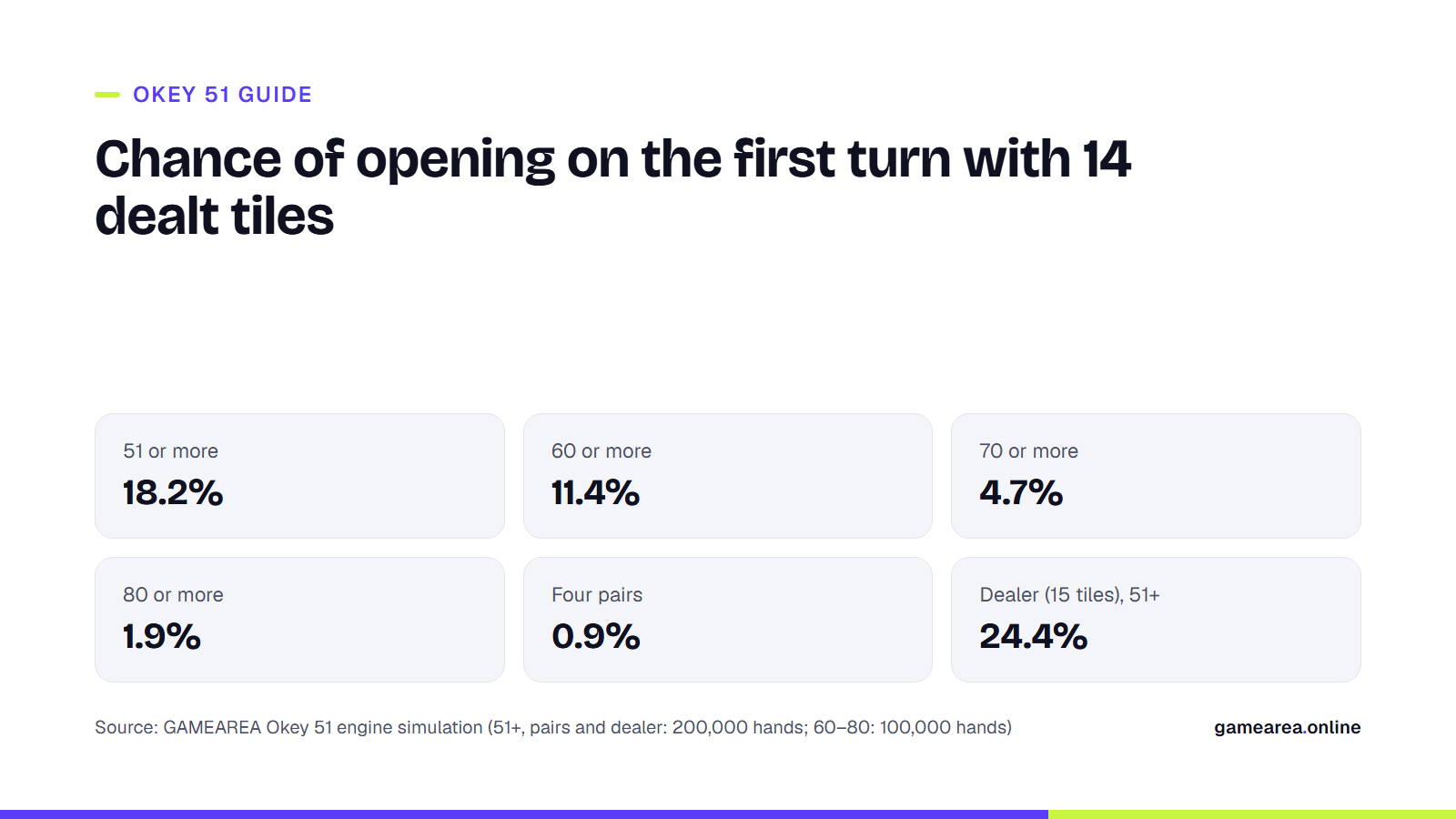
- In our simulation with the GAMEAREA game engine, 18.2% of 14-tile dealt hands can open 51 on the first turn; when the threshold rises to 70, that drops to 4.7%.
- A player who never opened before the hand ends is charged 51 points on top of the sum of the tiles on their rack; a real okey left in hand counts as 101.
- Once you have opened, you can lay off onto every run and set on the table, and you can swap an okey inside a meld for the real tile it stands for and take it into your hand.
Which melds get you to 51 points?
When counting an opening, every tile is worth the number on its face; a run is at least three consecutive numbers in the same colour, and a set is three or four tiles of the same number in different colours. Getting 51 from a single meld is almost impossible. A set of 13s in all four colours makes 52 and opens on its own; a five-tile run from 9 to 13 opens with 55. Apart from these, no four-tile meld is enough: four 12s are only 48, and a 10-11-12-13 run is 46.
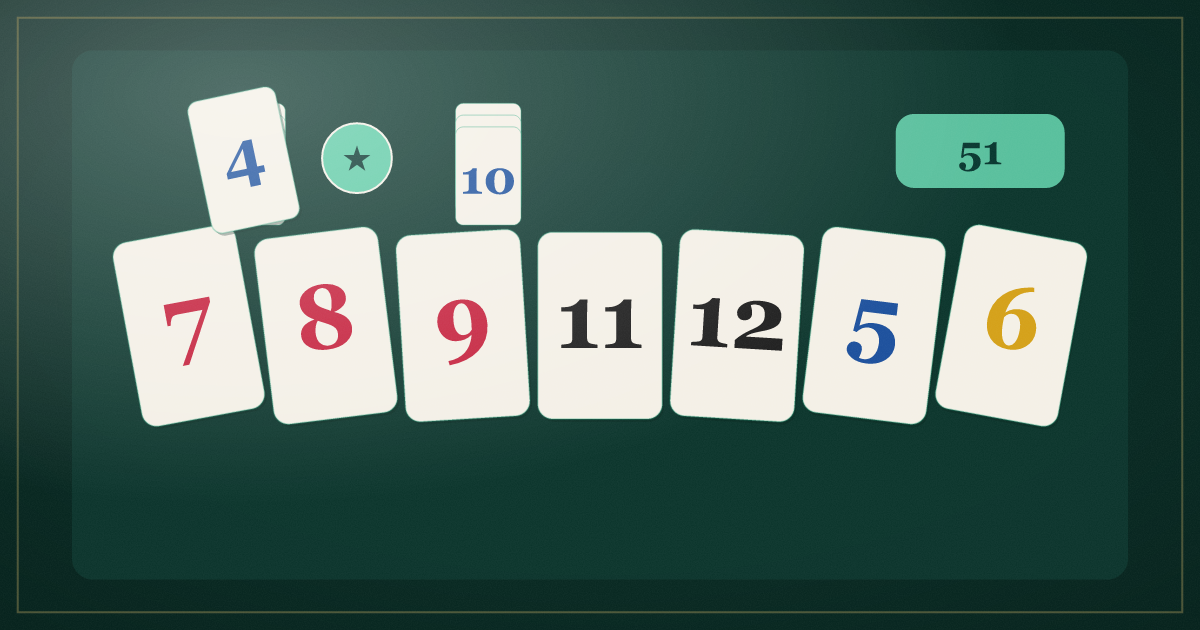
The realistic route is to combine two or three melds. If you open with six tiles, you need an average of 8.5 points per tile; for example, three 9s (27) plus a red 7-8-9 (24) make exactly 51. Low numbers are weak in this count: a 1-2-3 run is worth only 6 points, and you need three more melds next to it. So as you approach your opening, prioritise grouping tiles of 9 and above over trying to build runs from tiles between 1 and 4.
The value of the okey also depends on how the engine counts it. In a set, the okey takes that set's number. If it can sit at either end of a run, the GAMEAREA engine counts it at the high end: blue 12-13 with the okey scores 36 as 11-12-13, while blue 5-6 with the okey scores 18 as 5-6-7.
| Tiles | Example | Total | Reaches 51? |
|---|---|---|---|
| 4 | Four 13s | 52 | Yes, the only way with four tiles |
| 4 | Four 12s | 48 | No |
| 4 | 10-11-12-13 run | 46 | No |
| 5 | 9-10-11-12-13 run | 55 | Yes |
| 6 | Three 9s + red 7-8-9 | 51 | Yes, right on the threshold |
| 8 | Four pairs | Points not counted | Yes, if it is the first pairs opening |
| Total: face value of the tiles. Rules and okey counting: GAMEAREA Okey 51 game engine. | |||
Open straight away, or wait?
In Okey 51, the first player to get down on the table also sets everyone else's target. With every new run opening, the engine moves the threshold to one more than the last opening total: if someone opened with 51, you need 52; if they opened with 68, you need 69. The simulation shows how harsh this is: the chance of a 14-tile hand making 51 on the first turn is 18.2%, but for 60 it falls to 11.4%, and for 80 to 1.9%.
Two practical rules follow from this. First, if your hand clears the threshold, waiting is expensive; someone who opens before you pushes the target up, and your 51-point opening can suddenly fall short. Second, putting every valid meld in your hand on the table when you open increases your total and makes life harder for those who come after you. A meld you keep in hand will be scored against you as a penalty anyway when the hand ends.
The only case where waiting is worth considering is when your hand is very close to finishing outright without opening. The engine lets a player who has never opened finish the hand by completing 14 of their 15 tiles as sets, runs or seven pairs and discarding the last tile. But if you get stuck on that road, the penalty comes at its heaviest.
When does opening with four pairs make sense?
A pairs opening ignores points; if your hand is full of low numbers, it may be the only way out. But four pairs are rare in the deal: in the simulation, only 0.9% of 14-tile hands could show four pairs on the first turn. Pairs openings escalate too; if someone opened with four pairs, the next pairs opening needs five.
After opening with pairs, the remaining tiles have fewer places to go. In the engine, you can't add tiles to pairs on the table, and you can't open pairs a second time. You can only get rid of your single tiles by laying them down as new runs or sets, or by laying them off onto runs and sets on the table. So before opening with pairs, check whether your remaining tiles have somewhere to land on the table.
How do you lay off tiles after opening?
From the moment you open, every run and set on the table, whoever it belongs to, is an outlet for you. On your turn, after drawing a tile, you can add suitable tiles to these melds and lay down new ones; new melds after the opening have no points requirement. When a single tile is left in your hand, you finish the hand by discarding it.
Because hands in Okey 51 are played with 14 tiles, you usually have only a few tiles left after opening, and the race speeds up. Decide your laying-off order with two questions. Which tile might lose its place if you don't lay it off now? If another player fills the end of a run, the tile in your hand no longer has a spot in that run. Which tile is the most expensive as a penalty? If you can only lay off one tile in a turn, getting rid of the high number first reduces the penalty you'll be charged if someone finishes.
Don't forget the defensive side. Players who haven't opened yet can take the discarded tile by using it in their opening. Discarding a tile you could have laid off may complete the opening of the player after you.
How should you manage the okey tile?
The real okey fills any gap, but in GAMEAREA's scoring it counts as 101 points when left in hand. The fake joker, by contrast, isn't a wild card; it only represents the okey's number and colour, and if left in hand it carries that number's value. In Okey 51, this difference has three consequences.
First, spending the okey on your opening is usually right. Keeping an okey that would get you over the threshold on your rack while you wait for a better spot both delays your opening and carries the 101-point risk. Second, if there is an okey in a run or set on the table and you hold the real tile it stands for, you can put that tile into the meld after opening and take the okey into your hand. That's a strong move for completing another meld, but it turns the okey back into a risky tile. Third, if your last tile is the okey, you finish by discarding it and your opponents' penalties are doubled. Taking the okey back from the table also opens the door to this finish.
How do you avoid penalty points?
When someone finishes the hand, the other players pay the sum of the tiles on their racks as a penalty. Those who never opened are charged an extra 51 points on top of that; in hands finished with the okey or with pairs, all penalties are doubled. For example, if you're left with a 3 and an 8, you pay 11 points if you've opened and 62 if you haven't; if your opponent finished with the okey, those numbers become 22 and 124.
Keep an eye on the number of tiles in the wall, too. At a four-player table, 57 tiles are dealt, one tile becomes the indicator and 48 tiles remain in the middle; if the wall runs out, the hand ends with no winner. If the wall is getting low and you can see you won't finish, lay off or get rid of your big numbers, and only let go of the okey if you're sure it won't complete the opening of the player after you.
For the full rules, see our Okey 51 rules guide, and for its high-threshold sibling, our Okey 101 strategy article; you can try these calculations against bots at the GAMEAREA Okey 51 table.
Frequently asked questions
How many points do you need to open in Okey 51?
The first run opening needs at least 51 points, or four pairs. Later openings escalate: you have to beat the last run total by at least one point, or the last pair count by at least one pair.
What is the fewest tiles you can make 51 with?
Four: a set of 13s in all four colours makes exactly 52. No other four-tile meld reaches 51; with five tiles, a 9-10-11-12-13 run opens with 55.
Can I take the okey from a run or set on the table?
Yes, once you have opened yourself. You put the real tile the okey stands for into that meld and the okey goes into your hand. A fake joker can't be taken this way.
What is the penalty if the hand ends before I open?
51 is added to the sum of the tiles on your rack. A real okey left in hand counts as 101; if your opponent finished with the okey or with pairs, the total is doubled.
Sources
- GAMEAREA — Okey 51 Official source
- GAMEAREA — Okey 51 Kuralları: 51 ile Nasıl Açılır Official source
- Vikipedi — Okey
How this content was prepared
Prepared with AI assistance from the sources listed, key facts checked against official sources, not copied verbatim. Our AI principles
GAMEAREA Editörlüğü