Reversi endgame: Parity, tempo, edge play and the wedge
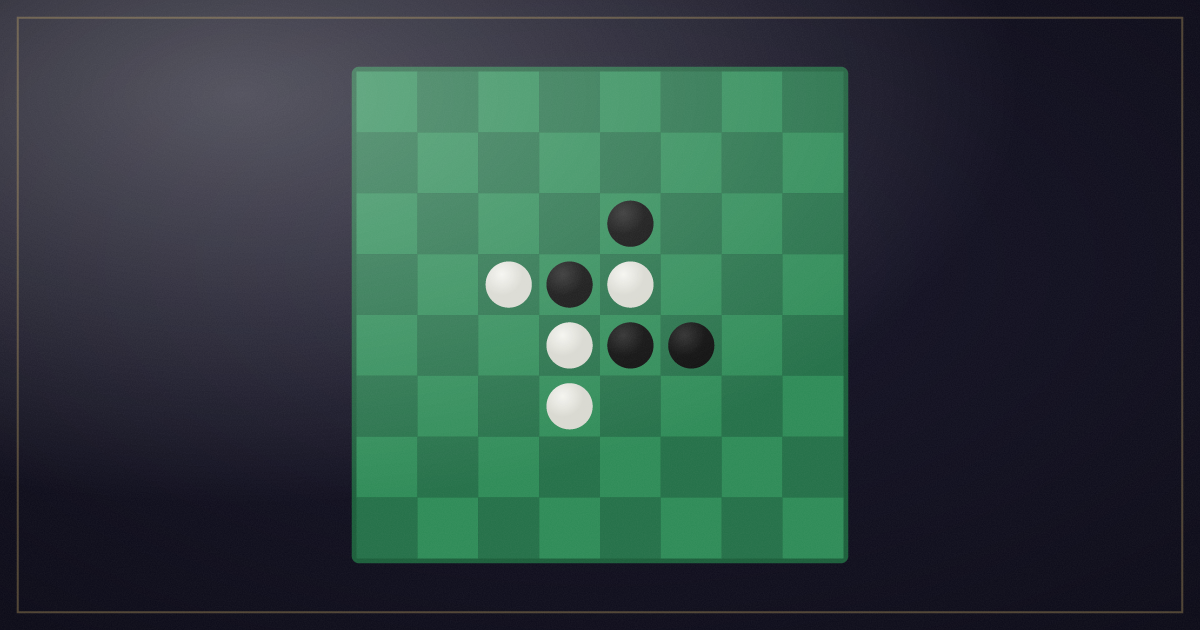
In Reversi, even a player who handles the midgame well can lose the game in the last ten moves, because the yardstick changes in the endgame: what matters now is not how many moves you have, but who places the last disc in each empty region. Parity, tempo, edge structures and the wedge are the four basic tools of this final stage.
In short
- In the endgame the empty squares split into small regions; moving into a region with an odd number of empty squares usually leaves the last move in that region to you.
- A "free move", one your opponent can't prevent and that opens no new options for them, works like passing and gains you a tempo.
- A disc placed on the edge between two opposing discs that can't be flipped along the edge, a wedge, often opens the door to a corner.
- Giving up a corner can be the right decision if you get tempo and a more valuable corner in return.
What do the rules make you watch for in the endgame?
Three points in the World Othello Federation's official rules directly affect the endgame. Passing isn't a choice: a player's turn is skipped only when they have no legal move. The game ends when neither player can place a disc. The result is decided by which colour has the majority of discs on the board. The game can also end before all 64 squares are filled. In the federation's world championship rules, the empty squares are then awarded to the winner; for example, a game that ends 33 to 29 with two empty squares is recorded as 35 to 29.
The Reversi table on GAMEAREA applies the same move and pass rules: the turn of a side with no move is skipped automatically, and the game ends when nobody can play. The score is counted only from the discs on the board, and empty squares aren't awarded to anyone. This difference doesn't change the winner, only the margin.
We covered basic concepts such as corners, X-squares and mobility in our Reversi strategy guide. This article picks up from there: what changes when ten or twelve empty squares are left on the board?
What is region parity, and which region should you enter first?
As the endgame approaches, the empty squares stop being a single area and form small pockets separated from each other by discs. Each of these pockets is called a region. If the two players take turns in a region, whoever enters a region with an odd number of empty squares first also places its last disc. The last disc is valuable because the opponent can't take back the discs you flip with that move in that region.
The practical rule that follows: enter odd regions, and in even regions let your opponent move first. If your opponent has no legal move at all in a region, that region is your reserve; think of it as a stock of moves you can use whenever you like.
To measure how strong the rule is, we used GAMEAREA's Reversi rules engine to stop randomly played games when 10 empty squares were left on the board, and solved 1,000 positions to the end with perfect play. We counted regions as groups of empty squares adjacent to each other, diagonals included.
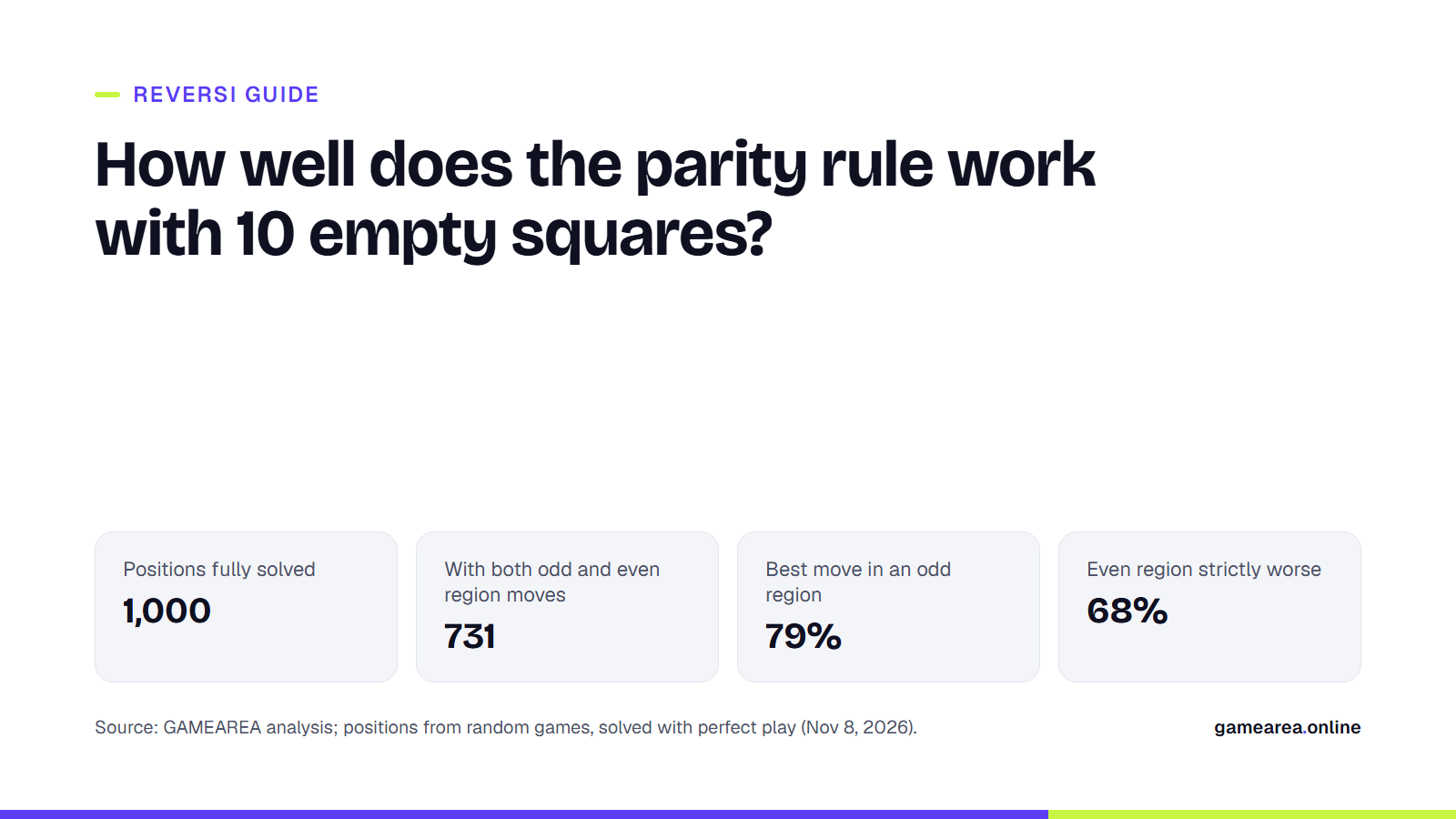
Of the 731 positions with move options in both an odd and an even region, the best move was in an odd region in 580 (79 percent). In 496 positions (68 percent), every move in an even region gave a strictly worse result than the best odd-region move. In the remaining 21 percent, the best move was in an even region. Because the positions come from random games rather than expert games, the percentages give a rough idea, but the lesson is clear: parity is a strong compass, not an absolute law. An odd-region move that gives away a corner or a big edge is a bad move even if it wins parity.
A pass reverses parity. If you leave your opponent without a move in a region, the turn order shifts by one move and the last move can pass to you. That's why, in the endgame, good players count not just the number of regions but also who can enter which region.
What do tempo and a free move mean?
A free move is a move your opponent can't prevent and that, once played, opens no new safe option for them. As the British Othello Federation's lesson adapted from Brian Rose's book stresses, such a move works like the right to pass: you play your free move, and your opponent is forced into a bad square, often an X-square. This is called gaining a tempo.
In the endgame, the tempo count goes like this: count the safe moves you and your opponent can play. The side that runs out of safe moves first has to give up a corner or an edge. A move that gifts your opponent a free move is usually a loss of tempo, however many discs it flips.
How do you play on the edge, and what is a wedge?
An edge where all six squares between the two corners are filled with one colour is called a balanced edge, and in most cases it is the most solid edge structure you can have. The dangerous ones are unbalanced edges: lines that fill a C-square without taking the corner can open the way to the neighbouring corner for your opponent. The best known of these is called a "wing".
A wedge means placing a disc on the empty square between two of your opponent's discs on the edge. Under the rules, discs are flipped only along the lines running directly from the newly placed disc; because the squares on both sides of the wedge are already filled, your opponent can't flip that disc along the edge. The wedge becomes a solid foothold on the edge and lets you attack the corner your opponent's discs reach towards.
From the defensive side, the lesson is simple: leaving a one-square gap between two discs on your own edge is an invitation to a wedge. Before moving on the edge, check whether your opponent can get into the resulting gap from another line.
At the end, should you count discs or moves?
In the midgame the disc count is misleading; the real measure is the number of moves. With around the last ten empty squares, though, the calculation becomes concrete and you need to count two things together: who makes the last move in each region, and which discs can no longer be flipped at all. Discs anchored to a corner that run unbroken along the edge are stable; these are the real points counted at the end of the game.
Follow a practical order: first note the regions and whether each is odd or even, then for each candidate move think about your opponent's reply and who will place the last disc in the region, and only then look at the number of discs flipped. A move that flips many discs but leaves the last move to your opponent often gives most of those discs back.
| Concept | What it means | Practical rule in the endgame |
|---|---|---|
| Region parity | Whether a region has an odd or even number of empty squares | Enter odd regions, let your opponent move first in even ones |
| Free move | A move your opponent can't prevent and that opens no options for them | Don't hand one to your opponent; save your own for the end |
| Tempo | An extra move that forces your opponent onto a bad square | Keep more safe moves than your opponent |
| Wedge | A disc placed on the edge between two opposing discs | Don't leave a one-square gap on your own edge |
| Balanced edge | All six squares between two corners filled with one colour | Attack an opponent with an unbalanced edge |
| Source: World Othello Federation rules; British Othello Federation lesson on edge play; parity percentages from GAMEAREA analysis (1,000 positions, 8 November 2026). | ||
When is it right to give up a corner?
"Never give up a corner" is a good rule to start with, but in the endgame it has plenty of exceptions. Two situations stand out in the British Othello Federation's lesson. The first is when giving up a corner gains you tempo in return: if, after your opponent takes the corner, it's their turn again and they're forced to create a new weakness, the trade works in your favour. The second is to attack an opponent's unbalanced edge: the opponent who takes the corner may lose the other corner to a wedge, and you win two edges in exchange for one.
When deciding, ask yourself: how many stable discs will the corner I give up bring? Is the corner or edge I'll get in return bigger? Whose turn is it after the trade, and does my opponent still have safe moves? If the answers to all three are in your favour, don't hesitate to give up the corner.
Frequently asked questions
Can I pass in Reversi when I have a move?
No. Under the official rules, if you have a legal move you must play it; a pass only happens when you have no move at all.
What happens to the empty squares if the game ends early?
In the World Othello Federation's championship rules, the empty squares are awarded to the winner. At the GAMEAREA table only the discs on the board are counted; the winner stays the same, only the margin changes.
Does the parity rule always point to the right move?
No. In the positions we solved, the best move was in an odd region roughly four times out of five; in the remaining cases, corner, edge or stable-disc considerations outweighed parity.
Why can't a wedge be flipped back straight away?
A disc on the edge can only be sandwiched along the edge. Because both neighbours of the wedge are already filled, your opponent finds no empty square on that line to place a disc on; the wedge is only in danger if one of the neighbouring discs later changes colour.
Sources
- World Othello Federation — Official rules for the game Othello Official source
- World Othello Federation — WOC Rules — World Othello Championship 2018 Official source
- GAMEAREA — Reversi Oyna — Othello Strateji Oyunu Official source
- British Othello Federation — Chapter 5: Basic edge play
- Samsoft — Strategy Guide for Reversi & Reversed Reversi
How this content was prepared
Prepared with AI assistance from the sources listed, key facts checked against official sources, not copied verbatim. Our AI principles
GAMEAREA Editörlüğü