Building a hand in Düz Okey: Sets or runs, and when should you hold the okey?
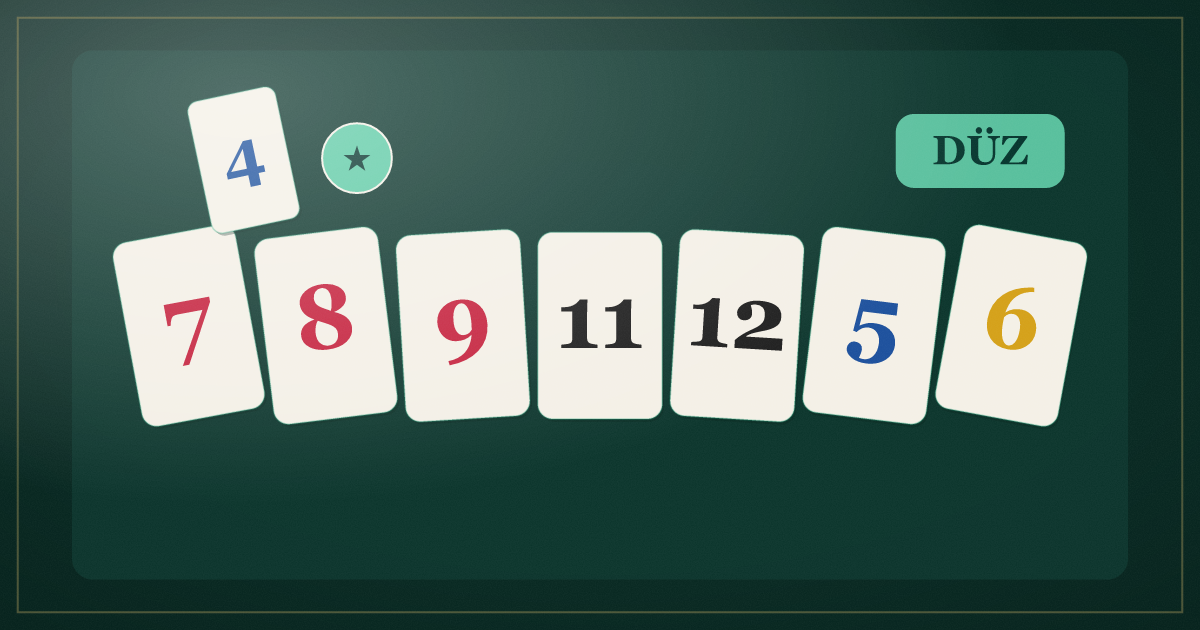
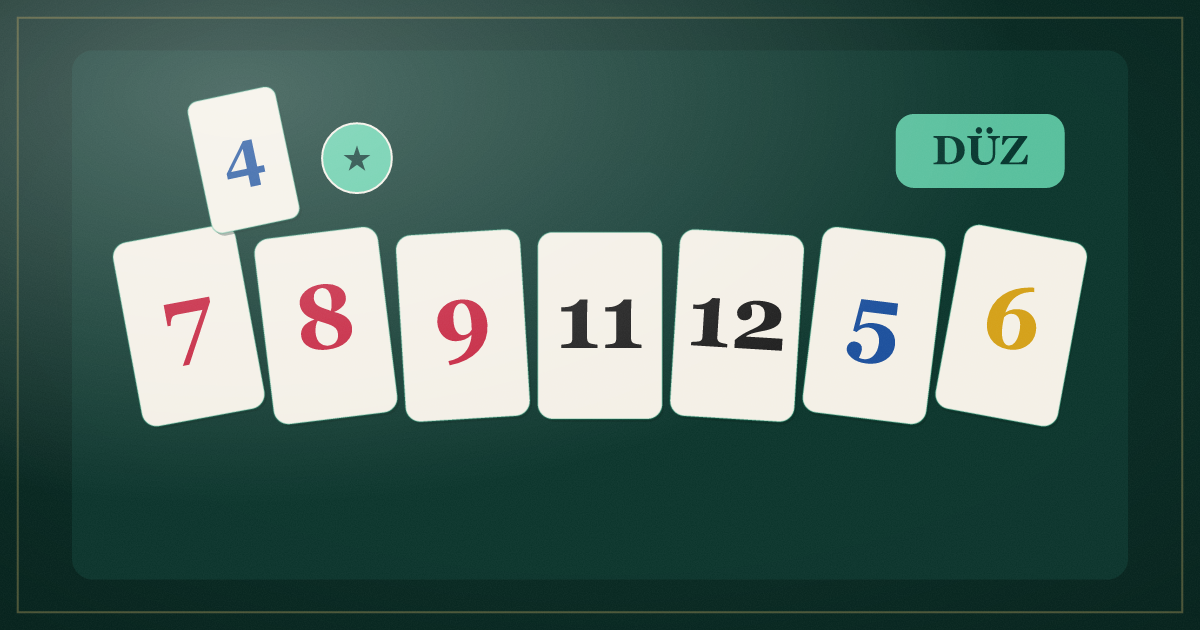
In Düz Okey everyone starts with the same number of tiles; the first player to finish is the one who waits most efficiently. Knowing how many different tiles can complete each partial meld makes most of your discard decisions for you.
In short
- Two adjacent tiles (for example yellow 5-6) and the same number in two colours (red 7, blue 7) are each completed by four tiles; gapped pairs (yellow 5-7) by only two.
- Flexible tiles that fit both a set and a run are the last ones to discard.
- Save the okey for the hardest gap, not for a group that will complete easily.
- With four or more pairs in hand, seriously consider finishing with pairs.
How do you finish a hand in Düz Okey?
The game uses 106 tiles: two of each number from 1 to 13 in four colours, plus two false okeys. Each of the four players is dealt 14 tiles, and the starting player gets one extra. The tile one above the indicator (1 if the indicator is 13) is that hand's okey and works as a wild tile in any group; the false okey only stands in for the okey tile itself. In Düz Okey nothing is laid on the table: once every tile on your rack forms valid groups, you finish by discarding your last tile.
There are two kinds of valid group. A run is at least three consecutive tiles of the same colour (yellow 4-5-6). A set is three or four tiles of the same number in different colours (red 9, blue 9, black 9). You can also finish with seven pairs. For the full rules, see our Düz Okey rules guide.
Which partial meld completes fastest?
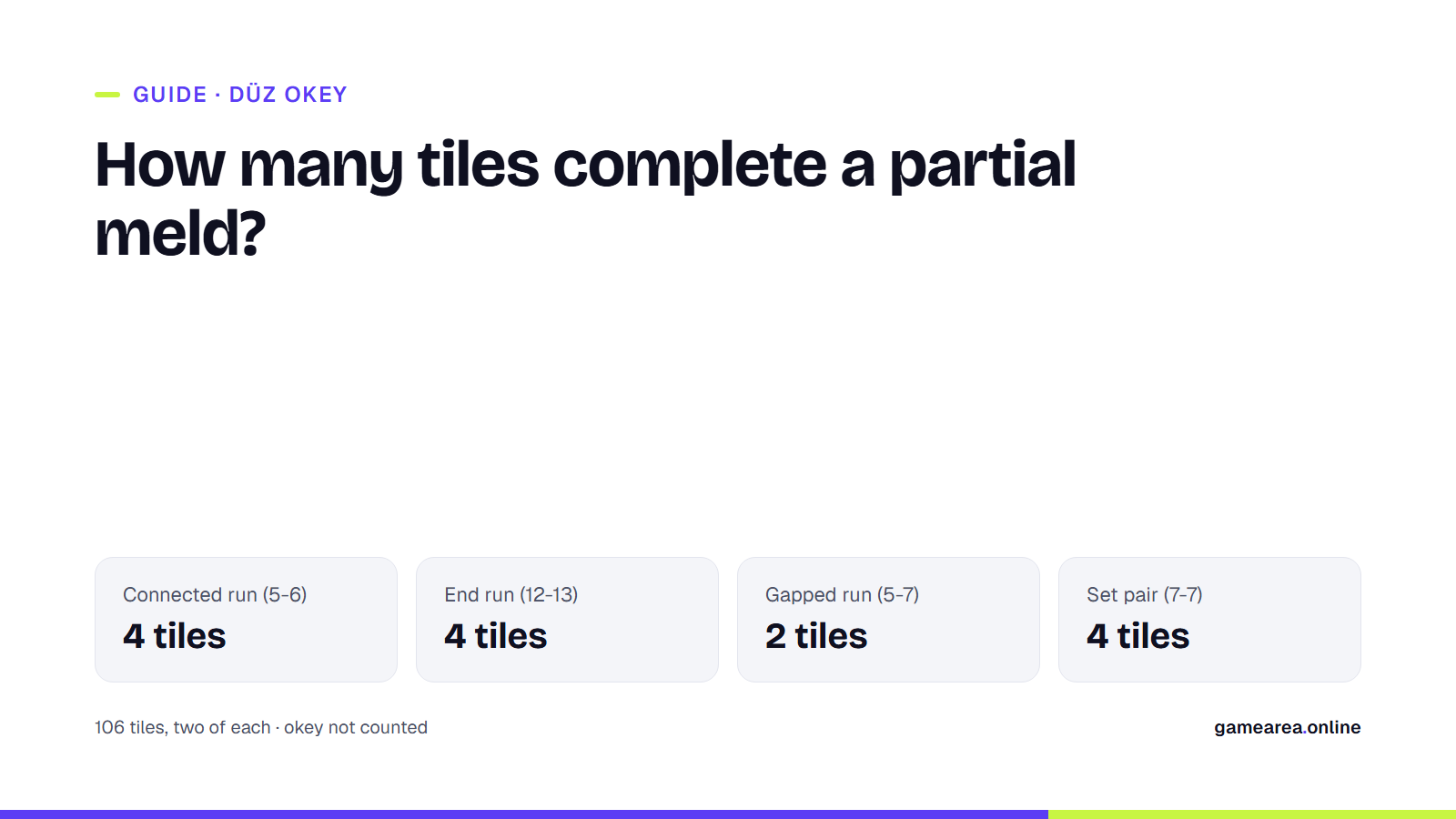
Because there are two of every tile, it is easy to count the tiles that can complete a partial meld. The table below shows how many "outs" each pair has at the start of a hand, before any tile is visible:
| Partial meld | Completing tiles | Outs |
|---|---|---|
| Connected run (yellow 5-6) | Yellow 4 or yellow 7 | 4 |
| Run at the end (yellow 12-13) | Yellow 11 or yellow 1 | 4 |
| Gapped run (yellow 5-7) | Yellow 6 only | 2 |
| Set pair (red 7, blue 7) | Yellow 7 or black 7 | 4 |
| Note: the okey and false okey are extra outs in every case. Every tile visible on the table lowers the count. | ||
The conclusion is simple: gapped pairs carry half the chances of connected ones. If you have to choose between yellow 5-6 and yellow 5-7, breaking up the gapped one is usually right. The second rule is about counting: if one of the tiles you need has been discarded or is sitting as the indicator, your outs have dropped. For example, if the indicator is yellow 6, the yellow 5-7 gap has only one out left.
What is a flexible tile, and why is it discarded last?
Some tiles fit two different groups. If you hold yellow 6-7 and red 8, blue 8, an incoming yellow 8 both extends the run and adds a third colour to the set. Tiles like this keep your options open until you decide which way the hand is going. As the hand develops and groups take shape, check which direction has fewer outs left and let the other go.
Conversely, isolated tiles with no connection to anything (especially 1s and 13s at the ends, or the only tile of a colour) are the first to go. When choosing your discard, also think about the player on your right: they see your discard first. If you have noticed them collecting a colour, try not to hand them middle tiles of that colour.
When should you use the okey, and when should you hold it?
The okey is the most valuable tile in your hand because it can fill any gap. The most common mistake is spending it straight away to complete an easy pair that has four outs. A better approach:
- Save it for the hard gap: Keep the okey for a gapped run or a group whose outs are gone; easy pairs are likely to come from the deck anyway.
- Keep it flexible until the end: You do not have to fix the okey to one group on your rack. When a tile you were waiting for arrives, you can move the okey to another gap.
- Consider finishing by discarding the okey: If your hand is complete apart from the okey, you can finish by discarding it as your last tile, and at many tables this counts as a more valuable finish. Remember that scoring varies from table to table.
- Never throw the okey away: Discarding it at any other time hands a wild tile to the player on your right.
When should you switch to pairs?
Finishing with pairs means completing seven pairs, and the okey can be the partner of a missing pair here too. If you see four or more pairs in your opening hand, pairs are a realistic target: each missing pair has only one partner left in the game, but you only need a few of them. If you have few pairs and good runs, stay with a normal finish. Carrying both goals for too long usually delays both; pick one within a few turns.
Frequently asked questions
Is 12-13-1 a valid run in Düz Okey?
Yes, 1 can follow 13. On GAMEAREA, 12-13-1 is a valid run.
What is the maximum size of a set?
Four tiles; each colour can appear only once.
What does the false okey do?
It only replaces that hand's okey tile; it cannot be used as a wild tile.
How many pairs do you need to finish with pairs?
Seven. The okey can be used as the partner of a missing pair.
Sources
- GAMEAREA — Düz Okey Oyna — Kapalı El 4 Kişilik Official source
- GAMEAREA — Düz Okey Kuralları: Kapalı El Rehberi Official source
- Vikipedi — Okey
How this content was prepared
Prepared with AI assistance from the sources listed, key facts checked against official sources, not copied verbatim. Our AI principles
GAMEAREA Editörlüğü