Scholar's mate in chess: how the four-move checkmate works and how to stop it
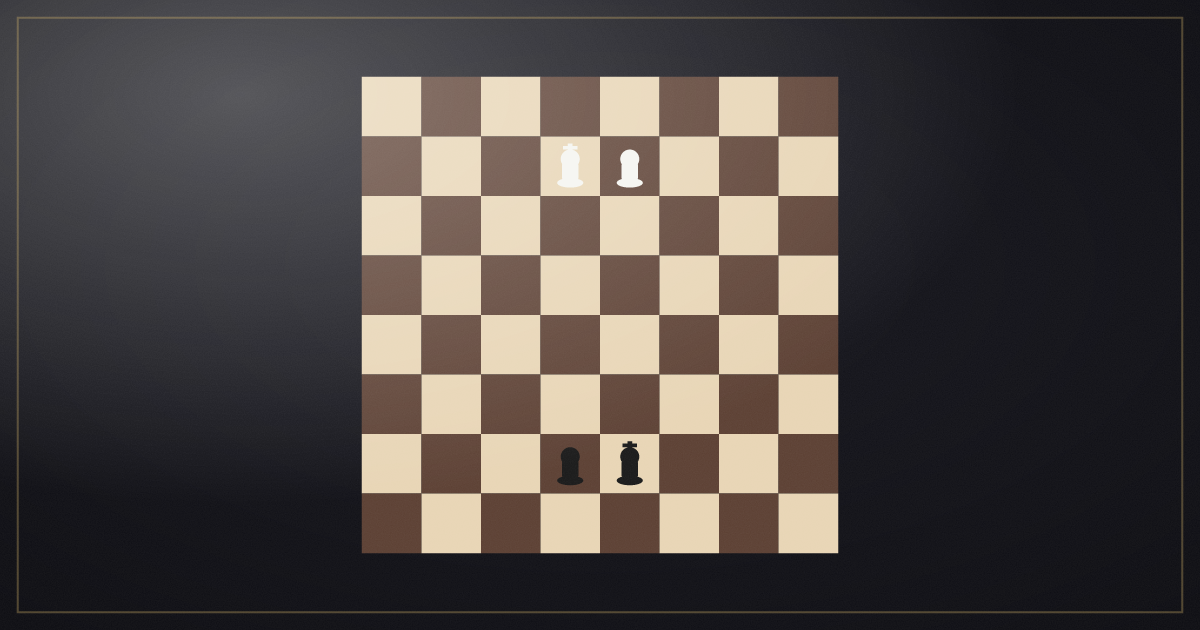
Scholar's mate is the short checkmate in which White aims the queen and the light-squared bishop at the f7 pawn and ends the game on move four with Qxf7#: 1.e4 e5 2.Bc4 Nc6 3.Qh5 Nf6?? 4.Qxf7#. Stopping it is easy once you see it coming; a single move that guards f7 or blocks the queen's path is enough.
In short
- The mate lands on f7: the bishop on c4 and the queen on h5 or f3 both hit a pawn that, in the starting position, only the king defends.
- Against 3.Qh5, the moves 3...g6, 3...Qe7 and 3...Qf6 all prevent mate; the natural-looking 3...Nf6?? is the one that loses.
- A queen brought out early gets chased by a prepared opponent's developing moves, and White falls behind in development.
- Fool's mate (1.f3 e5 2.g4 Qh4#) takes only two moves and is the fastest checkmate in chess; this time the mistake is White's.
What is Scholar's mate?
Under Article 1.4.1 of the FIDE Laws of Chess, checkmate means the king is under attack and the side to move has no legal way out of it; the player who delivers it wins. Scholar's mate is the best-known opening trap that ends this way. White does not castle and barely develops: the queen and the light-squared bishop simply converge on one square. If Black misses the plan, the game is over on the seventh half-move.
The trap catches so many beginners because Black's losing move looks perfectly sensible. Nf6 develops a piece and attacks the queen on h5. But it ignores the threat on f7, so White does not retreat the queen; it takes the pawn and the game ends on the spot.
How do you play Scholar's mate?
This is the most common sequence. We played every move through the GAMEAREA chess engine to confirm that the final position really is checkmate:
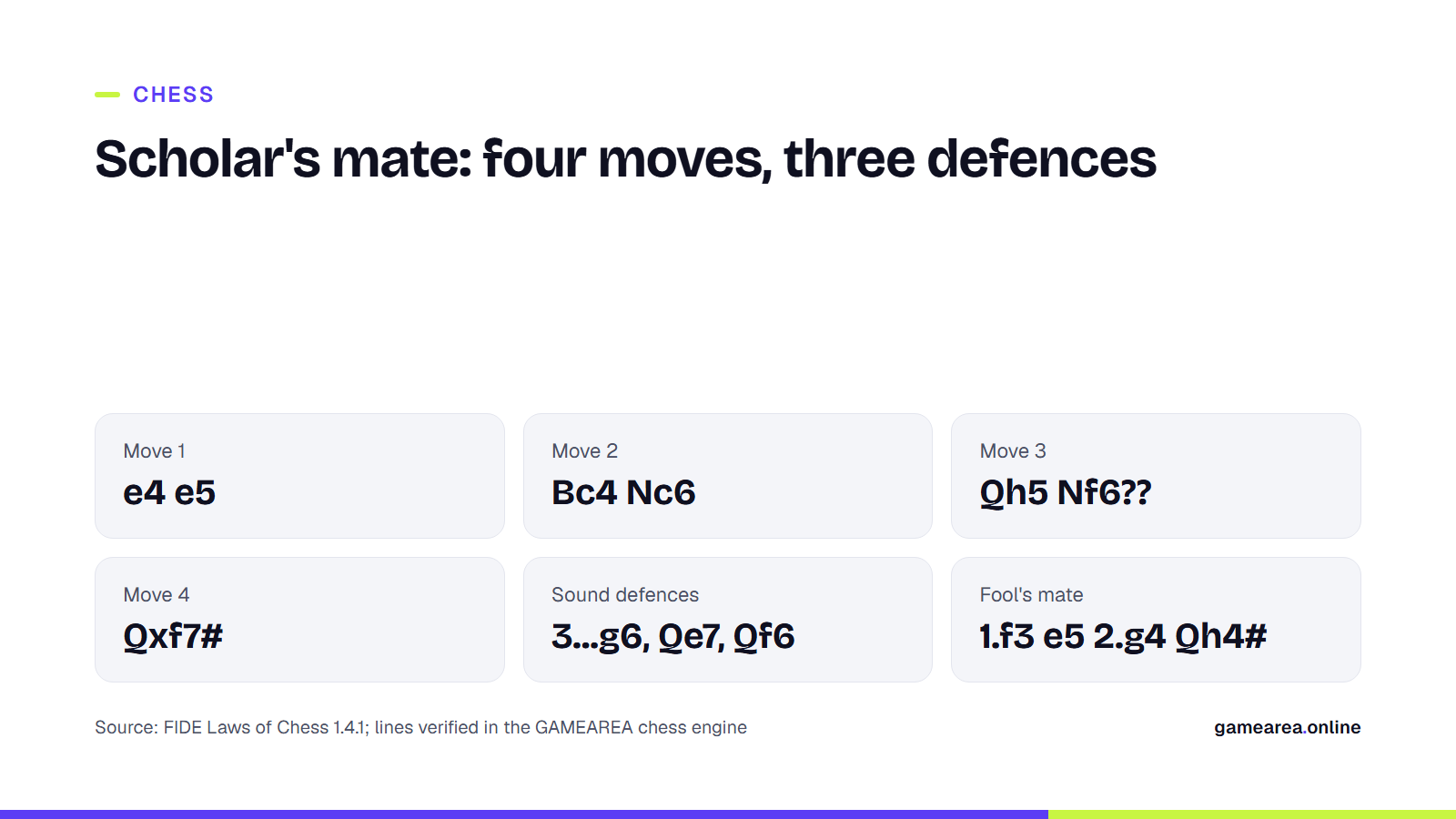
- 1.e4 e5 Both sides push the king's pawn two squares. With the e2 pawn gone, diagonals open for both the bishop and the queen.
- 2.Bc4 Nc6 The bishop arrives on c4 and stares straight at f7. Black develops the knight and protects e5.
- 3.Qh5 The queen attacks both f7 and e5. Since the knight on c6 covers e5, the real threat is f7.
- 3...Nf6?? The blunder: it attacks the queen but does nothing for f7.
- 4.Qxf7# The queen takes on f7 with check. The king cannot capture it because the bishop on c4 protects the queen. With the queen on d8, the bishop on f8 and a pawn on d7, the king has nowhere to go, and the queen on f7 covers e7.
The same mate can arrive by a different move order. 1.e4 e5 2.Qh5 Nc6 3.Bc4 Nf6?? 4.Qxf7# ends identically, and so does 1.e4 e5 2.Bc4 Bc5 3.Qh5 Nf6?? 4.Qxf7#, where Black brought out the bishop instead of the knight on move two.
Scholar's mate via Qf3
The queen can also go to f3 instead of h5: 1.e4 e5 2.Bc4 Nc6 3.Qf3. The threat is still Qxf7#, this time along the f-file. If Black ignores it with something like 3...d6?? or 3...Bc5??, then 4.Qxf7# is mate. The Qf3 set-up is less obvious than Qh5, but it is even easier to meet: 3...Nf6 develops the knight and closes the f-file, so the queen's road to f7 is blocked.
Why is f7 such a weak square?
In the starting position Black's f7 pawn is defended only by the king, and the same goes for White's f2 pawn. Each of the other seven pawns is covered by at least one piece besides the king: the rook on a8 guards a7, the bishop on c8 guards b7, the bishop on f8 guards g7. f7 and f2 depend on the king alone. Attack that square with two pieces and one defender is not enough. On top of that, the capture comes with check, so Black never gets time to counterattack. The weakness cuts both ways: if White neglects development, a bishop on c5 and a queen on h4 can target f2 in exactly the same way.
How do you stop Scholar's mate?
We tested each defence below against 3.Qh5 in the engine; after none of them is Qxf7 checkmate.
3...g6: chase the queen
The g-pawn attacks the queen and closes the h5-f7 diagonal. If White grabs a pawn with 4.Qxe5+, then 4...Nxe5 wins the queen, because the knight on c6 defends e5. White's most consistent follow-up is 4.Qf3, hitting f7 a second time. Now 4...Nf6 is the right answer: the knight develops and shuts the f-file. Watch out for a trap built on the same idea: if Black plays 2...g6?? before the knight reaches c6, in the order 1.e4 e5 2.Qh5, then 3.Qxe5+ gives check and attacks the rook on h8 at the same time, and the rook falls. In that order, play 2...Nc6 first.
3...Qe7: guard both f7 and e5
Bringing the queen to e7 defends f7 and e5 at once. If White plays 4.Qxf7+, 4...Qxf7 wins the white queen for nothing. The cost is small: the bishop on f8 is shut in for a while, and Black will need an extra move later to free it.
3...Qf6: guard f7 with the queen
This also defends f7, and 4.Qxf7+ Qxf7 again costs White the queen. The drawback is that it occupies f6, the most natural square for Black's kingside knight. It removes the mating danger completely, but it is less comfortable for development than 3...g6 or 3...Qe7.
Why is bringing the queen out early risky?
Scholar's mate only works if the opponent misses the threat. Against a prepared player, White's queen ends up alone in the centre or on the edge, and every developing move Black makes gives it a new target. The line 3...g6 4.Qf3 Nf6 above shows it well: the queen has moved twice while Black has made two useful moves. Each time the queen is chased, White loses time, the knights stay at home and castling is delayed. That is why the chess opening principles recommend central pawns first, then the minor pieces, then early castling; the queen usually joins the game after that groundwork.
What is the difference between Scholar's mate and Fool's mate?
Fool's mate is the shortest possible checkmate in chess, and it reverses the roles: White is the side that loses. In 1.f3 e5 2.g4 Qh4#, White's f- and g-pawn moves open the e1-h4 diagonal in front of the king, and the black queen mates from h4. 1.f4 e5 2.g4 Qh4# and 1.g4 e5 2.f3 Qh4# lead to the same result.
| Feature | Scholar's mate | Fool's mate |
|---|---|---|
| Length | 4 moves (7 half-moves) | 2 moves (4 half-moves) |
| Who mates | White | Black |
| Target | The f7 pawn | The opened e1-h4 diagonal |
| Example line | 1.e4 e5 2.Bc4 Nc6 3.Qh5 Nf6?? 4.Qxf7# | 1.f3 e5 2.g4 Qh4# |
| How to avoid it | 3...g6, 3...Qe7 or 3...Qf6 | Do not open the f- and g-pawns together early on |
| Source: checkmate definition from FIDE Laws of Chess, Article 1.4.1; lines verified in the GAMEAREA chess engine | ||
Recognising mating patterns is the quickest way to stay out of opening traps. If you want to learn how to finish a game yourself, the guide to basic checkmates with two rooks and queen and rook is a good next step. To try these four moves and their defences yourself, open chess on GAMEAREA and play the bot without an account; check and checkmate are verified on the server.
Frequently asked questions
How many moves does Scholar's mate take?
Scholar's mate takes four moves: White plays Qxf7# on move four. Because Black has only played three moves by then, it is seven half-moves in total. The best-known line is 1.e4 e5 2.Bc4 Nc6 3.Qh5 Nf6?? 4.Qxf7#, and the queen can reach the same mate from f3 instead of h5.
What is the best defence against Scholar's mate?
After 3.Qh5 the most comfortable choices are 3...g6 and 3...Qe7. The g-pawn chases the queen, and if White renews the threat with 4.Qf3, then 4...Nf6 closes the f-file. Qe7 guards f7 and e5 together. 3...Qf6 also stops mate but takes the knight's best square. The one natural move to avoid is 3...Nf6.
Does Scholar's mate work against strong players?
Usually not. The threat is obvious, and an experienced player stops it with one correct move. After that, White's early queen gets chased by Black's developing moves and White loses time. Knowing the trap is worth more than setting it, because you will meet the same idea yourself when playing beginners.
Are Fool's mate and Scholar's mate the same thing?
No. Fool's mate is the shortest checkmate in chess and lasts two moves: 1.f3 e5 2.g4 Qh4#. Here the mistake is White's and Black delivers mate. Scholar's mate lasts four moves, is delivered by White and relies on the double attack of the queen and bishop on the f7 pawn.
Sources
- FIDE — FIDE Laws of Chess taking effect from 1 January 2023 (Articles 1.4.1, 3.9, 5.1.1) Official source
- GAMEAREA — Play Chess — GAMEAREA Official source
How this content was prepared
Prepared with AI assistance from the sources listed, key facts checked against official sources, not copied verbatim. Our AI principles
GAMEAREA Editörlüğü