9×9 Go opening: Where does the first stone go, what is good shape and how does komi change the plan?
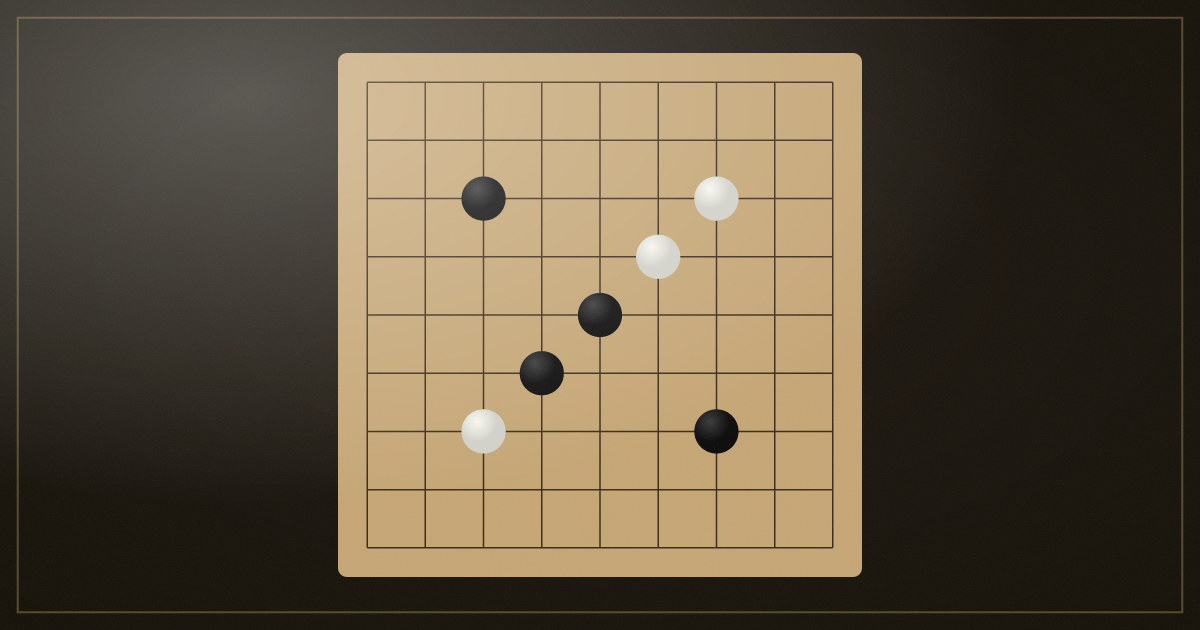
The opening in 9×9 Go doesn't unfold the way it does on the big board, with the corners shared out one by one; as soon as the first few stones are down, groups touch and the fighting starts. Where the first stone goes, which direction you play in and whether your stones make good or bad shape decide most of the game on the small board within the first ten moves.
In short
- 56 of the 81 points on a 9×9 board are on the first two lines; only 25 points are on the third line and above, so every stone influences a large part of the board.
- The most common first move in professional 9×9 games is the 5-5 point at the very centre of the board, known as tengen.
- The empty triangle is bad shape; the tiger's mouth and a hane at the head of two stones are good shapes that do a lot with few stones.
- On GAMEAREA, White receives 6.5 komi: to win, Black has to finish at least 7 points ahead before komi.
Why is the 9×9 opening so fast and so combative?
If you divide the board into rings from the edge towards the centre, you see the difference straight away. On 9×9, there are 32 points on the first line, 24 on the second, 16 on the third and 8 on the fourth; the fifth line is a single point, the centre. On a 19×19 board, the first two lines make up about 38 percent of the board; on 9×9 that rises to 69 percent. On the small board there is almost no distance between the edge and the centre.
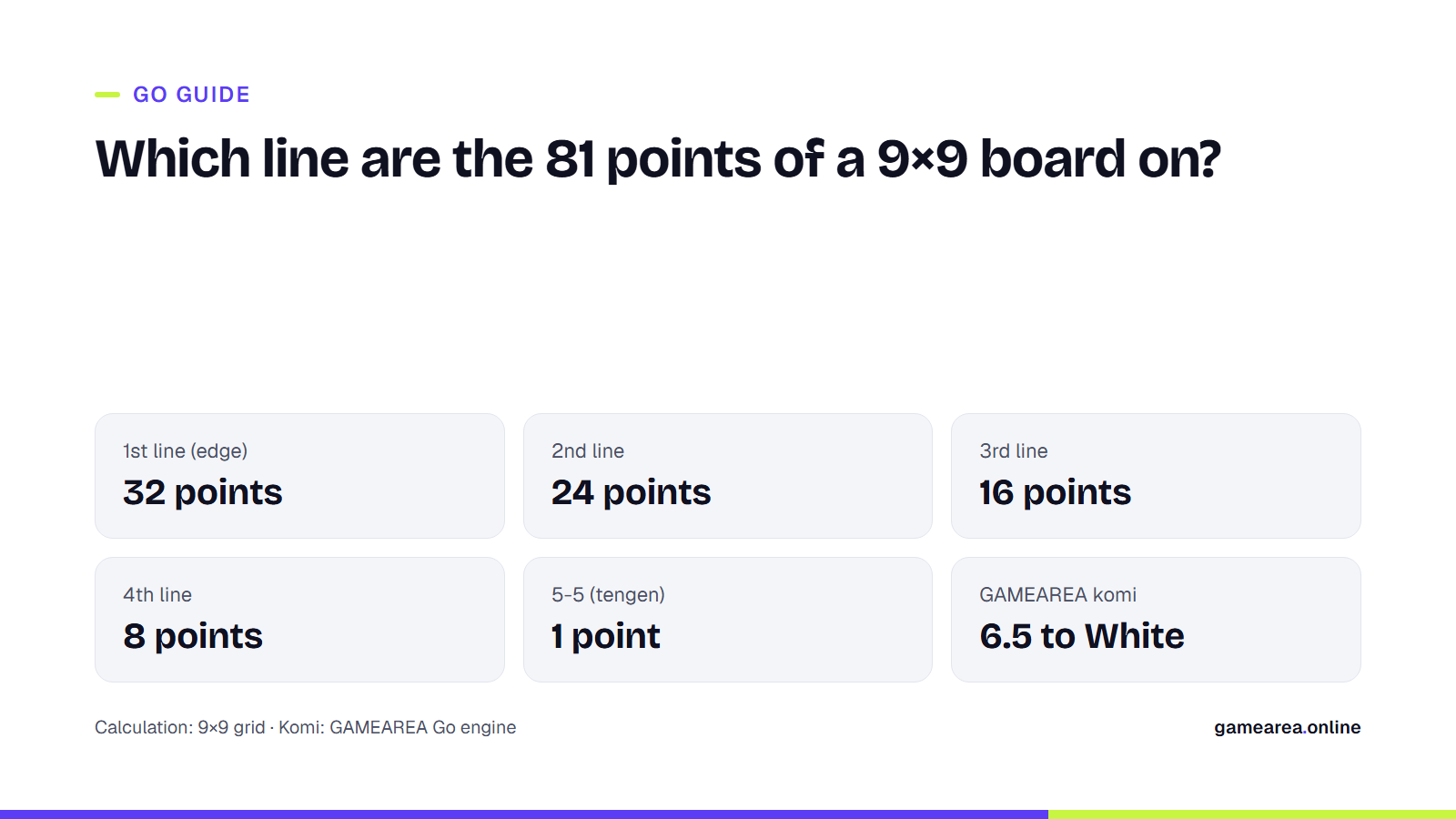
The result is that the opening and the middle game merge. On the big board, stones placed in the corners may not touch each other for dozens of moves; on 9×9, stones are in contact by the third or fourth move. The British Go Association recommends that beginners learn the basics on 9×9. That density is the reason: cutting, connecting and keeping groups alive come up in the first few minutes. A player calmly trying to enclose a corner often realises too late that the opponent has split the board in two with a couple of stones.
Where does the first stone go: Tengen, 4-4 or 3-3?
We name points by the lines counted from the edge. 5-5 is on the fifth line in both directions, in other words the centre. 4-4 is the diagonal neighbour of the centre, 3-3 is the point near the corner, and 5-3 is on the third line at the middle of the side. In Sensei's Library's list compiled from professional games, the most popular first move is 5-5. It is followed, roughly in this order, by 3-4, 4-4, 5-3, 5-4 and 3-3.
| First move | Location | Steps to the farthest corner | Character |
|---|---|---|---|
| 5-5 (tengen) | Dead centre | 8 | Equal influence in all four directions, an answer to every approach |
| 5-4 | Next to the centre | 9 | Holds the centre, a light investment in one side |
| 4-4 | Diagonal to the centre | 10 | Picks a corner area, stays close to the centre |
| 5-3 | Middle of the side, 3rd line | 10 | Holds the side, one step from the centre |
| 3-4 | Corner, asymmetric | 11 | Corner-focused, leaves the centre open to the opponent |
| 3-3 | Corner | 12 | Secures the corner with few stones, narrow influence |
| Steps: number of horizontal and vertical steps, our own calculation. Ranking: Sensei's Library, professional 9×9 games. | |||
The distance column in the table sums up why 5-5 is so popular. A stone in the centre is at most eight steps from every corner; wherever White approaches, Black can direct the second stone towards that side and squeeze the approaching stone. Corner moves carry over the habit from the big board: 3-3 secures the corner quickly, but on 9×9 a single corner isn't big enough to win the game, and the centre is left to the opponent. A community note on Sensei's Library also reports that strong AI analysis finds the 3-4 opening problematic on 9×9.
Which direction should you play in?
After the first two or three stones, the question stops being "where" and becomes "in which direction". A few principles work well on 9×9.
- Play towards your opponent's weak stone, not in front of your own wall. A stone placed right in front of a thick wall covers ground the wall already influences a second time. Playing the same stone towards an isolated opposing stone both gains territory and creates an attack.
- Splitting is worth more than connecting. On the small board, the side with two separate groups has to keep both alive. If you see the connection point between your opponent's stones, taking it is often bigger than expanding your own area.
- Run a weak group towards the centre. A group escaping towards the edge struggles to find both eye space and liberties. The centre gives it the chance to open out in two directions.
- When contact is made, strengthen your own stone first. Rushing off elsewhere after touching an opposing stone leaves that stone open to being cut.
Good shape, bad shape: What are the empty triangle, the hane and the tiger's mouth?
Empty triangle. A shape where three stones form an L and the fourth corner is left empty. In open space, three stones in a straight line have 8 liberties; when the same three stones form an empty triangle, they drop to 7 and influence a narrower area. That's why the empty triangle is considered inefficient. If there is an opposing stone on the fourth corner, things change; this filled triangle is usually considered good shape. Occasionally there are situations where the empty triangle is the best move.
Hane. A move that bends around the opponent's stones, placed diagonally at their end; it's one of the most natural answers to a contact move. The well-known proverb says "hane at the head of two stones": a player who plays hane at the end of two opposing stones side by side keeps them low while growing their own influence. A hane on the first line, meanwhile, can be decisive in life-and-death fights because it reduces the opponent's eye space; that's where the saying "there is death in the hane" comes from.
Tiger's mouth. A shape made by two diagonal moves that looks like an open mouth with an empty middle. If the opponent puts a stone inside this mouth, that stone is immediately in atari unless it's connected to some other support, and it can be captured on the next move. That's why the mouth is effectively counted as connected; this is also called a hanging connection. Making a tiger's mouth instead of directly closing the cutting point usually gives the same connection while influencing a wider area.
A similar logic applies to the bamboo joint: this shape, in which two pairs of stones are lined up with a gap between them, can't be cut unless there is a shortage of liberties. The four-stone diamond shape formed by capturing an opposing stone is called ponnuki, and it radiates strong influence in every direction.
How does 6.5 komi affect the opening?
Black moves first. To balance this advantage, White receives 6.5 komi on GAMEAREA; the half point also rules out a draw. Because points are whole numbers, Black winning means finishing at least 7 points ahead before komi is added. The British Go Association puts the value of the first move at about 7 points; according to Sensei's Library, standard komi in Japan has been 6.5 since 2002.
This burden changes both sides' plans. If the board is shared out roughly equally, komi is enough for White. So for White, keeping both groups solidly alive and calming the boundaries is often a sufficient plan. Black, on the other hand, can't win with a quiet split; Black has to split White, attack weak groups, and build thickness in the centre and turn it into territory. One contributor on Sensei's Library seeing 5-5 as the best opening especially for games with high komi fits this logic too.
If you want to see the rules from the start, read our 9×9 Go beginner's guide; to keep your groups alive after the opening, see our article on two eyes and life-and-death shapes; and you can try out first moves against the bot at the GAMEAREA Go table.
Frequently asked questions
What is the most popular first move in 9×9 Go?
The 5-5 point at the very centre of the board, known as tengen. In Sensei's Library's list of professional games, it is followed, roughly in this order, by 3-4, 4-4, 5-3, 5-4 and 3-3.
Why is the empty triangle considered bad shape?
The same three stones have 8 liberties in a straight line in open space, but 7 when they form an empty triangle, and they influence a narrower area. Still, in some special situations it can be the best move.
Does a tiger's mouth count as connected?
In practice, yes. An opposing stone that enters the mouth is immediately in atari if it has no other support, and it can be captured.
How much komi is there on GAMEAREA?
White receives 6.5 komi. For Black to win, Black has to be at least 7 points ahead before komi is added.
Sources
- GAMEAREA — Go Official source
- GAMEAREA — 9×9 Go Başlangıç Rehberi: Kurallar, Komi, Skor Official source
- British Go Association — How to Play Official source
- Sensei's Library — 9x9 Openings
- Sensei's Library — Empty triangle
- Sensei's Library — Komi
- Wikipedia — Shape (Go)
How this content was prepared
Prepared with AI assistance from the sources listed, key facts checked against official sources, not copied verbatim. Our AI principles
GAMEAREA Editörlüğü