Basic chess tactics: How to set up a fork, pin, skewer and discovered attack
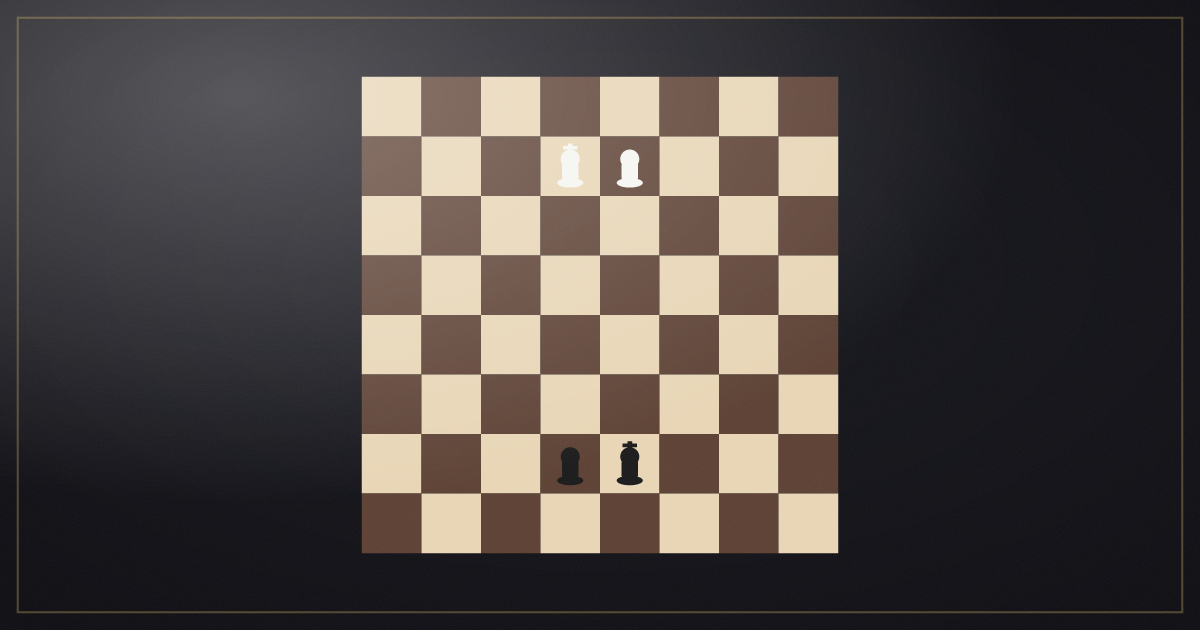
At amateur level, most chess games are won not by a deep plan but by a tactic a few moves long: one piece attacking two targets at once, or a piece that suddenly cannot move. Knowing four basic motifs helps you spot chances and stop falling into the same traps.
In short
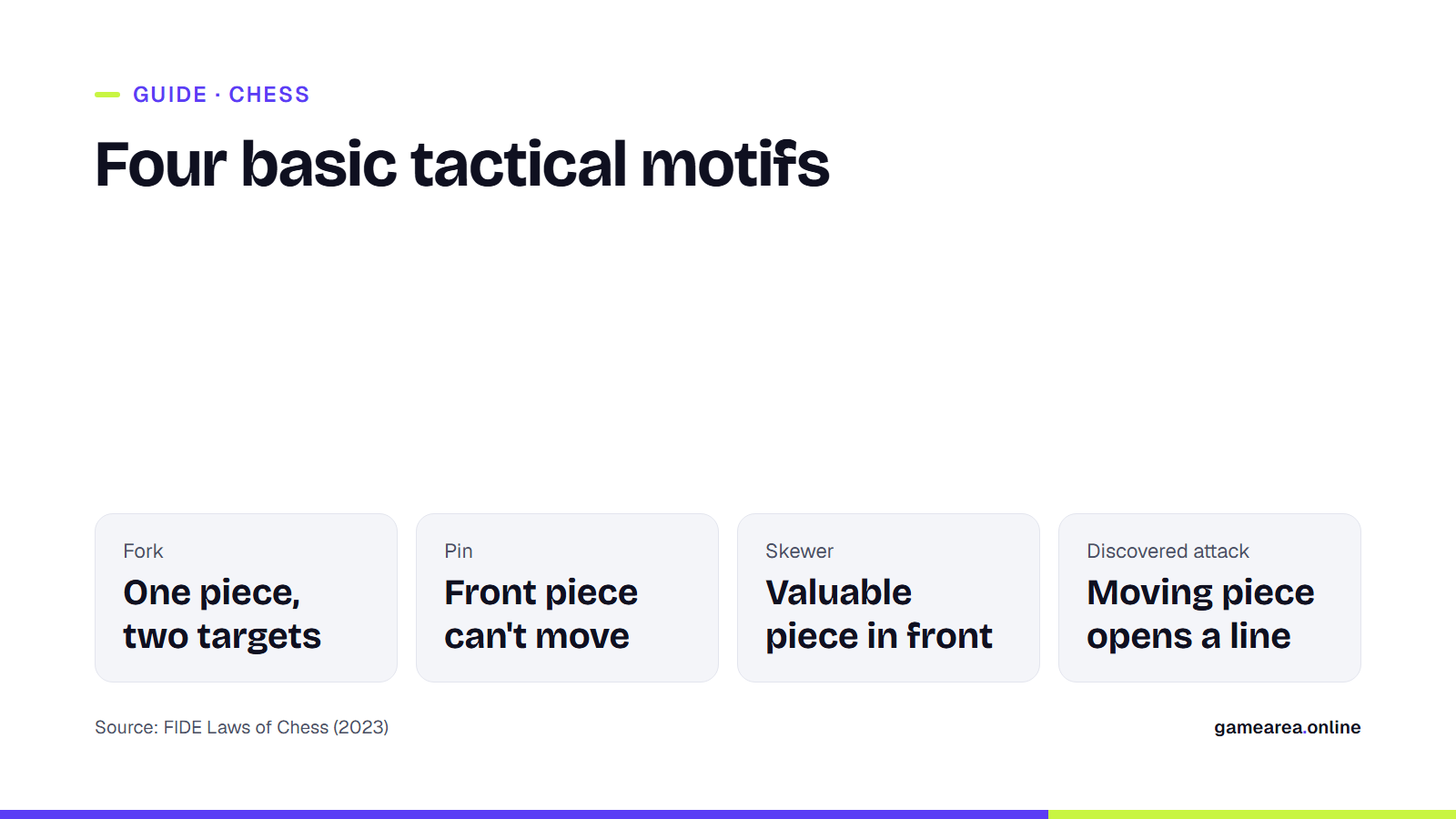
- Fork: One piece attacks two enemy pieces at once; the opponent can save only one.
- Pin: The front piece cannot move without exposing a more valuable piece behind it.
- Skewer: The reverse of a pin; the valuable piece is in front, and when it moves the one behind falls.
- Discovered attack: A piece moves away and opens the line of the piece behind it, creating two threats at once.
Why do tactics matter so much?
A tactic is a forcing sequence of moves that wins something concrete within a few moves: material, checkmate or a decisive advantage. Strategy is the longer-term plan for where your pieces belong. Between beginners and club players, tactics usually decide the result, because losing a knight or a bishop is a far bigger swing than the small edge a well-built pawn structure gives you.
The first step in seeing tactics is to ask three questions every move: Can my opponent give check? Is any piece left undefended? Are two pieces lined up on the same line? Every motif below grows out of one of those three weaknesses.
What is a fork, and which piece forks most often?
A fork is a single move in which one piece attacks two or more enemy pieces. Because the opponent gets only one move, one of them is usually lost. A fork that includes a check is even stronger, since the opponent must deal with the king first.
The knight is the classic forking piece: it moves in an L-shape and cannot be blocked, so the opponent often misses the incoming fork. The textbook example is a knight landing on a square that attacks both the enemy king and queen; in that case the queen is almost always lost. Pawn forks are common too: a single pawn can advance and hit two pieces on its diagonals, and since the pawn is the least valuable piece, the trade always favours you. The queen, moving both straight and diagonally, is the most dangerous forking piece against loose pieces.
Defence: Do not leave your king and queen a knight's jump apart from the same square, and do not leave undefended pieces a knight's move away from each other.
What is the difference between a pin and a skewer?
Both happen when a long-range piece (bishop, rook or queen) attacks two pieces standing on the same rank, file or diagonal. The difference is which piece is in front.
In a pin the front piece is less valuable. If the king is behind it, this is an absolute pin, and the front piece may not move at all: under the FIDE Laws of Chess, a player may not make a move that leaves their own king in check. If a valuable piece such as a queen or rook is behind it, the pin is relative; the front piece can move, but at the cost of losing the piece behind. A pinned piece is also a good target: since it cannot move away, attacking it with a pawn often wins material.
In a skewer the front piece is the more valuable one. For example, a rook catches the enemy king and a rook behind it on the same rank; the king has to step away and the rook behind is lost. This is why queens and rooks left on the same line as their king are so often lost in endgames.
Defence: Avoid keeping your king on the same diagonal or file as your queen or rook; when you are pinned, consider putting a cheap piece in between or attacking the pinning piece.
How do discovered attacks and discovered checks work?
In a discovered attack, a piece moves and opens the line of a bishop, rook or queen standing behind it. That creates two threats in one move: the threat made by the piece that moved, and the threat along the newly opened line. If the opened line hits the enemy king, it is a discovered check; while the opponent is busy saving the king, the moving piece can take whatever it attacked.
The strongest form is the double check: both the moving piece and the opened line give check at the same time. Blocking or capturing does not help against a double check, because there are two threats at once; the only answer is to move the king. That is why double checks so often lead straight to mate.
How can you get better at spotting tactics?
- Solve short puzzles every day: Short, regular practice fixes the patterns in your mind better than long, irregular sessions.
- Look at forcing moves first: Checks, captures and threats, in that order.
- Review your own games: Name the motif that cost you material; you are less likely to make the same mistake twice.
- Practise while you play: When you play online chess on GAMEAREA, make the three questions a habit before every move.
If you do not know the basic mates yet, our guide to basic checkmates shows how to turn the advantage a tactic wins into a finished game.
Frequently asked questions
Can a pinned piece move?
Not if the king is behind it; that would be an illegal move. If another piece is behind it, it can move, but it risks losing that piece.
Which piece forks most often?
The knight. It jumps over other pieces and its moves are hard to anticipate, so it is the first piece that comes to mind for forks.
How do you get out of a double check?
Only by moving the king. Blocking or capturing one attacker does not remove the other check.
How do I tell a skewer from a pin?
Look at the piece in front on the line of attack: if the less valuable piece is in front, it is a pin; if the more valuable piece is in front, it is a skewer.
Sources
- FIDE — FIDE Laws of Chess taking effect from 1 January 2023 Official source
- Wikipedia — Chess tactic
How this content was prepared
Prepared with AI assistance from the sources listed, key facts checked against official sources, not copied verbatim. Our AI principles
GAMEAREA Editörlüğü