Backgammon dice odds: how often is a blot hit, and when does a checker enter from the bar?
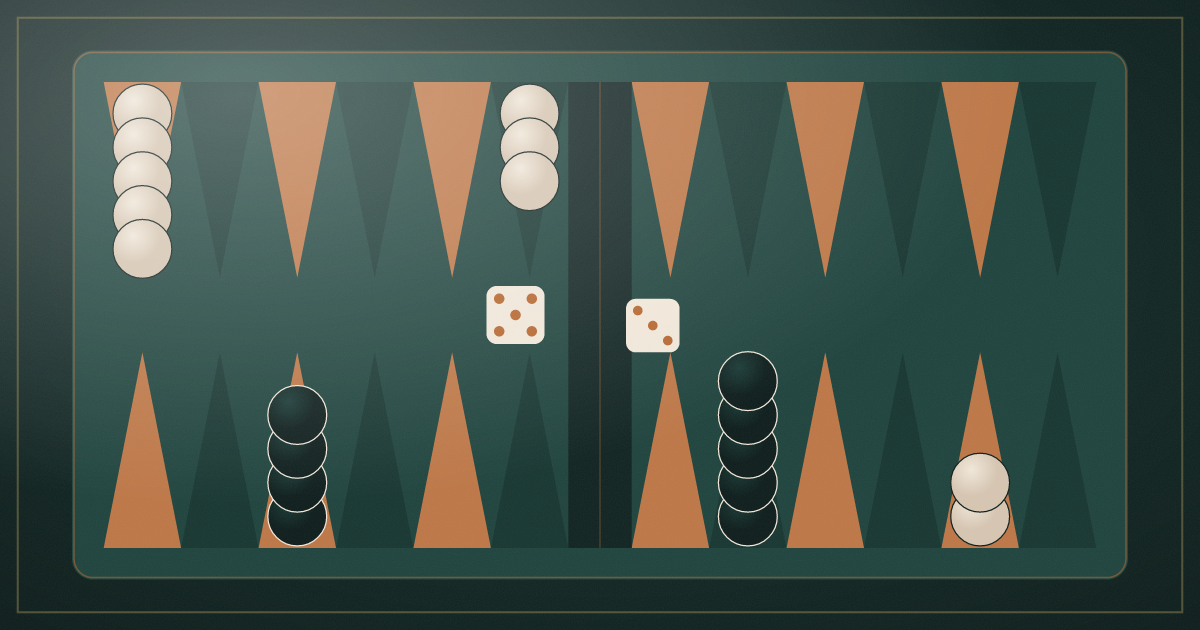
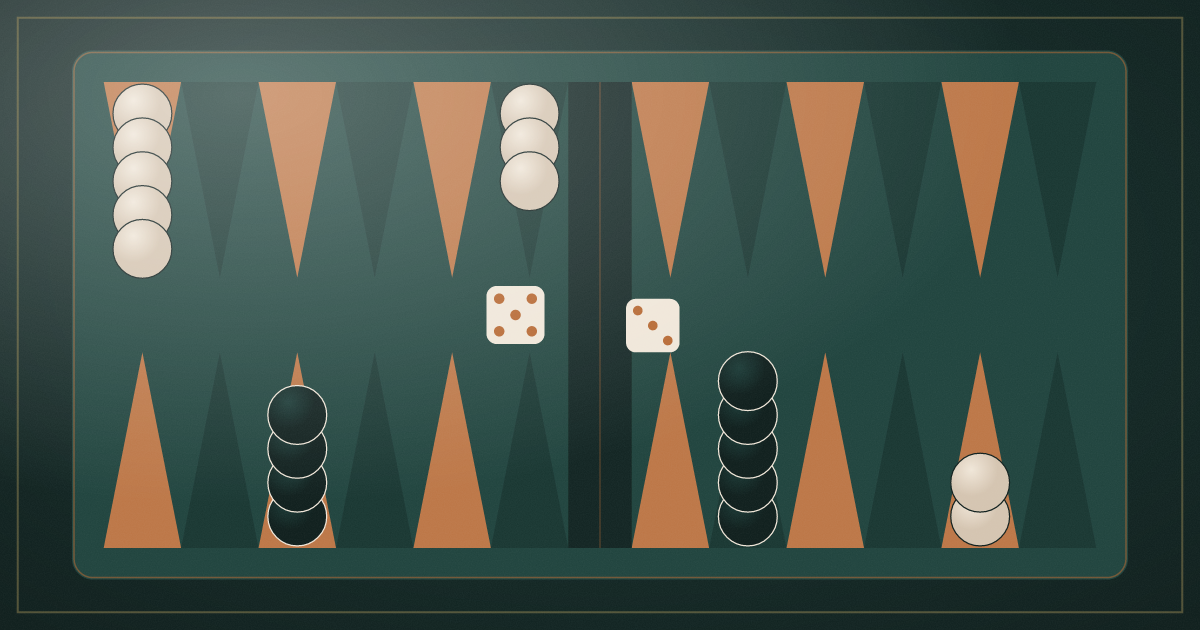
Every backgammon move is a risk calculation: the chance your blot is hit, the chance your opponent's checker enters from the bar, or the chance of rolling doubles. Knowing the 36 outcomes two dice can give lets you work these out at the table in seconds.
In short
- Two dice give 36 different outcomes; 6 of them are doubles, so the chance of doubles is one in six.
- The chance that a given number shows on at least one die is 11 in 36, about 31 percent.
- With nothing blocking the way, the most-hit distance is 6 (17 in 36); from 7 away and beyond, the chance falls quickly.
- A checker on the bar enters 11 times in 36 when your home board has just one open point, and 20 times in 36 with two open points.
How do you count the 36 dice combinations?
Each die gives six results, from 1 to 6, so two dice together make 6 × 6 = 36 outcomes. The key point is that 3-5 and 5-3 count as two different outcomes, because the two dice are distinct. A double such as 4-4, on the other hand, is a single outcome. So of the 36 outcomes, 30 are non-doubles (15 combinations, each in two orders) and 6 are doubles.
The chance of a number showing on at least one die follows from this: there are 5 × 5 = 25 outcomes where neither die shows it, which leaves 11. So when you say "I need a 6", your chance is 11 in 36. Because doubles are played four times, the average progress per roll works out to about 8.17 pips, which is the basis for estimating the race when you do a pip count.
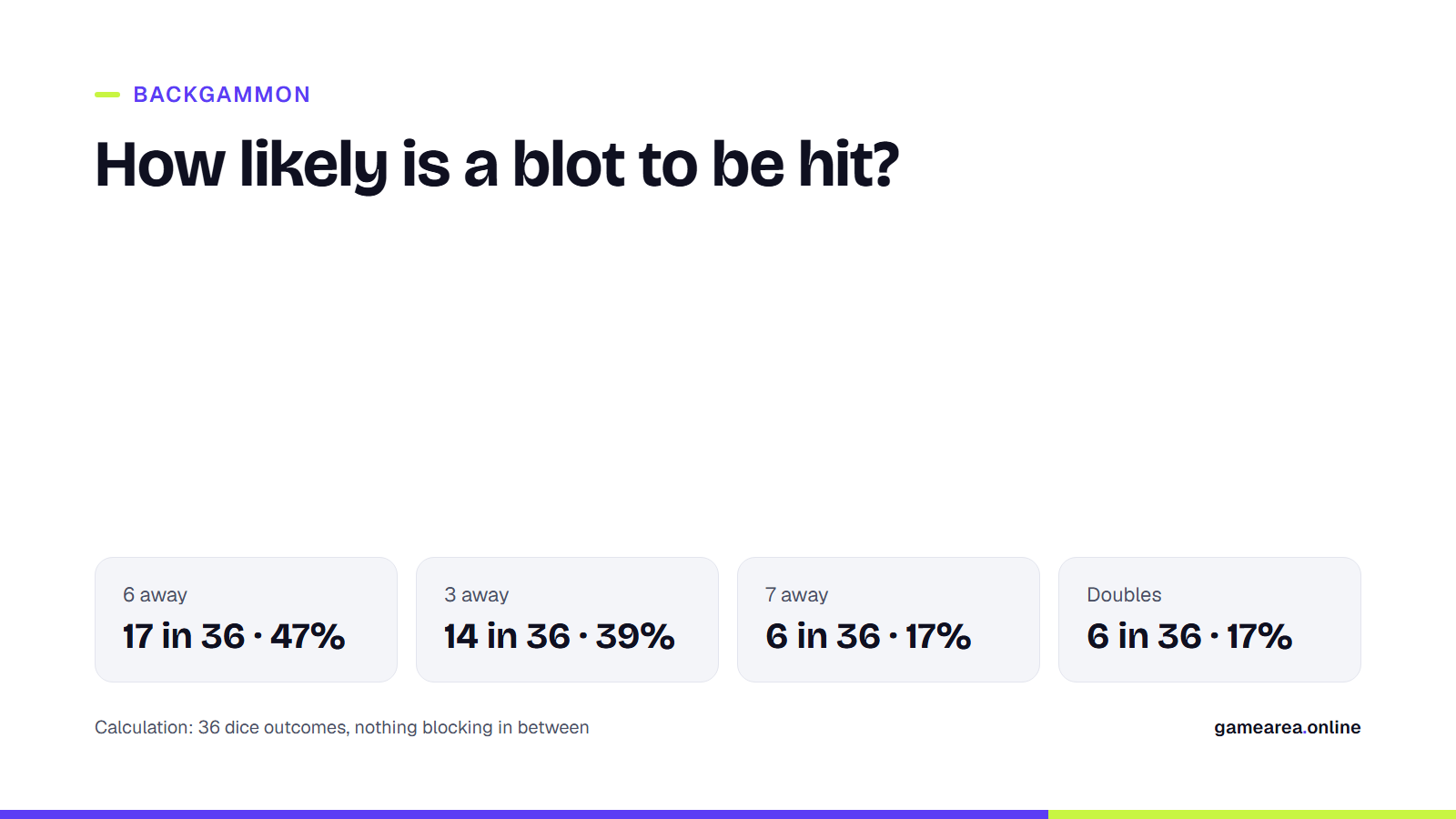
How likely is a blot to be hit?
When your opponent's checker is 6 or fewer points away from your blot, that is called a direct shot. At those distances a single die can reach your checker, and the sum of both dice and doubles open extra routes. Assuming nothing blocks the points in between, the numbers are as follows:
| Distance | Hitting rolls (out of 36) | Approximate chance |
|---|---|---|
| 1 | 11 | 31% |
| 2 | 12 | 33% |
| 3 | 14 | 39% |
| 4 | 15 | 42% |
| 5 | 15 | 42% |
| 6 | 17 | 47% |
| 7 | 6 | 17% |
| 8 | 6 | 17% |
| 9 | 5 | 14% |
| 10 | 3 | 8% |
| 11 | 2 | 6% |
| 12 | 3 | 8% |
| Calculation: a count of all 36 dice outcomes, assuming nothing blocks the points in between | ||
Two practical rules come out of the table. First, a blot at a distance of 6 or less is hit 31% to 47% of the time. Distance 6 is the riskiest, and the risk falls as the distance shrinks. Second, from 7 points away and beyond, the chance drops to about a third of what it is at 6; if you have to leave a blot, leaving it 7 or more away from the enemy checker is far safer than somewhere with the same risk.
If you have points made in between, the numbers go down. For example, an opponent trying to hit a blot 8 points away with 4-4 cannot use that route if the 4th point along is one of your made points. So making points does not only block your opponent; it directly reduces their hitting chances. For the details of point-making strategy, see our backgammon prime guide.
How likely is a checker to enter from the bar?
A hit checker goes to the bar, and that player cannot move any other checker until it enters on an open point in the opponent's home board. The chance of entering is the opposite of the chance that both dice show closed points. Here is the table by how many of the six points are open:
| Open points in home board | Entering rolls (out of 36) | Approximate |
|---|---|---|
| 1 | 11 | 31% |
| 2 | 20 | 56% |
| 3 | 27 | 75% |
| 4 | 32 | 89% |
| 5 | 35 | 97% |
| Calculation: 36 − (number of closed points)² | ||
This table shows what a hit is worth. When you have four points made in your own home board, a checker you hit there stays out 44% of the time each turn, and your opponent cannot move any other checker for as long as it does. With five points made, the wait is much longer.
How do you use these numbers at the table?
On every move, ask yourself two questions: how many of my checkers does this move leave exposed, and how many rolls does the opponent have to reach them? If you have to leave two different blots, remember to count rolls that reach both of them only once when you add up the hitting rolls. Also weigh how much you lose if you are hit: losing a checker close to your own home board costs fewer pips than losing one far away.
To try the numbers in practice, you can play against bots at the backgammon table on GAMEAREA.
Frequently asked questions
What is the chance of rolling doubles in backgammon?
6 of the 36 outcomes are doubles, so on every roll there is a one-in-six chance, about 17 percent.
What is the chance of rolling a specific number?
The chance of a number showing on at least one die is 11 in 36, about 31 percent.
How far from the opponent is it safer to leave a blot?
With nothing in the way, distances of 7 and beyond are hit much less than distances of 1 to 6; 6 is the riskiest distance.
How likely is a checker to enter on a single open point?
11 in 36, about 31 percent. With two open points the chance rises to 20 in 36.
How many pips does a roll move on average?
About 8.17 pips, counting doubles as played four times.
Sources
- GAMEAREA — Tavla Oyna — GAMEAREA Official source
- Vikipedi — Tavla
- Wikipedia — Backgammon
How this content was prepared
Prepared with AI assistance from the sources listed, key facts checked against official sources, not copied verbatim. Our AI principles
GAMEAREA Editörlüğü