Backgammon prime strategy: how to build a six-point block and when to let it go
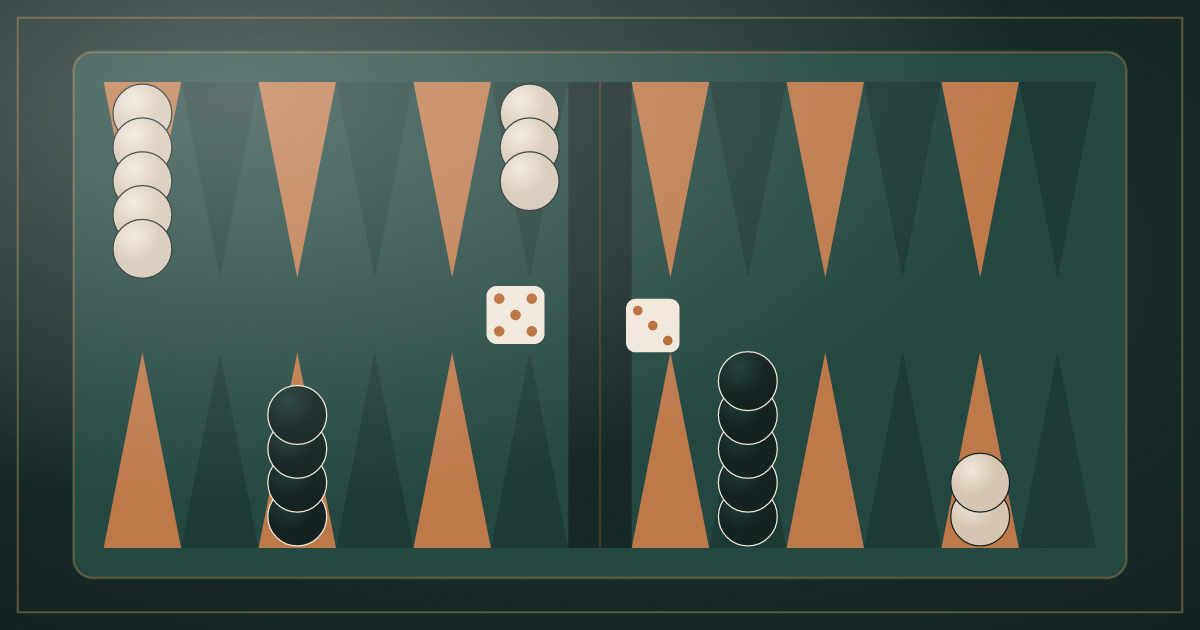
The strongest structure in backgammon is the prime: six consecutive made points that trap your opponent's back checkers. A full six-point prime cannot be jumped whatever the dice show, because a single die moves a checker at most six points. This guide covers which points a prime grows from, how much a four- or five-point block is worth, and when to let the prime go.
In short
- Two checkers make a point. Six consecutive made points form a full prime; a checker trapped behind it cannot escape until the prime breaks.
- Priority order: your 5-point, your bar point (7) and your 4-point. These three form the spine of the prime and cut off the opponent's escape numbers.
- Even a four- or five-point partial prime works: the fewer escape numbers remain, the lower the opponent's chance of getting out each turn.
- A prime cannot be held forever. When spare checkers run out you either roll the prime forward or hit and close the board; timing is the strategy itself.
What is a prime, and why six points?
If you have two or more checkers on a point, the opponent cannot land there; the point is "made". Consecutive made points form a prime. With six in a row the checker behind cannot pass on any roll: the highest single die is a six, so a six-point wall cannot be jumped. The US Backgammon Federation's beginner guide calls this the full prime for that reason.
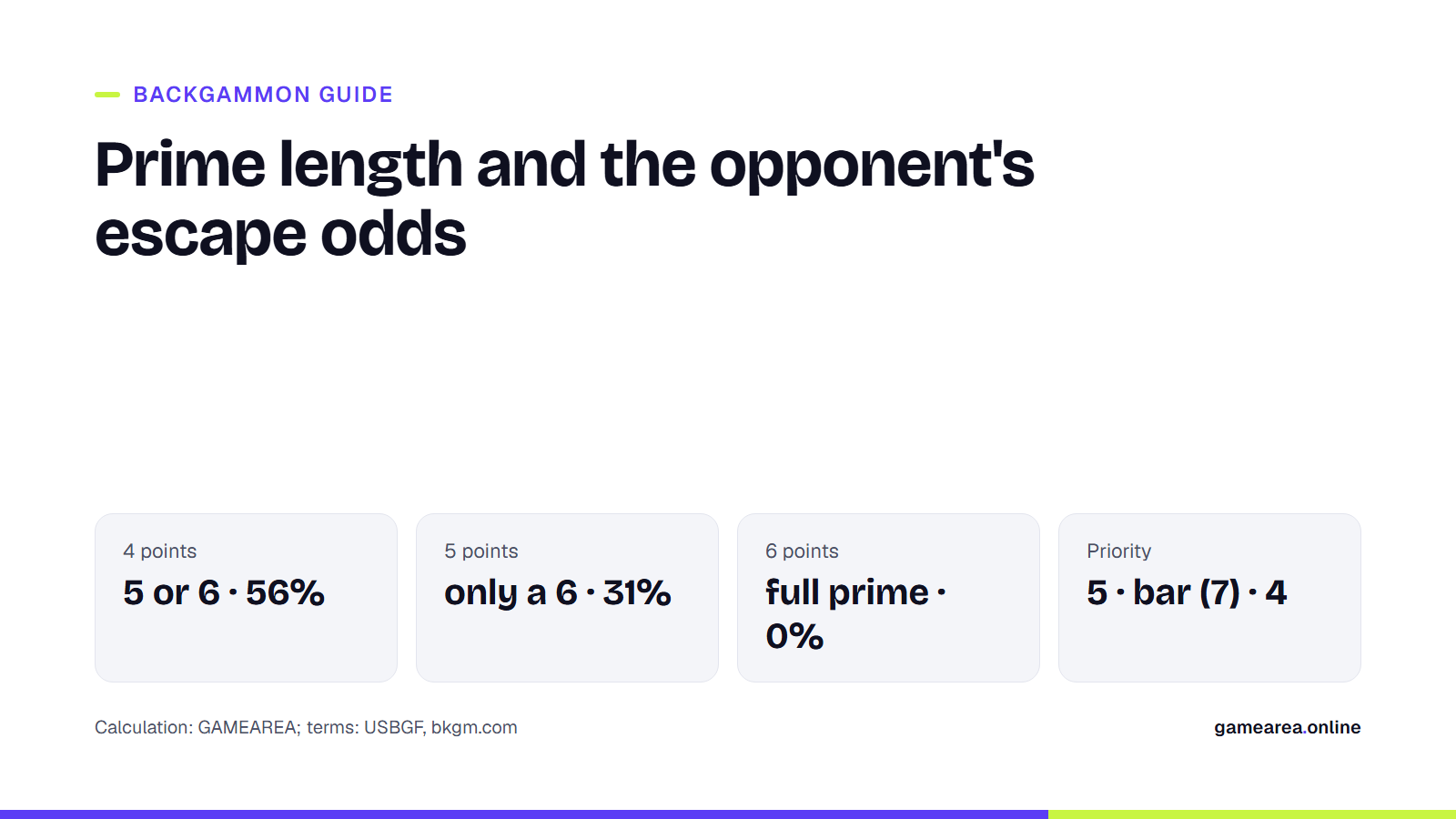
Shorter blocks matter too. A checker behind a four-point prime escapes only with a 5 or 6; behind a five-point prime only with a 6. The chance that at least one of two dice shows a 6 is 11 in 36, about 31 percent, so a five-point prime keeps the opponent locked in roughly two turns out of three. The full dice tables are in our dice odds guide.
Which points does a prime start from?
A prime's value depends not just on its length but on where it stands. The opponent's back checkers usually start on your 1-point, so the prime that traps them sits somewhere between your 2-point and 7-point. Three points stand out:
- The 5-point. It sits in the middle of the opponent's escape route and is the most valuable point in your home board. The "golden point" the opponent talks about is the same square from their side: if they anchor on your 5-point, your prime becomes very hard to build.
- The bar point (7). Named for sitting next to the bar. With the 7-point made, the opponent cannot escape from your 1-point with a 6, the most common escape number.
- The 4-point. Together with the 5 and 7 it nearly completes a four-point block; the 3- and 6-points are already made in most positions.
There are two ways to bring checkers to these points. The first is to place builders in your outer board: checkers on the 8-, 9-, 10- and 11-points bear directly on the target point. The second is slotting: leaving a single checker on the target point and covering it next turn. Slotting is risky, because the blot can be hit. If the opponent's back checkers are within direct range (six points), accumulating builders is safer than slotting.
From four points to a full prime
Most primes are not built in one move; they grow from a four-point block outward. The rule: extend the prime in front of the opponent's checker, not behind it. With the 4-5-6-7 points made, making the 8-point locks the checker further in, while making the 3-point only fills the home board and still lets a 6 escape. While the opponent's checker sits on your 1-point, investing in the 8-point pays more than dropping down to the 2-point.
Once the prime is complete, a second decision follows: hit or hold? If the opponent has a single checker behind a full prime, hitting it is often unnecessary; it cannot escape anyway, and a checker sent to the bar re-enters as long as your home board has an open point. If the opponent holds two checkers on one point, an anchor, there is nothing to hit; you hold the prime and wait for the rest of their position to crack.
When does a prime break, and how do you count timing?
A prime cannot be held indefinitely, because you must roll every turn. You do not want to move the prime's checkers, so you play the spares. When the spares run out, you either take checkers from the back of the prime and move them to the front, or break it. Backgammon literature calls this timing: which side is forced to concede first. Good timing means the opponent leaves a blot or breaks a key point before you do.
Practical rule: before you commit to a prime, have at least two and preferably three spare checkers in your outer board. If the opponent's other checkers are coming home quickly, your time is running short; then rolling the prime forward (taking the two checkers from the rearmost point and making the point in front) beats breaking it. The block survives and only shifts one point.
A prime's natural end is the closed board: all six home-board points made, so a checker on the bar cannot enter. That is when hitting the back checker becomes right; it waits on the bar while you bear off, and the chance of a gammon rises sharply.
What if the opponent builds the prime?
On the receiving end there are two defences. First, escape early: get your back checkers out with big rolls such as 6-5 or 6-6 before the block reaches four points, since only 6s rescue you once it reaches five. Second, anchor: keep two back checkers together on the opponent's 5- or 4-point. Two checkers cannot be hit, and they stop the opponent from making that point, so the prime stays incomplete. The anchor also gives you shots at blots the opponent leaves while clearing. Which opening rolls serve priming and anchoring is covered in our opening moves guide.
| Prime length | Opponent's escape numbers | Escape chance per turn |
|---|---|---|
| 4 points | 5 or 6 | 20/36 ≈ 56% |
| 5 points | only a 6 | 11/36 ≈ 31% |
| 6 points (full prime) | none | 0% |
| Calculation: GAMEAREA; assumes the opponent's checker sits directly behind the prime with an open landing point. Terms: USBGF beginner guide, bkgm.com glossary. | ||
You can practise priming against the bot in GAMEAREA Backgammon and then try it at the ranked tables.
Frequently asked questions
How long should a prime be?
Six consecutive points lock the opponent completely. Five points let them out only with a 6; even four points keep them stuck about half the time.
Which point should I make first?
Your 5-point, then the bar point (7) and the 4-point. These three are the spine of the prime.
Should I hit after completing a full prime?
No hurry while the prime is full; the checker cannot escape. Hitting becomes right once your home board is closed, because the checker on the bar cannot enter and the gammon chance rises.
What do I do if my opponent is priming me?
Escape with big rolls before the block passes four points, or anchor two back checkers on the opponent's 5- or 4-point; two checkers cannot be hit and keep the prime incomplete.
Sources
- US Backgammon Federation — Beginner's Guide to Backgammon Official source
- Backgammon Galore (bkgm.com) — Backgammon Glossary
- GAMEAREA — Tavla Oyna — Çevrimiçi Tavla Official source
How this content was prepared
Prepared with AI assistance from the sources listed, key facts checked against official sources, not copied verbatim. Our AI principles
GAMEAREA Editörlüğü