Atari, ladders and nets in Go: the basic techniques for capturing stones
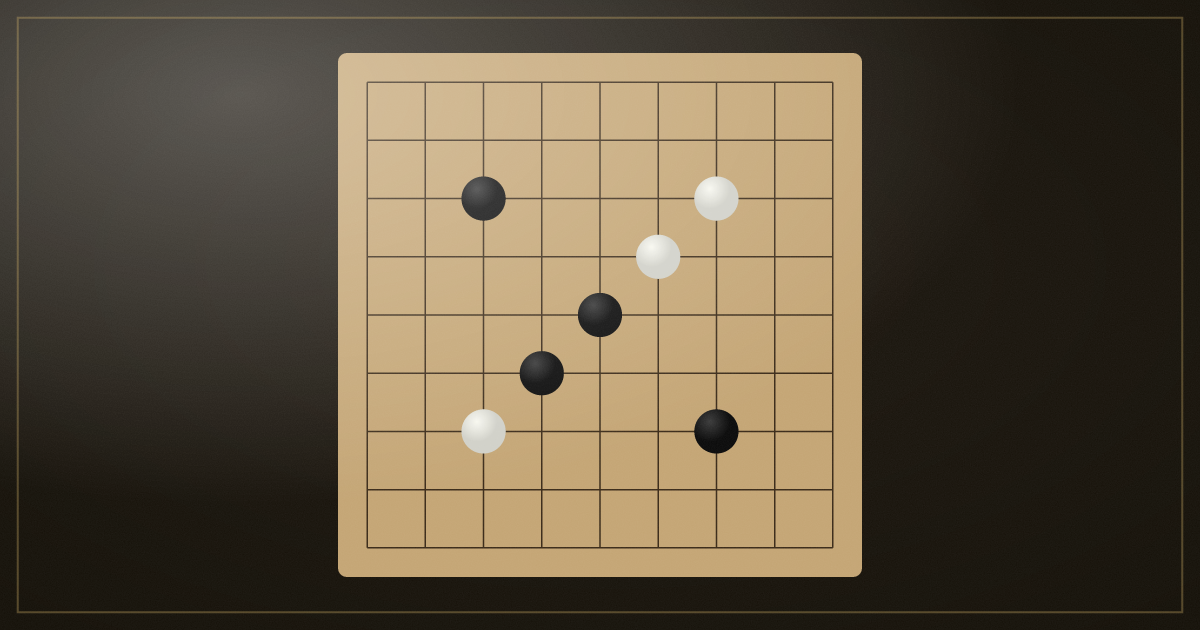
In Go, a stone or a group of stones is removed from the board when all the empty points around it, its liberties, have been filled by enemy stones. Knowing the capturing techniques lets you take your opponent's stones and also keep your own out of the same traps.
In short
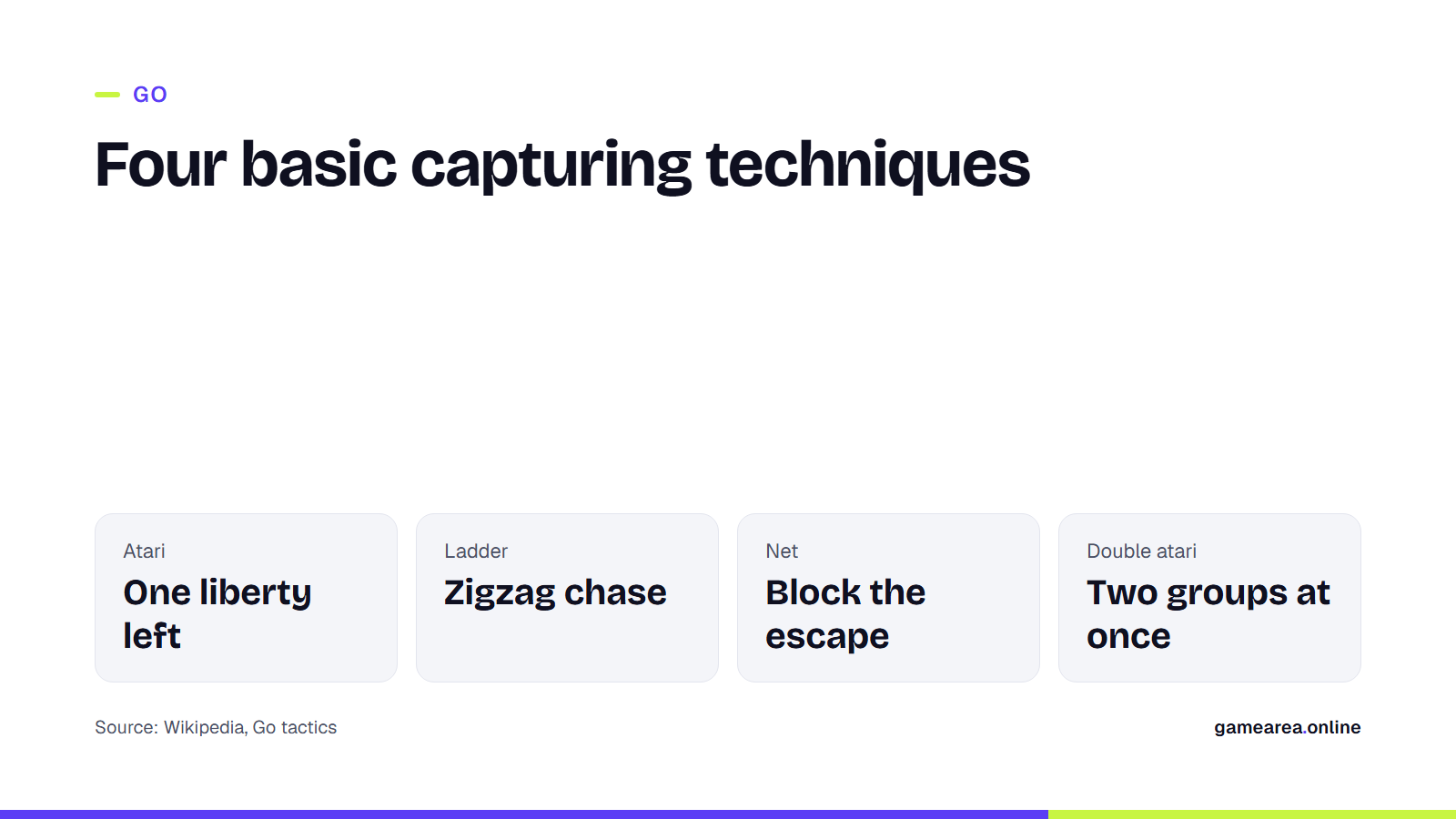
- Atari is when a stone or group has only one liberty left; your opponent can capture it on the next move.
- A ladder chases a stone in atari across the board in a zigzag all the way to the edge; if the fleeing side has a stone along the way, the ladder fails.
- A net is a move that seals off the escape route instead of chasing the stone directly; you use it when a ladder does not work.
- Double atari puts two groups in atari at once; your opponent cannot save both.
What does atari mean in Go?
Every stone on the board has as many liberties as there are empty points directly next to it horizontally and vertically. A single stone in the middle of the board has four liberties, a stone on the edge has three and a stone in the corner has two. Stones that are connected side by side behave as a single group that shares its liberties. When a stone or group has only one liberty left, it is said to be in atari.
Atari threatens to capture on the next move. The side in atari usually has two options: extend the group toward its last liberty to gain new liberties, or balance the threat with a counter-threat somewhere else. Not every atari is right; an atari that lets your opponent extend and grow stronger often just fixes their shape for them.
How does a ladder work?
In a ladder, the stone in atari tries to escape by extending, but after each extension it still has only two liberties. The attacker puts it back in atari with every move. The chase traces a diagonal zigzag across the board, and when the fleeing group reaches the edge it runs out of liberties and the whole group is captured at once. Because most of the moves are forced, you can read out the result of a ladder in advance.
Whether a ladder works depends on whether the fleeing side has a stone on the zigzag path or right next to it. If it does, the fleeing group connects to that stone, gains liberties and the ladder breaks. The attacker is then left with a weak shape full of cutting points. That is why you need to check the path from start to finish before you start a ladder.
What is a ladder breaker?
A ladder breaker is a stone placed on the path of a ladder so that the fleeing group can connect to it. Strong players usually play a ladder breaker together with another threat: the same move breaks the ladder and does useful work elsewhere on the board. While the opponent answers one of the two threats, the other one comes true. On a 9×9 board distances are short, so ladders resolve quickly and breaker stones come into play far more often.
What is a net, and when should you use one instead of a ladder?
A net (geta in Japanese) is a move that seals off the escape route from one point away instead of putting the stone in atari directly. Whichever way the fleeing stone extends, it runs into the attacker's stones and is captured. The net's biggest advantage is that ladder breakers do not affect it; a net works even if there is an enemy stone on the ladder's path.
That gives a practical rule: if you can capture a stone with either a ladder or a net, capturing it with a net is usually safer. The only condition for a net is that you really can block the points on the escape route; if your opponent can counter-attack from inside the net with an atari of their own, you have to read the net carefully as well.
What are double atari and snapback?
Double atari means putting two separate enemy groups in atari with a single move. Your opponent can save only one of them, and the other is captured. Shapes that leave cutting points are vulnerable to double atari, which is why it pays to secure your connections in time.
Snapback means sacrificing a stone to capture a larger enemy group. When your opponent takes the sacrificed stone, their own group is left with one liberty and is captured straight back. Think about these techniques together with the shapes in our guide to two eyes and life and death, which covers keeping your groups alive; shape mistakes in the opening also often open the door to these captures. Take a look at our 9×9 opening guide and try out what you have learned in the Go game.
Frequently asked questions
What should I do when I am in atari?
First check whether the group is worth saving. If extending gains new liberties, extend; if extending only runs into a ladder, it is usually better to give up the stone and play elsewhere.
How can I tell whether a ladder works?
Follow the zigzag path all the way to the edge. If the fleeing side has a stone on the path or right next to it, the ladder breaks and you should not attack.
Is a net or a ladder better?
If both work, a net is usually safer, because ladder breakers do not affect it.
Do these techniques change on a 9×9 board?
The rules are the same. Because the board is small, ladders are shorter, the edges are closer and every capture has a more direct effect on the result of the game.
Sources
- GAMEAREA — Go Oyna — GAMEAREA Official source
- Wikipedia — Ladder (Go)
- Wikipedia — Go tactics
How this content was prepared
Prepared with AI assistance from the sources listed, key facts checked against official sources, not copied verbatim. Our AI principles
GAMEAREA Editörlüğü