Batak bidding strategy: how many tricks to bid, and when to pass
In Batak, the hand is often won or lost during the auction, before a single card is played. This guide uses the numbers to show how many tricks to bid with your 13 cards, why the scoring rewards a conservative bid, and when passing is the right call.
In short
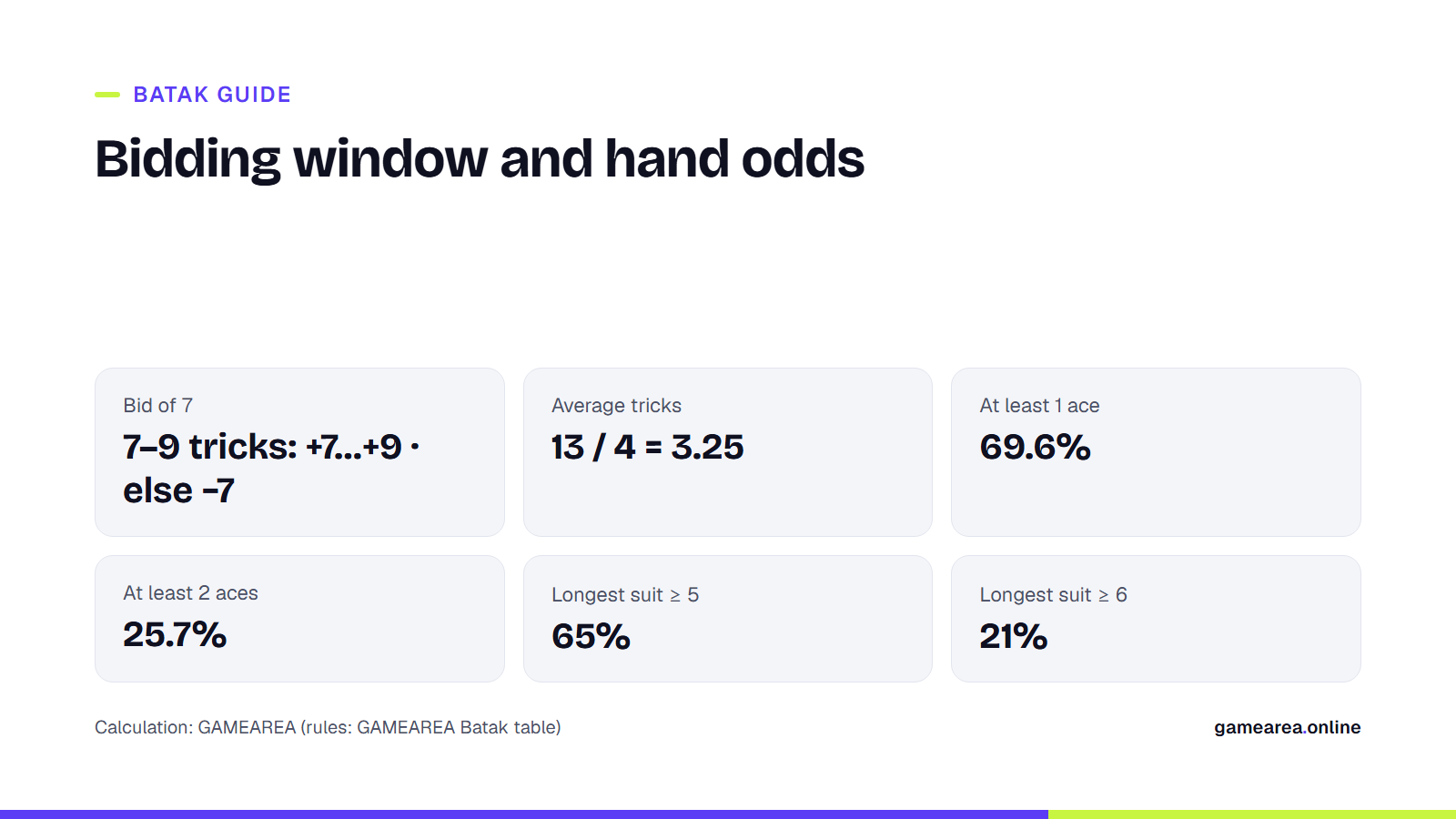
- With four players sharing 13 tricks, the average player takes 3.25; since the minimum bid is 4, bidding at all takes an above-average hand.
- If the declarer takes between their bid and two more, they score the tricks they took; fall short, or take 3 or more extra, and they lose points equal to the bid.
- Because of this three-trick window, bidding the low end of your estimate is usually the safest choice.
- On defense, your first goal is to take at least one trick: a player who takes none also loses points equal to the bid.
How does the scoring shape your bid?
At the GAMEAREA Batak table, bids run from 4 to 13, and the highest bidder chooses trump and leads the first card. The declarer's score depends on a window: a player who bids 7 and takes 7, 8 or 9 tricks scores the number of tricks taken. Take 6 or take 10, and they lose 7 points. The other three players score one point per trick; a player who takes no tricks loses points equal to the bid. The match ends at 52 points. For the full rules, see our guide on how to play Batak.
This structure tells you two things. First, a higher bid earns more points, but missing it costs just as much. Second, you don't need to hit your trick count exactly; you only need to land inside a three-trick range. So if your estimate is "somewhere between 6 and 8," bidding 6 means all three outcomes score.
How do you count your hand?
Each player is dealt 13 cards, and each suit has 13 cards. In a random deal, the chance of holding at least one ace is about 70%, and at least two aces about 26%. The chance that your longest suit has at least 5 cards is 65%, at least 6 cards 21%, and at least 7 cards about 4%. In other words, a trump suit of six or more cards is a genuinely strong starting point for a bid.
A rough count works well for sizing up a hand. It isn't a rule, just a starting point for deciding quickly:
- Aces: Each ace is usually worth one trick.
- King with the ace: With the ace and king of the same suit, you can expect two tricks from that suit. A lone king without the ace to protect it is uncertain.
- Trump length: Since you choose trump, your longest suit is the natural candidate. Every card beyond the fourth in that suit has a chance of earning an extra trick once your opponents run out of trumps.
- Short suits: A side suit where you hold no cards or just one gives you a chance to trump in when that suit is led.
For example, a hand with the ace, king, queen, 10, 7 and 4 of spades (six cards), the ace of hearts and the ace-king of diamonds counts roughly like this: 2 tricks from the spade ace-king and 2 from length; 1 from the heart ace; 2 from the diamond ace-king. The rough count comes to 7, but since you don't know how the cards are distributed, a cautious estimate is 6 to 8 tricks. Bidding 6 with this hand turns 6, 7 and 8 tricks into points.
When should you raise, and when should you pass?
As the bidding climbs, the question changes: instead of "Can I win this hand?" ask "Can I take this many tricks without falling below the number bid?" If the low end of your estimate isn't above the current bid, passing is often right. An opponent settling into a high bid is an opportunity for you, too: on defense you score your own tricks while trying to keep the declarer below their bid.
Bidding 13 ends the auction immediately and requires you to take every trick; at 13 the window closes as well. It's an option only for near-perfect hands. If all four players pass, the cards are redealt, so you never have to force a bid with a weak hand.
What should you focus on as a defender?
For the three defenders, the priorities are simple. First, take at least one trick, because zero tricks means a penalty equal to the bid. Then try to keep the declarer below their bid: if the declarer bid 8 and you can hold them to 6, they lose 8 points. Sometimes the opposite works too; pushing the declarer to 3 tricks over their bid also triggers the penalty, but it's hard to plan. The techniques in our Batak card counting guide for tracking the trump suit work on defense as well.
Frequently asked questions
What is the minimum bid in Batak?
At the GAMEAREA table, the minimum bid is 4 and the maximum is 13. You can't bid 1, 2 or 3.
Is it a penalty to take more tricks than you bid?
Not up to two extra; you score the tricks you took. If you take 3 or more tricks over your bid, you lose points equal to the bid.
What happens if I take no tricks?
If you aren't the declarer and you took no tricks, you lose points equal to that hand's bid.
How many tricks should I bid?
Count your hand by aces, ace-kings and trump length, then bid the low end of the range you get. That way, three different outcomes all score.
Sources
- GAMEAREA — Batak Oyna Official source
- GAMEAREA — Batak Nasıl Oynanır: İhale, Koz ve Puanlama Official source
- Pagat.com — Card games in Turkey
How this content was prepared
Prepared with AI assistance from the sources listed, key facts checked against official sources, not copied verbatim. Our AI principles
GAMEAREA Editörlüğü