Card counting in Batak: When are trumps gone, and when does your ace get trumped?
Winning the bid in Batak, the Turkish trick-taking card game, is only half the job; to make the number of tricks you bid, you need to estimate how the trumps and side suits are split among your opponents. In this article we calculated those distributions exactly and explain which cards you need to count at the table.
In short
- Each suit has 13 cards. Take away the ones in your hand, and the rest are spread across the 39 unseen cards, that is, among your three opponents.
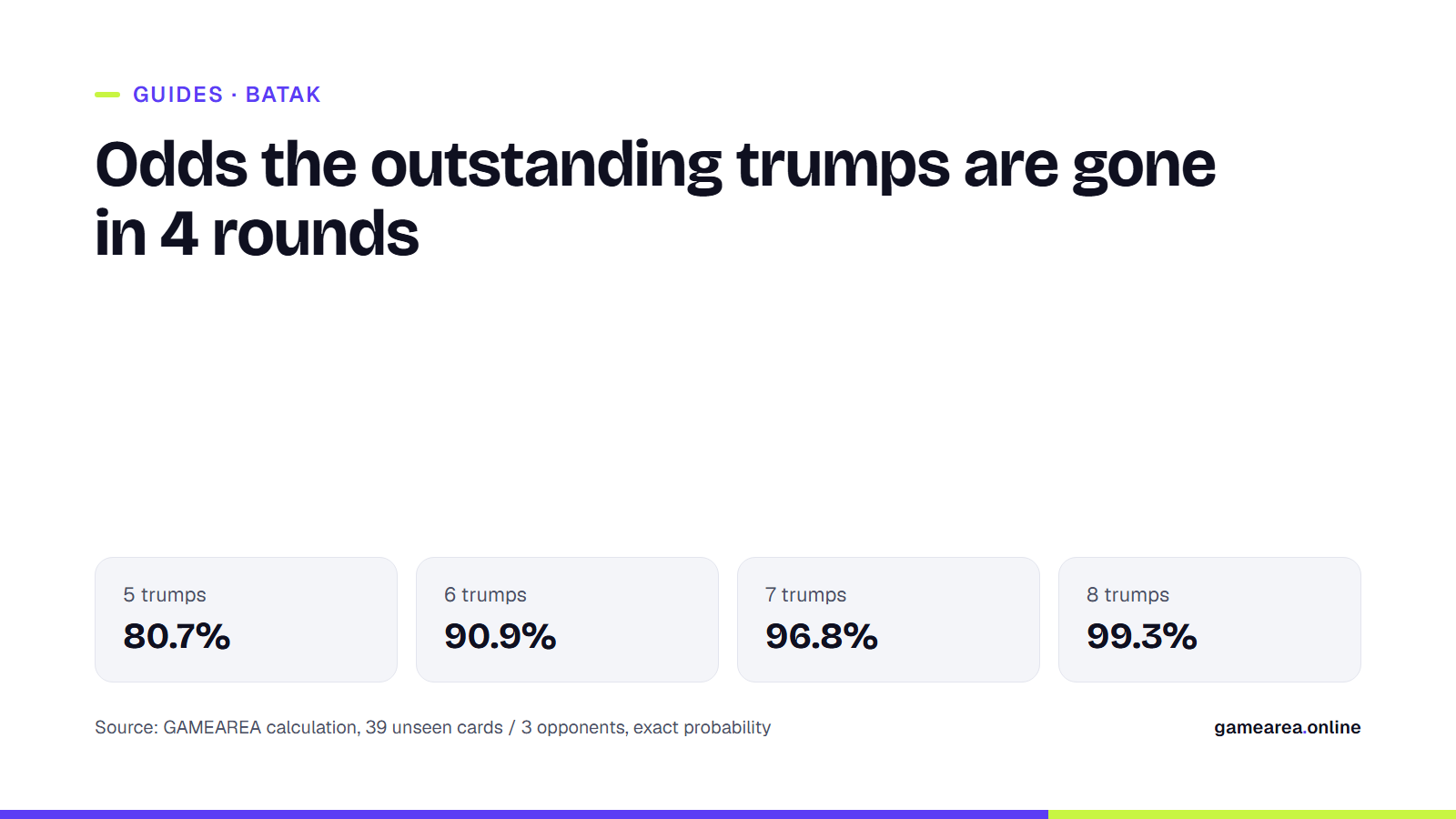
- Playing with 6 trumps, the chance that the 7 outstanding trumps are gone within 4 rounds is about 91%. With 5 trumps it drops to 81%.
- In a side suit, your ace is very likely to win on the first round. A king on the second round, however, carries real risk depending on how many cards of that suit you hold.
- Batak's mandatory overtaking rule hands you free information about your opponents' hands. Reading it is the easiest part of card counting.
Why does card counting help in Batak?
Batak is played by four people with a 52-card deck, and everyone gets 13 cards. The 39 cards not in your hand are dealt among three opponents. Unlike bridge, you have no partner here; every card outside your hand is in an opponent's hand. That is why the calculation covers three hands, not two.
The point of counting cards is not memorization but answering two questions: How many trumps are still out, and who might hold them? Will my next high card win, or will someone who is out of that suit trump it? At GAMEAREA's Batak table, bids range from 4 to 13; if you take between the number you bid and two more, you score, and if you fall outside that range, you go down (you are set). Because taking too few and too many tricks bring the same penalty, judging correctly when to draw trumps translates directly into points. For the full rules, see our Batak rules guide.
How are the outstanding trumps split, depending on how many you hold?
The table below shows, once you have chosen trumps, the most common way the remaining trumps are split among your three opponents and how many rounds it takes to collect them. A "trump round" is a trick led with a trump in which everyone has to follow with a trump. Once the opponent holding the most trumps runs out, there are no trumps left outside your hand.
| Trumps in hand | Outstanding | Most likely split | Gone in 3 rounds | Gone in 4 rounds |
|---|---|---|---|---|
| 4 | 9 | 4-3-2 (45.2%) | 11.0% | 65.6% |
| 5 | 8 | 3-3-2 (31.1%) | 31.1% | 80.7% |
| 6 | 7 | 3-2-2 (33.9%) | 54.7% | 90.9% |
| 7 | 6 | 3-2-1 (53.3%) | 75.4% | 96.8% |
| 8 | 5 | 2-2-1 (41.2%) | 89.6% | 99.3% |
| Source: GAMEAREA calculation. Exact (hypergeometric) probabilities over every possible deal of the 39 unseen cards, 13 to each of the three opponents. | ||||
The practical takeaway: if you play with 5 trumps, clearing trumps usually takes 4 rounds and leaves you with 1 trump. You have almost no trumps left to protect your side suits from being trumped. With 6 trumps the picture improves noticeably; with 7 or more, trumps are usually gone in 3 rounds and you have trumps to spare. This is the numerical case for choosing trumps by suit length rather than because of a single ace.
A caveat: these odds are estimates for the moment play begins. What each player says during bidding also carries information. For example, an opponent who bids 7 probably holds a long suit. As the game goes on, every card you see lets you update this estimate.
What are the odds your ace or king gets trumped in a side suit?
If you hold an ace or king in a suit other than trumps, the real question is: Will all three opponents have a card of that suit on that round? An opponent who is out of the suit has to play a trump, which means your high card gets trumped.
| Your cards in the suit | Round 1: everyone follows suit | Round 2: everyone follows suit |
|---|---|---|
| 1 card | 99.3% | 91.6% |
| 2 cards | 98.6% | 86.3% |
| 3 cards | 97.5% | 78.4% |
| 4 cards | 95.6% | 67.3% |
| 5 cards | 92.4% | 52.3% |
| Source: GAMEAREA calculation; assumes the opponents hold trumps and must play one once they are out of the suit. | ||
So your ace will most likely win on the first round, however many cards you hold in the suit. The second round is different: in a five-card suit, your king has a fifty-fifty chance of winning on the second round. That is why playing the high cards of a long side suit before the opponents' trumps are gone is risky. Drawing trumps first and then opening the long suit is usually safer.
What does the mandatory overtaking rule tell you about an opponent's hand?
In Batak on GAMEAREA you must follow the suit led. If the card currently winning the trick is of the suit led and you hold a higher card, you must play the higher one. If you are out of the suit, you must play a trump, and if a trump is already winning, you must overtake it with a higher trump. These rules leak information on every trick:
- If an opponent played a low card of the suit led, they have no card in that suit higher than the highest card on the table. For example, a player who plays a low heart while the king of hearts is winning does not hold the ace of hearts.
- If an opponent did not follow suit and played a trump, they are out of that suit. Expect them to trump later rounds of that suit as well.
- If an opponent did not follow suit and discarded a card of another suit, they have no cards left in that suit or in trumps. This is the most valuable information for counting trumps.
- If an opponent did not overtake with a trump, all of their trumps are lower than the trump on the table.
You don't need to memorize every card to make these four observations. Just keep track of the number of trumps (counting down from 13) and which opponent has run out of which suit.
How do you count cards at the table in practice?
- As soon as you choose trumps, work out how many trumps are outstanding: 13 minus the trumps in your hand.
- Every time a trump falls, reduce that number by one. On rounds you lead with a trump, watch who does not play a trump; that player is out of trumps.
- In side suits, track only the aces and kings and who has run out of the suit. The order of the low cards rarely matters.
- Don't forget the bid window. Once you have reached the number you bid, you are safe for up to two more tricks. A third extra trick means going down, so in the last tricks you may need to hold back your trump on purpose.
Frequently asked questions
How many trumps do you need to bid in Batak?
There is no hard limit, but the calculations show that 6 or more trumps give a clear advantage. With 5 trumps, clearing trumps usually takes 4 rounds and leaves you with no trumps for protection.
If I hold 6 trumps, how are the outstanding ones split?
The 7 outstanding trumps are most often split 3-2-2 (about 34%) or 4-2-1 (about 28%). The chance that the trumps are gone within 4 rounds is about 91%.
If an opponent played a low card, does that mean they have no high card?
Yes, if the card winning the trick is of the suit led. The rule forces a player holding a higher card to play it. But if someone has trumped the trick, the opponent can play any card of the suit led.
Do these odds change during bidding?
Yes. The tables apply when you have no information. Every bid and every card played changes your estimate of the opponents' hands.
Sources
- GAMEAREA — Play Batak Online — Turkish Bidding Trick-Taking Card Game Official source
- GAMEAREA — Batak Online: Bidding, Trump, Scoring Official source
- Pagat.com — Card games in Turkey
How this content was prepared
Prepared with AI assistance from the sources listed, key facts checked against official sources, not copied verbatim. Our AI principles
GAMEAREA Editörlüğü