Chess opening principles: how to build the center, development and castling in 10 moves
Many beginners think the opening means memorising long move sequences, yet most of the first ten moves can be played with a few simple principles. Controlling the center, bringing pieces into play quickly and getting your king safe will carry you into the middlegame with a sound position, whichever opening you choose.
In short
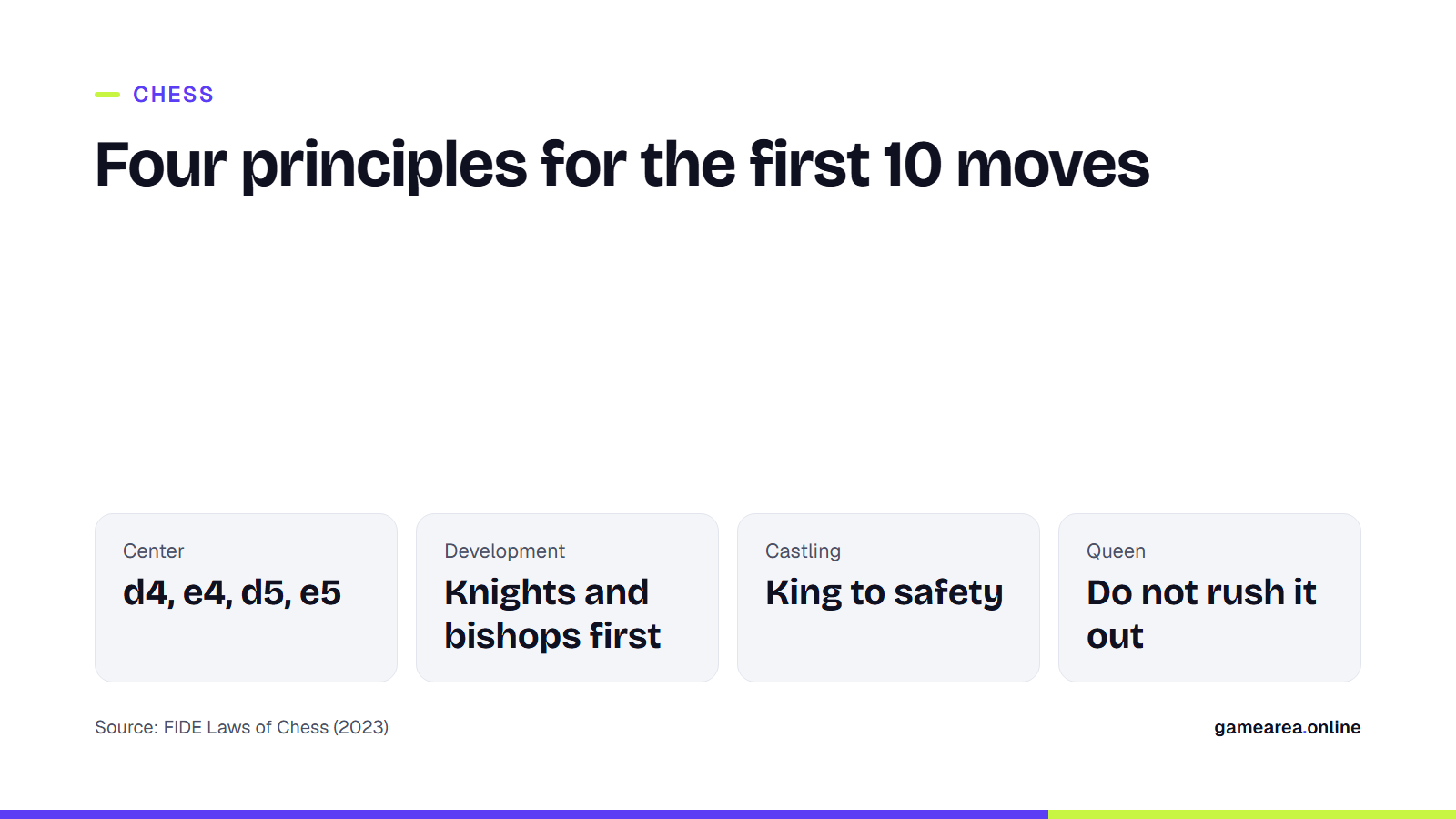
- The center squares (d4, e4, d5, e5) are where pieces influence the most squares; control them with pawns and pieces.
- Develop a new piece with every move; playing the same piece twice in the opening wastes time.
- Castling is the one move that tucks the king into the corner and brings a rook toward the center; under FIDE rules it is not allowed if the king or that rook has already moved.
- Bringing the queen out early lets your opponent develop with tempo by attacking it.
Why does the center matter so much?
The four squares in the middle of the board are where pieces can reach the most squares. A knight in the center can cover up to eight squares, while a knight in the corner reaches only two. That is why pawn moves such as e4 or d4 in the opening both hold the center and open the diagonals for your bishop and queen. You do not have to occupy the center with pawns; putting pressure on central squares with knights and bishops serves the same purpose.
If your opponent is trying to take the center, you need to meet it head on or pressure their pawns. A player who gives up the center completely finds no room to develop and ends up pushed onto the defensive.
In what order should you develop your pieces?
The general rule is to bring out the minor pieces (knights and bishops) before the major pieces (queen and rooks). Knights often come out before bishops, because their most natural squares (f3 and c3 for White, f6 and c6 for Black) are usually clear. Bishops find their best diagonals as the pawn structure becomes clearer.
Every move should bring a new piece into the game. Moving the same piece a second time in the opening should have a concrete reason, such as saving an attacked piece or winning something decisive. If your opponent has developed three pieces and you have one in play, you will be outnumbered in the first clash.
| Principle | Why | Common mistake |
|---|---|---|
| Control the center | Pieces have the widest reach | Moving the a- and h-pawns early |
| Develop minor pieces | Pieces are ready for the fight | Moving the same piece again and again |
| Castle early | King is safe, rooks get connected | Leaving the king in the center |
| Bring the queen out late | Gives the opponent no tempo | Attacking with the queen alone |
| Rules: FIDE Laws of Chess (2023); principles: established opening theory | ||
When should you castle, and what are the rules?
Castling is the special move in which the king and a rook change places in a single move. Under the FIDE Laws of Chess, the king moves two squares towards its rook and the rook lands on the square the king crossed. Once the king or the rook you would castle with has moved, the right to castle is lost permanently. Castling is not possible at that moment if the king's square, the square it passes over or the square it lands on is attacked by the opponent, or if there are pieces between the king and the rook.
In practice you castle once your knight and bishop development is done, in most openings within the first eight to ten moves. Castling kingside is quicker, since only two pieces stand in between. Castling queenside takes more preparation but brings the rook straight onto the d-file. A second benefit of castling is that your two rooks end up protecting each other, which is called connecting the rooks.
What are the most common opening mistakes?
Bringing the queen out early is the most common mistake. Because the queen is valuable, your opponent attacks it, developing pieces with tempo while you spend moves running away with it. The second mistake is wasting time with edge pawns; the a- and h-pawns do not influence the center. The third is leaving the king in the center: once the center opens, a king on the e-file becomes a direct target for the opponent's rooks and queen. Finally, playing the f-pawn early weakens the diagonal in front of the king, and the shortest checkmate, Fool's Mate (1.f3 e5 2.g4 Qh4#), comes from exactly this weakness.
These principles do not fully replace memorised openings, but they tell you what to do once your memorised lines run out. To learn the tactics that decide the game after the opening, see our chess tactics guide, and you can try the principles out against bots by playing chess on GAMEAREA.
Frequently asked questions
Which opening should I start chess with?
Starting with e4 or d4 as White is a good choice because it takes the center and opens lines for your pieces. Playing by the principles matters more than the name of the opening.
Is castling compulsory?
No, but leaving the king in the center is dangerous in most positions. Castling secures the king and brings a rook into the game in a single move.
Can you castle while the king is under threat?
No. Under FIDE rules, you cannot castle if the king's square, the square it passes over or the square it lands on is under attack.
Why shouldn't you bring the queen out early?
Your opponent develops their own pieces with moves that chase the queen. While you spend moves saving it, they get ahead in development.
Do I need to memorise openings?
Not at the start. The principles of the center, development and king safety are enough to play most of the first ten moves correctly; memorisation becomes more valuable as you improve.
Sources
- FIDE — FIDE Laws of Chess taking effect from 1 January 2023 Official source
- GAMEAREA — Satranç Oyna — GAMEAREA Official source
- Vikipedi — Satranç açılışları
How this content was prepared
Prepared with AI assistance from the sources listed, key facts checked against official sources, not copied verbatim. Our AI principles
GAMEAREA Editörlüğü