Okey 101 strategy: when to open, how to lay off, and when to take the discard
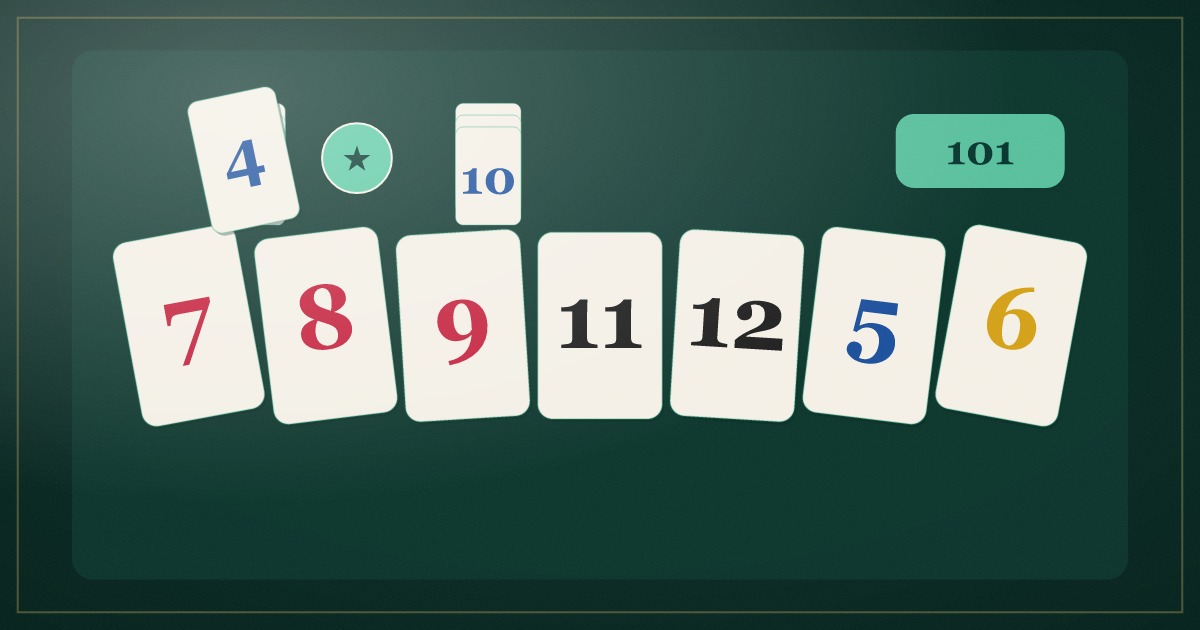
Most hands lost in Okey 101 with a good rack come down to timing: opening too early and being stuck with awkward tiles, or sitting on a ready hand while the threshold climbs. This guide covers when to open, lay off and take the discard, with the penalty maths behind each choice.
In short
- Your first opening needs sets and runs worth at least 101 points, or five pairs; because of the escalating rule, each later run-based opening must beat the last one, and each later pairs opening must beat the last pairs opening.
- When the hand ends, a player who never opened takes the sum of the tiles left in hand plus an extra 101 points; that is the real price of waiting.
- A real okey stuck in your rack counts as 101 points, and penalties are doubled when the hand is ended with an okey or with pairs.
- Before you open you cannot quietly pick up the discard; a tile taken from the discard has to be used in that turn's opening.
When is the right moment to open in Okey 101?
Opening as soon as your groups pass 101 is usually the right call, but it is not the only test. Opening changes two things at once: it shrinks your rack and it raises the bar for everyone else. If you open with 108, every player who opens after you has to reach at least 109. That escalating rule turns an early, high opening into a move that both saves you and puts the table under pressure.
The one good reason to wait is a rack you can close almost completely with a tile or two, so you would be close to going out the moment you open. Otherwise, holding a hand that already clears the bar risks the target rising when someone else opens first. A hand parked on 101 can suddenly fall short when an opponent opens with 112.
Why is not opening so expensive?
At GAMEAREA's Okey 101 table, when a hand ends each player's penalty is the sum of the face values of the tiles left on their rack. A player who never opened gets a further 101 added. A real okey left in hand counts as 101 instead of its own value. When a hand is ended by discarding the okey or by pairs, the losers' penalties are doubled.
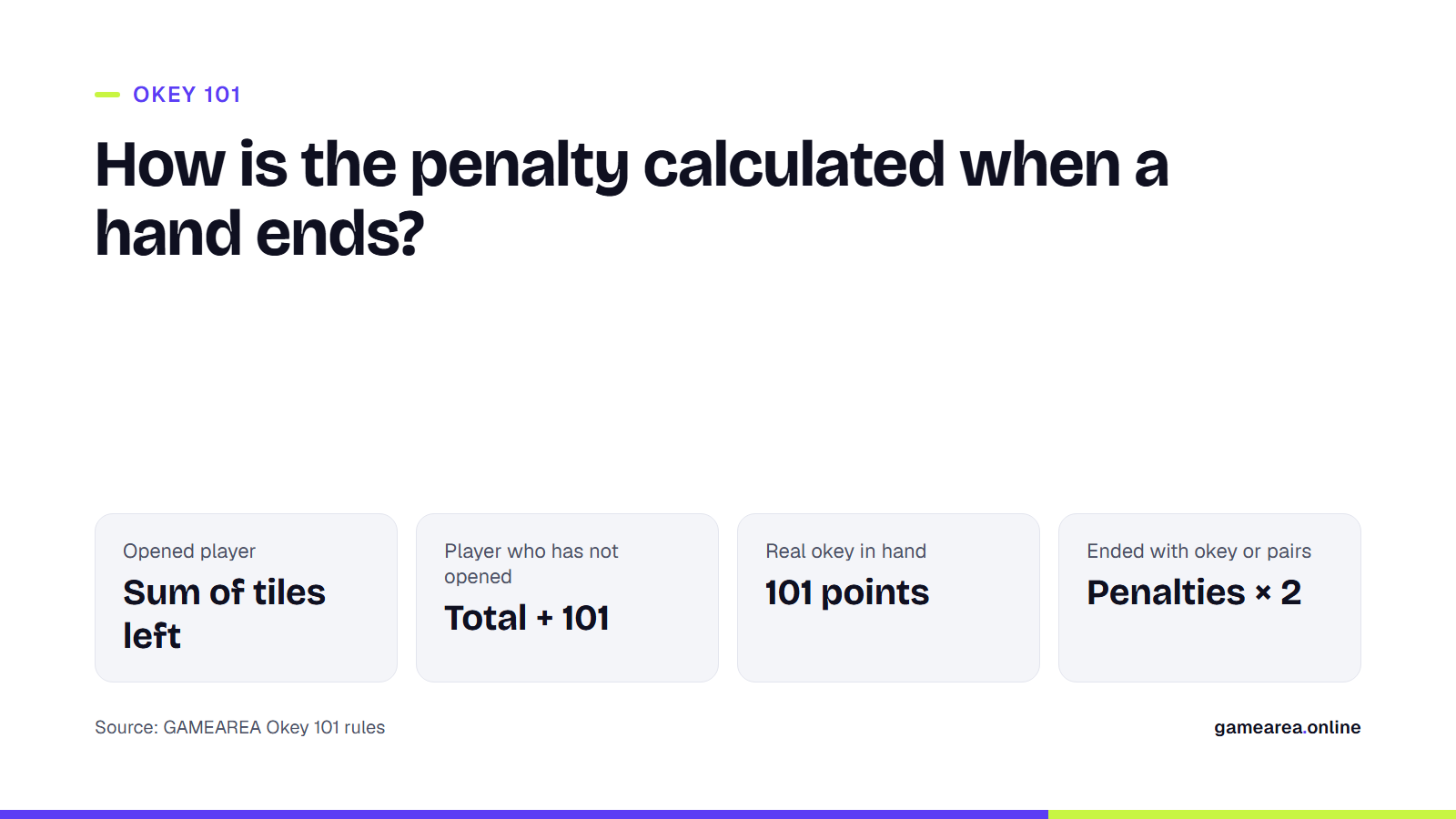
This is the whole strategy in one table: a player who has not opened cannot get their penalty below 101, even if only small tiles are left. A player who has opened sees the penalty fall towards zero as the rack empties. So when you are stuck on 98 or 99, the single tile that lets you open is often worth more than a high tile you have been saving.
| Situation | Penalty |
|---|---|
| Opened, 2, 5 and 9 left | 16 |
| Not opened, same tiles | 16 + 101 = 117 |
| Opened, real okey and a 4 left | 101 + 4 = 105 |
| Not opened, opponent ended with pairs | (16 + 101) × 2 = 234 |
| Source: GAMEAREA Okey 101 rules and game-engine scoring | |
How should you use the right to take the discard?
Before opening you cannot simply add the previous player's discard to your rack. Taking it is only valid if you use that tile in your opening during the same turn. Two things follow. First, if you are one group short of 101 and the discard completes that group, taking it instead of drawing opens your hand this turn. Second, you cannot grab a tile just because you like it if it will not be part of your opening.
Once you have opened, you can take the discard freely. From then on, drawing from the stock hides information, while taking the discard shows the table what you are collecting. Near the end of your hand, taking the discard buys speed; when you are far from finishing, it makes it easier for opponents to read which tiles you are holding.
How does laying off become a weapon after you open?
The moment you open, every set and run on the table becomes a possible way out for you. If a yellow 4-5-6 is on the table, a yellow 3 or yellow 7 in your rack is no longer a stray tile; it can be laid off straight away. The missing fourth colour of a three-colour set of 8s works the same way. Every tile you lay off removes a tile that would otherwise be written down as penalty when the hand ends.
Laying off also has a defensive side. If an opponent who has not opened yet sits next to you, the tile you discard may complete their opening. Laying off a tile instead of discarding it both shrinks your rack and denies the opponent material to take. You can find the full rules in our Okey rules guide.
Keep the okey or use it?
A real okey fills any gap, so it is often the shortest route to opening. But since an okey left in your rack counts as 101, saving it for the end is risky: if an opponent goes out first, your most expensive tile is stuck in your hand. The practical rule is to put the okey into the group that gets you over the threshold and not to delay opening while waiting for a bigger group. Ending the hand by discarding the okey doubles penalties, but that is a move to try only when the rest of your rack is completely ready. For a detailed look at scoring and tile odds, read our Okey 101 scoring maths article.
When is opening with five pairs the right choice?
If your rack is full of low numbers and runs cannot reach 101, five pairs may be your only realistic way out. The cost of opening with pairs is that you are left with many single tiles afterwards, and each of them has to be laid off or discarded. So after a pairs opening, prioritise tiles that can be laid off on the sets and runs on the table. Pairs escalate too: once someone has opened with pairs, the next pairs opening needs more pairs.
If you want to try these ideas straight away, you can play against bots at the Okey 101 table on GAMEAREA with nothing at stake.
Frequently asked questions
What is the penalty in Okey 101 if the hand ends before I open?
The face values of the tiles in your rack are added up and 101 is added on top. If a real okey is in your rack, it counts as 101 points.
What does the escalating rule mean?
The total of the last opening on the table is the new target, and the next player must beat it by at least one point. If someone opened with 105, you need at least 106.
Can I take the discard before I have opened?
Only if you use that tile in your opening in the same turn. You cannot take a discard before opening if it will not be part of the opening.
When should I lay off after opening?
Laying off every tile you can lowers your penalty risk. Lay off onto the groups on the table instead of discarding tiles that could help an opponent who has not opened yet.
Is ending with the okey always a good idea?
No. Ending the hand with an okey doubles penalties, but spending the okey on your opening often rescues the hand sooner. Unless the rest of your rack is fully ready, use the okey to open.
Sources
- GAMEAREA — Okey 101 Oyna — Açık Masa 4 Kişilik Taş Oyunu Official source
- GAMEAREA — Okey 101 Nasıl Oynanır: 4 Kişilik Taş Oyunu Kuralları ve Rehberi Official source
- Vikipedi — Okey
How this content was prepared
Prepared with AI assistance from the sources listed, key facts checked against official sources, not copied verbatim. Our AI principles
GAMEAREA Editörlüğü