Okey 101 scoring maths: the fewest tiles that clear 101, and the odds of drawing what you need
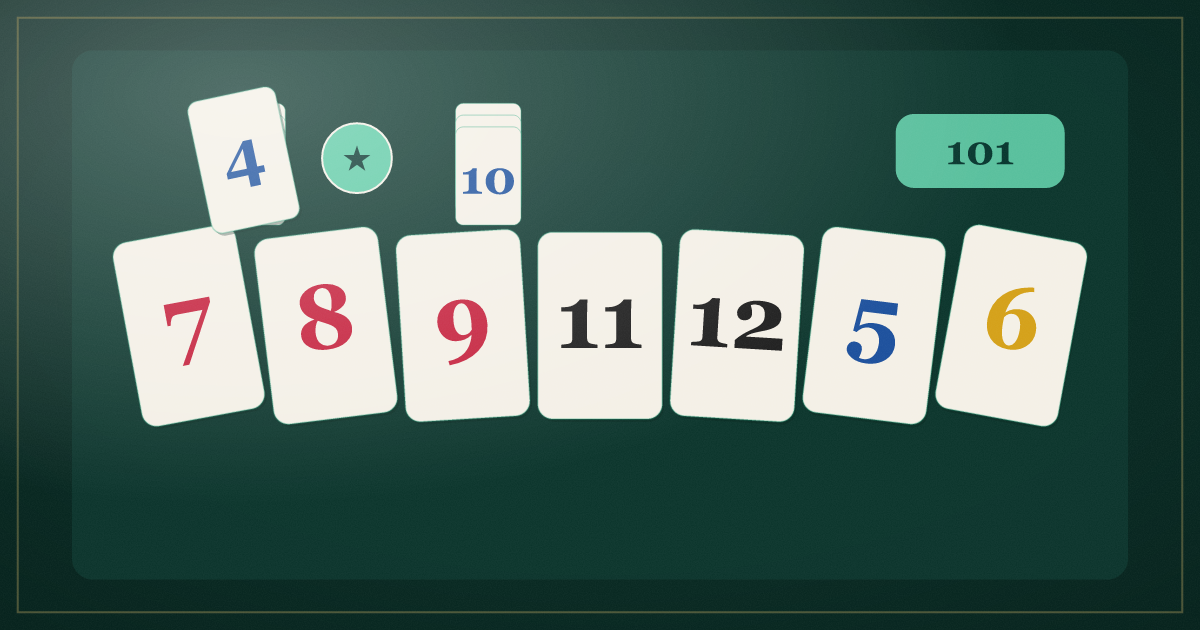
Opening in Okey 101 is arithmetic, not intuition: once you know how many points each group in the 106-tile set is worth and how often the tile you need actually turns up, you can work out before you sit down how many tiles and how many turns it takes to clear the 101 threshold. This guide lays out the shortest routes to an opening, when a five-pair opening makes sense, and the draw odds, all in numbers.
In short
- To open, the face value of your sets and runs must total at least 101, or you open with five pairs; every later opening must beat the previous one (the escalating rule).
- 101 can be reached with as few as 9 tiles; the most 8 tiles can ever score is 100.
- There are two jokers (okey) and two fake jokers; after your 21 tiles are dealt, 84 tiles remain unseen.
- A specific tile has roughly a 2.4% chance of being your next draw; a tile that extends an open-ended run, about 4.8%.
How are points counted in Okey 101?
The set contains tiles numbered 1 to 13 in red, black, blue and yellow, two of each, for 104 tiles, plus two fake jokers: 106 in total. The tile one above the indicator is that round's okey (joker) and exists twice; the fake jokers only stand in for the number and colour the okey represents. At the Okey 101 table on GAMEAREA each player is dealt 21 tiles.
Scoring is simple: a group is worth the sum of the face values in it. A set (same number, different colours) has three or four tiles; a run (same colour, consecutive numbers) has at least three. The joker takes the value of the tile it replaces, so a joker between two 13s counts as 13, while a joker completing 1-2 counts as 3.
| Group | Tiles | Points |
|---|---|---|
| Set of 13s (four colours) | 4 | 52 |
| Set of 12s (four colours) | 4 | 48 |
| Run 10-11-12-13 | 4 | 46 |
| Set of 13s (three colours) | 3 | 39 |
| Run 11-12-13 | 3 | 36 |
| Run 7-8-9 | 3 | 24 |
| Run 1-2-3 | 3 | 6 |
| Calculation: sum of face values. Rules: GAMEAREA Okey 101 rules guide | ||
What is the fewest tiles that clears 101?
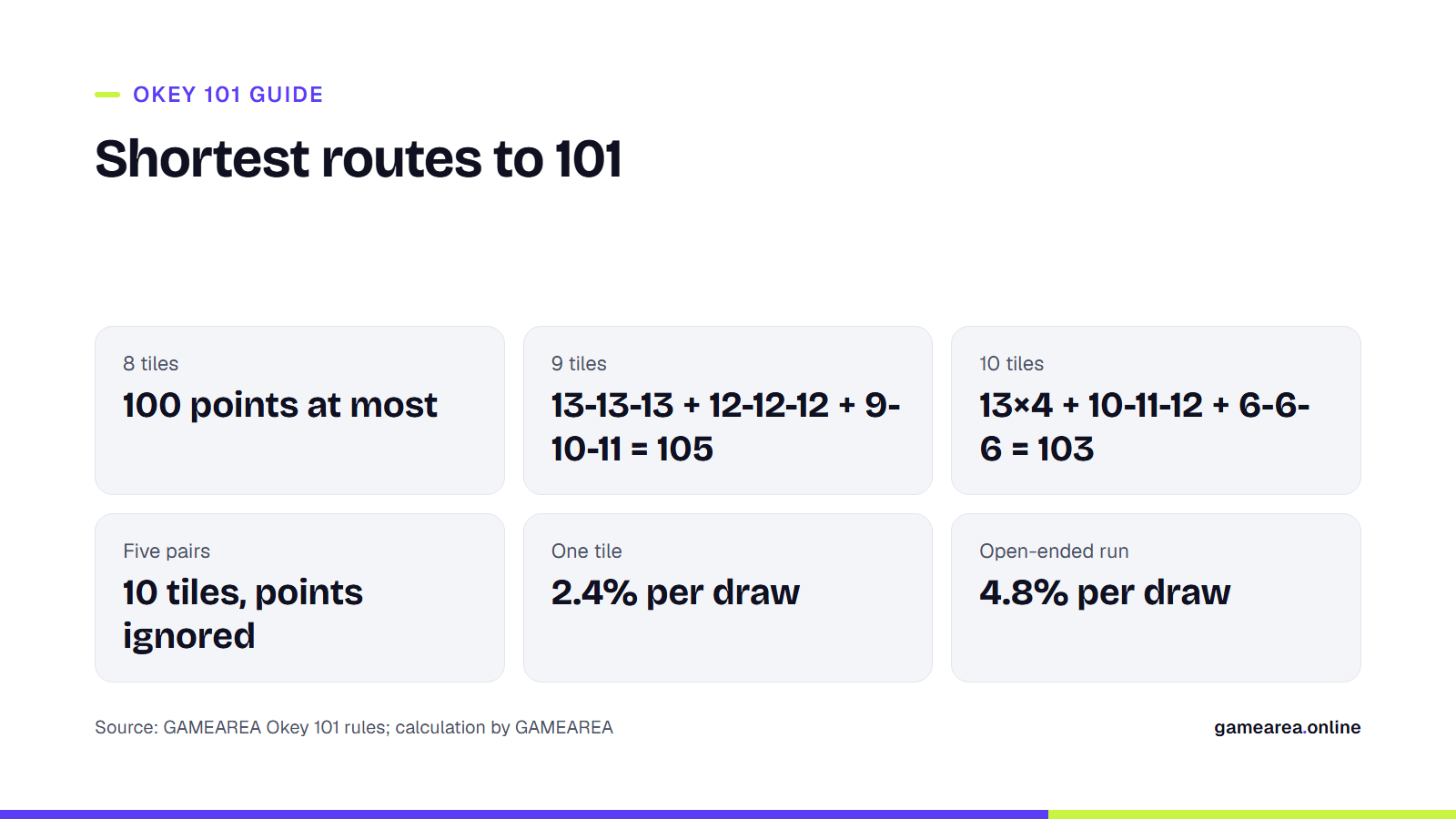
Because a group needs at least three tiles, a 7-tile opening can only be built as 3+4; at best, three 13s and four 12s make 39+48=87. With 8 tiles, two four-tile sets cap out at 52+48=100: one point short. It is the cruellest number in Okey 101: even holding all four 13s and all four 12s, you still need a third group.
The smallest hand that clears the threshold has 9 tiles in three groups of three. For the total to pass 101, the average tile must be worth more than 11.2, which in practice means all three groups are built from 11s, 12s and 13s. For example, three 13s (39), three 12s (36) and a yellow 9-10-11 run (30) open with 105. A single four-tile set makes life easier: four 13s (52) plus a 10-11-12 run (33) plus three 6s (18) opens with 103 on 10 tiles.
The upshot is that low numbers barely carry the threshold. A 1-2-3 run is only 6 points; an 11-12-13 run built from the same three tiles is worth six times as much. Your 21 tiles average about 7 in face value, roughly 147 raw points, but only valid groups count, so most of it never reaches the opening. If opening is the goal, spend your time grouping tiles from 9 upwards, not building runs out of 1 to 5.
When is a five-pair opening worth it?
Every tile has exactly one twin in the set. Five pairs grant an opening regardless of point value, so they can be the only way out when your hand is full of small numbers. The maths: if you already hold three pairs, you need two of the four twins of your remaining single tiles. The more "candidate" tiles you keep, the better the odds; any one of four twins arriving is far likelier than waiting for one specific number. On the other hand, five pairs need 10 tiles, one more than the 9-tile points opening, so a hand heavy in 11s, 12s and 13s opens faster on points.
How often does the tile you need show up?
After the deal you see your 21 tiles and the indicator; the other 84 tiles, including those in your opponents' racks, are unknown to you. The chance that a specific tile (with both copies still out there) is your next draw is 2/84, about 2.4%. That is the figure when you wait for the missing colour to turn a set of three into four. An open-ended run such as 8-9, which 7 or 10 would extend, can be completed by four tiles: 4/84, about 4.8%. Waiting for the twin of a single tile you hold leaves only one copy, so the odds fall to 1/84, 1.2%.
Over several turns the numbers shift. A tile with two copies out has roughly a 22% chance of appearing at least once in 10 draws; for the open-ended run with four useful tiles, that passes 40%. Tracking the discards shrinks the unknown pool, and the moment you see one copy of your target hit the discard pile your odds halve. How to read what opponents discard and pick up is covered separately in Okey strategy: reading opponents.
| What you wait for | Useful tiles | Per draw | In 10 draws |
|---|---|---|---|
| Twin for a pair | 1 | 1.2% | 12% |
| Colour completing a set | 2 | 2.4% | 22% |
| One-ended run (e.g. 11 for 12-13) | 2 | 2.4% | 22% |
| Open-ended run (e.g. 7 or 10 for 8-9) | 4 | 4.8% | 40% |
| Calculation: 84 unknown tiles, before any discards are counted | |||
How do the joker and fake joker enter the maths?
Because the joker fills any gap, it adds two useful tiles to every wait: a one-ended run goes from 2 to 4 saving tiles, an open-ended run from 4 to 6. The fake joker is not a wild card; it only stands in for the tile the joker represents and carries that tile's value. If the indicator is a 7, the joker is an 8, and the fake joker is used as an 8 and scores 8. That is why hoarding the fake joker as a "spare wild" is a mistake: it is a numbered tile, so put it in a set.
The escalating rule pushes the arithmetic one step further: if someone has opened with 104, your opening must be 105 or more. Keep a running total of your groups every turn, and remember that what lifts a hand stuck on 100 to 101 is never a one-point joker but a new group. For a refresher on the rules, the Okey 101 rules guide walks through opening, taking from the discard and laying off step by step.
Frequently asked questions
How many points do you need to open in Okey 101?
The face value of the sets and runs you lay down must total at least 101; alternatively you can open with five pairs. Every later opening must beat the previous total.
What is the minimum number of tiles for 101?
9 tiles: three groups of three, all built from 11s, 12s and 13s. The highest total 8 tiles can reach is 100.
How many points is the joker worth?
The value of the tile it replaces. Slotted between 12 and 13 it counts as whatever the run needs, not 13; placed as the third 13 beside two 13s it scores 13.
What are the odds of drawing the tile I need?
Right after the deal, about 2.4% per draw for a tile with both copies still out. The figure changes as you count the discards.
Can the fake joker be used as a wild card?
No. The fake joker only stands in for the number and colour of that round's joker tile, and scores that tile's value.
Sources
- GAMEAREA — Okey 101 on GAMEAREA Official source
- GAMEAREA — How to play Okey 101 (GAMEAREA rules guide) Official source
- Vikipedi — Okey
How this content was prepared
Prepared with AI assistance from the sources listed, key facts checked against official sources, not copied verbatim. Our AI principles
GAMEAREA Editörlüğü