Domino strategy: Counting tiles, doubles and the blocked hand
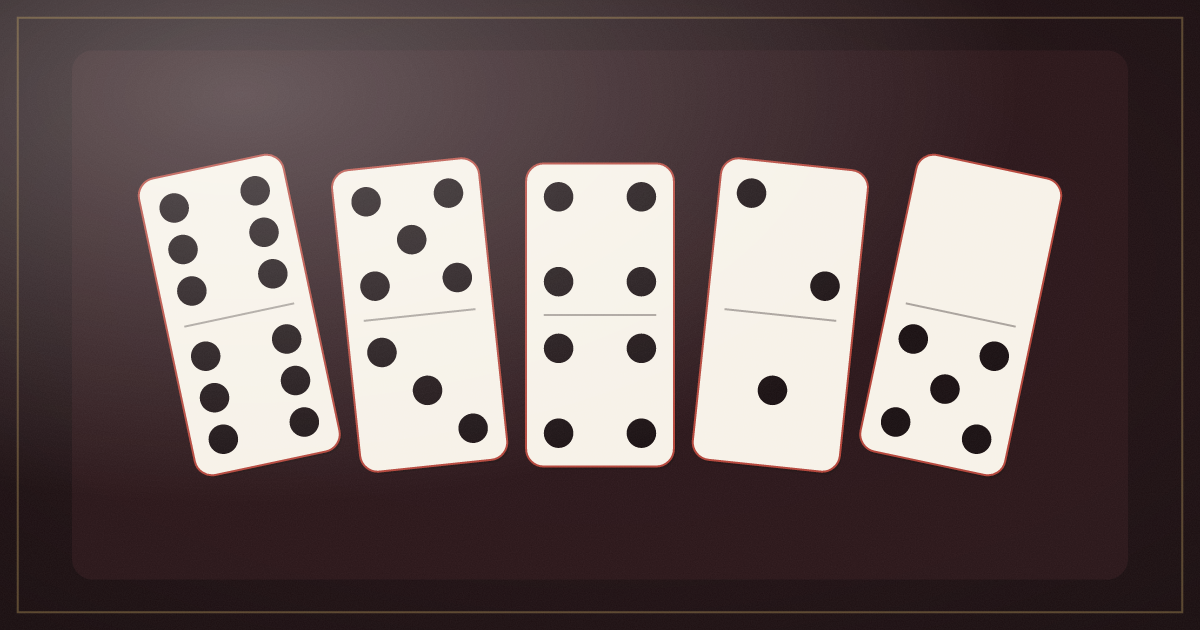
In dominoes, seeing the tiles in your own hand is easy; the real edge is working out the ones you can't see. Because the numbers in a double-six set are fixed, every move on the table gives you calculable information about your opponents' hands and about the outcome of a blocked round.
In short
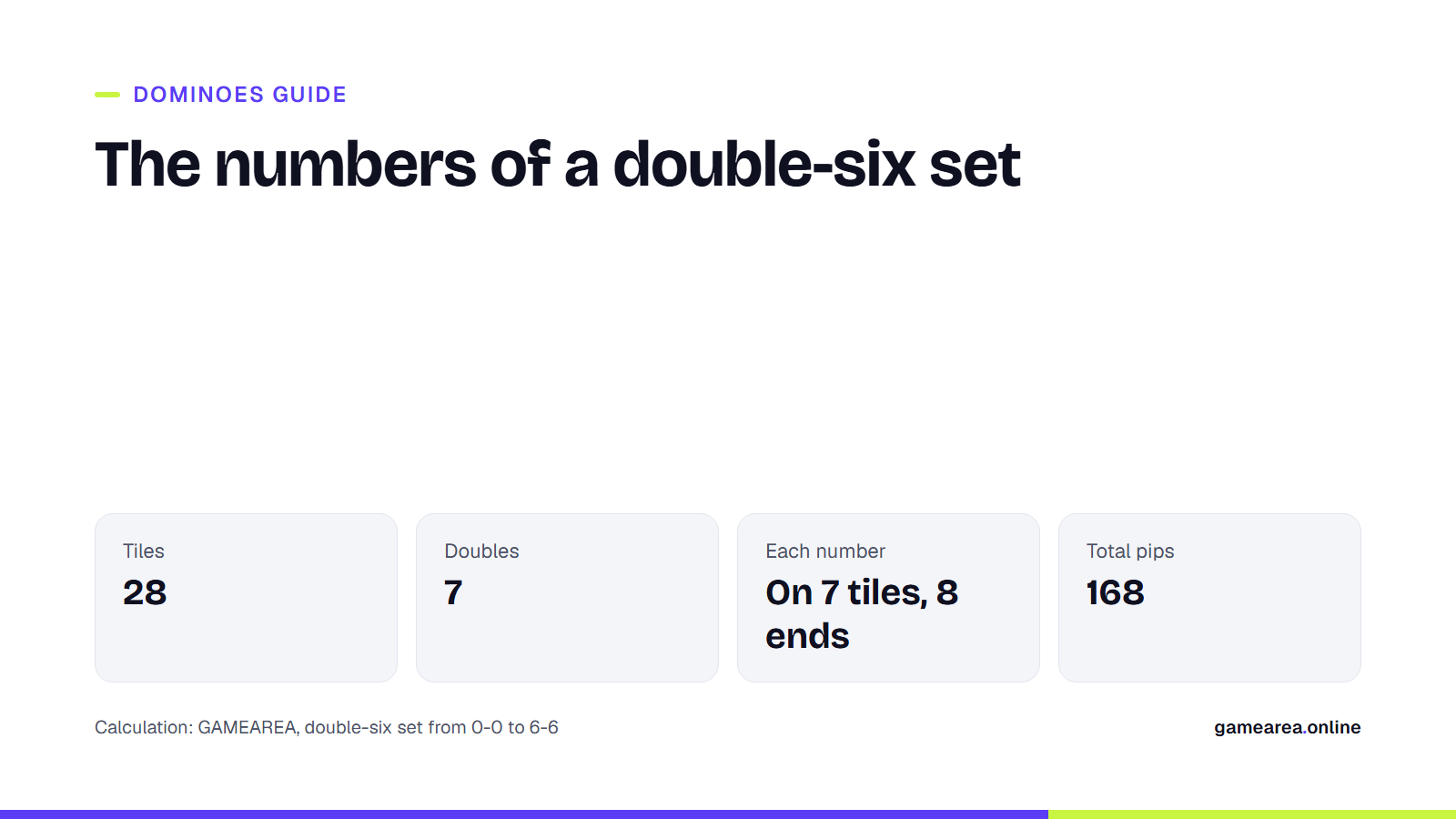
- The set has 28 tiles: 7 doubles and 21 non-doubles. Each number appears on 7 tiles and on 8 ends in total.
- The dots (pips) across the whole set add up to 168; in a blocked round you can work backward from this number to your opponent's hand.
- A double connects to only one number; getting rid of it before that number runs out is the safest way to avoid getting stuck.
- On GAMEAREA, a blocked round goes to the player with the fewest pips left in hand; if the lowest totals are tied, the round is a draw.
What numbers are in a double-six set?
The two halves of each tile carry one of seven values, from 0 to 6. There are 21 ways to pair two different values (7 × 6 / 2); add the 7 doubles, which carry the same value on both halves, and you get the 28-tile set. Each tile appears in the set only once.
Any number, say 3, appears on six non-double tiles (3-0, 3-1, 3-2, 3-4, 3-5, 3-6) and on one double (3-3): 7 tiles in total. Because the double carries the value twice, the value 3 shows up on 8 halves in the set. This simple fact is the basis of the whole calculation: since every value is printed 8 times, the total number of dots is 8 × (0+1+2+3+4+5+6) = 8 × 21 = 168. That works out to an average of 6 pips per tile.
How do you count tiles in practice?
Since you know each value has 7 tiles, you can look at the line of play and your own hand and work out how many tiles of each number are still unseen. You don't need to memorize the whole set; tracking the numbers on the two open ends is enough for most decisions. If one end shows a 4, five of the seven tiles with a 4 are on the table and one is in your hand, only a single 4 is left out there.
The number of players determines where the tiles you can't see might be. At the GAMEAREA Domino table, the deal works like this:
| Players | Tiles each | Total in hands | Boneyard | Tiles you can't see at the start |
|---|---|---|---|---|
| 2 | 7 | 14 | 14 | 21 (7 with your opponent, 14 in the boneyard) |
| 3 | 6 | 18 | 10 | 22 (12 with your opponents, 10 in the boneyard) |
| 4 | 5 | 20 | 8 | 23 (15 with your opponents, 8 in the boneyard) |
| Deal: GAMEAREA Domino rules. Unseen tiles are calculated by subtracting your own hand from 28. | ||||
The takeaway from the table: at the start of a two-player game, any tile you can't see has a one-in-three chance of being in your opponent's hand and a two-in-three chance of being in the boneyard. At a four-player table, about two thirds of the tiles you can't see are in your opponents' hands; guessing is harder, but every move narrows things down a little further.
The most valuable information is an opponent drawing from the boneyard. On GAMEAREA, a player with a playable tile can't draw; the server doesn't allow it. So if an opponent reached for the boneyard, they held neither of the two open-end numbers at that moment. The same goes for a player who passes after the boneyard runs out. When you keep track of this, you choose which end to leave to whom based on evidence rather than guesswork.
When should you play your doubles?
A non-double tile, for example 5-2, can connect to two different numbers: it can be played whenever one of the ends shows a 5 or a 2. The 5-5, however, can only go on an end showing 5. And because it is one of the 7 tiles with the value 5, the chance of playing the double drops as the other six 5s land on the table. That is why doubles are the tiles most likely to get stuck in your hand.
There is also the question of weight. The seven doubles add up to 0+2+4+6+8+10+12 = 42 pips, exactly a quarter of the set. The 6-6 alone, at 12 pips, is the heaviest tile in the set. A double left in your hand in a blocked round can change the result on its own.
A practical order of priorities looks like this:
- If the number is running low, play it now. If five of the seven tiles of a value are visible and you hold its double, drop the double the first time an end shows that number.
- If you control the number, don't rush. If you hold two or three more non-doubles of the same value, you can play the double at a moment when you want to keep that end open, since the double doesn't change the end's value.
- Think about heavy doubles early. Holding the 6-6 or 5-5 while the boneyard shrinks is the most expensive risk if the game blocks.
At the start of a round you have no choice: the player holding the highest of the doubles dealt starts the round with that double.
What happens when the hand is blocked?
If the boneyard is empty and everyone at the table has to pass in turn, the round is blocked. Under GAMEAREA's rules, the pip totals of the tiles left in each hand are then compared, and the player with the lowest total wins the round. If two players tie for the lowest total, the round is a draw. Some house variants score a blocked hand differently, but at the GAMEAREA table this comparison alone decides the round.
This is where the number 168 comes in handy. In a two-player game, once the boneyard is empty you can know your opponent's total exactly: subtract the total of the tiles on the table and the total of your own hand from 168, and what remains is your opponent's. For example, there are 18 tiles on the table with a combined 104 pips, and your 4 tiles add up to 22 pips. Since the set has 28 tiles, your opponent has 6 tiles left, totaling 168 − 104 − 22 = 42. If you have a move that blocks the table, you win the round 22 to 42.
At a three- or four-player table, the same calculation gives you your opponents' combined load, not how much each of them holds. Still, once you know the hand sizes and who drew on which number, the estimate narrows considerably. If you want to go through the rules step by step, see our guide to the rules of draw dominoes.
Frequently asked questions
How many tiles and doubles are in a domino set?
A double-six set has 28 tiles: 7 doubles from 0-0 to 6-6 and 21 non-doubles.
What is the total number of dots on all the domino tiles?
168. Each value is printed 8 times in the set; 8 × (0+1+…+6) = 168.
Who wins a blocked round?
On GAMEAREA, the player with the fewest pips left in hand wins. If the lowest totals are tied, the round is a draw.
Can I draw from the boneyard when I have a playable tile?
No. You can only draw from the boneyard if you have no playable tile; passing is only possible once the boneyard is empty.
Who starts the round?
The player holding the highest double among those dealt starts the round with that double.
Sources
- GAMEAREA — Domino Oyna Official source
- GAMEAREA — Çekmeli Domino Nasıl Oynanır: Online Kurallar ve Başlangıç Rehberi Official source
- Pagat.com — Draw Dominoes: rules and variations
How this content was prepared
Prepared with AI assistance from the sources listed, key facts checked against official sources, not copied verbatim. Our AI principles
GAMEAREA Editörlüğü