Card counting in Pişti: When should you play the jack, and how big is the pişti risk?
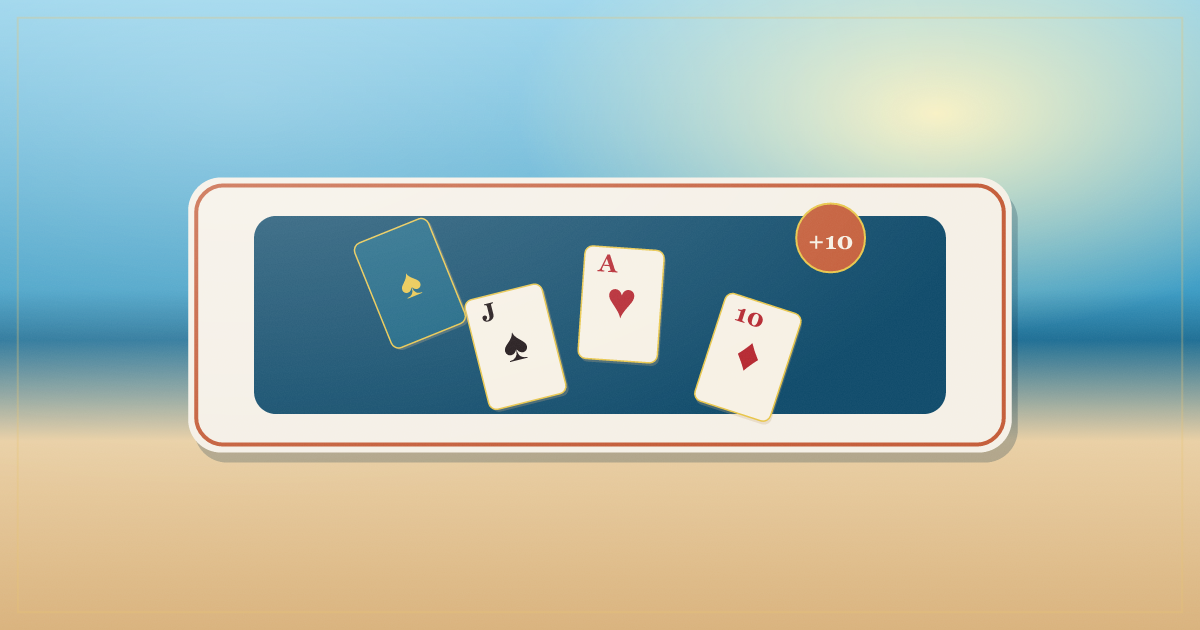
Pişti may look like a game of luck, but all 52 cards are revealed over the course of a deal, and a player who remembers what has been played starts to read the opponent's hand. This guide shows which decisions card counting changes and what the risk of conceding a pişti actually is, in numbers.
In short
- Each deal is worth 13 points in cards plus 3 for the majority; a single pişti (10 points) is worth almost as much as all of that.
- Before leading to an empty table, check how many cards of that rank are still unseen: the fewer left, the lower the pişti risk.
- Count the four jacks. The jack is the only card that takes the pile unconditionally, and once the last one is gone the balance of the game shifts.
- If you have been counting, you know your opponent's four cards exactly in the final round, and whatever is left on the table goes to the last player to capture.
Where do the points in Pişti come from?
Strategy starts with knowing where the points are. At the GAMEAREA Pişti table, each ace is worth 1, each jack 1, the two of clubs 2 and the ten of diamonds 3. Together, these cards add up to 13 points. The side that collects more than half the cards in a deal, meaning at least 27 of the 52, scores 3 more; if it's a tie, nobody gets them. For the full rules, see the how to play Pişti guide.
On top of that come piştis: capturing a single card on the table by playing the same rank is worth 10 points, and playing a jack onto a lone jack is worth 20. Taking a single card with a jack, however, is a normal capture, not a pişti. Keep that balance in mind: next to the 16 points available from cards and the majority in a deal, a single pişti brings in 10. Since a match runs to 101, a difference of a few piştis often decides the game.
How do you count cards?
There are four cards of each rank in the deck. You don't need to memorize every card; tracking two things is enough:
- Jacks: There are four. Always know how many have been played.
- The ranks on the table and in your hand: Before leading to an empty table, recall how many cards of each rank in your hand you have already seen.
Of the four cards dealt to the table at the start, three are face down; whoever takes the first pile also takes them, and only that side sees them. That puts three unknown cards into your count, and if you are the one who takes the first pile, that uncertainty resolves in your favor.
Which card should you lead to an empty table?
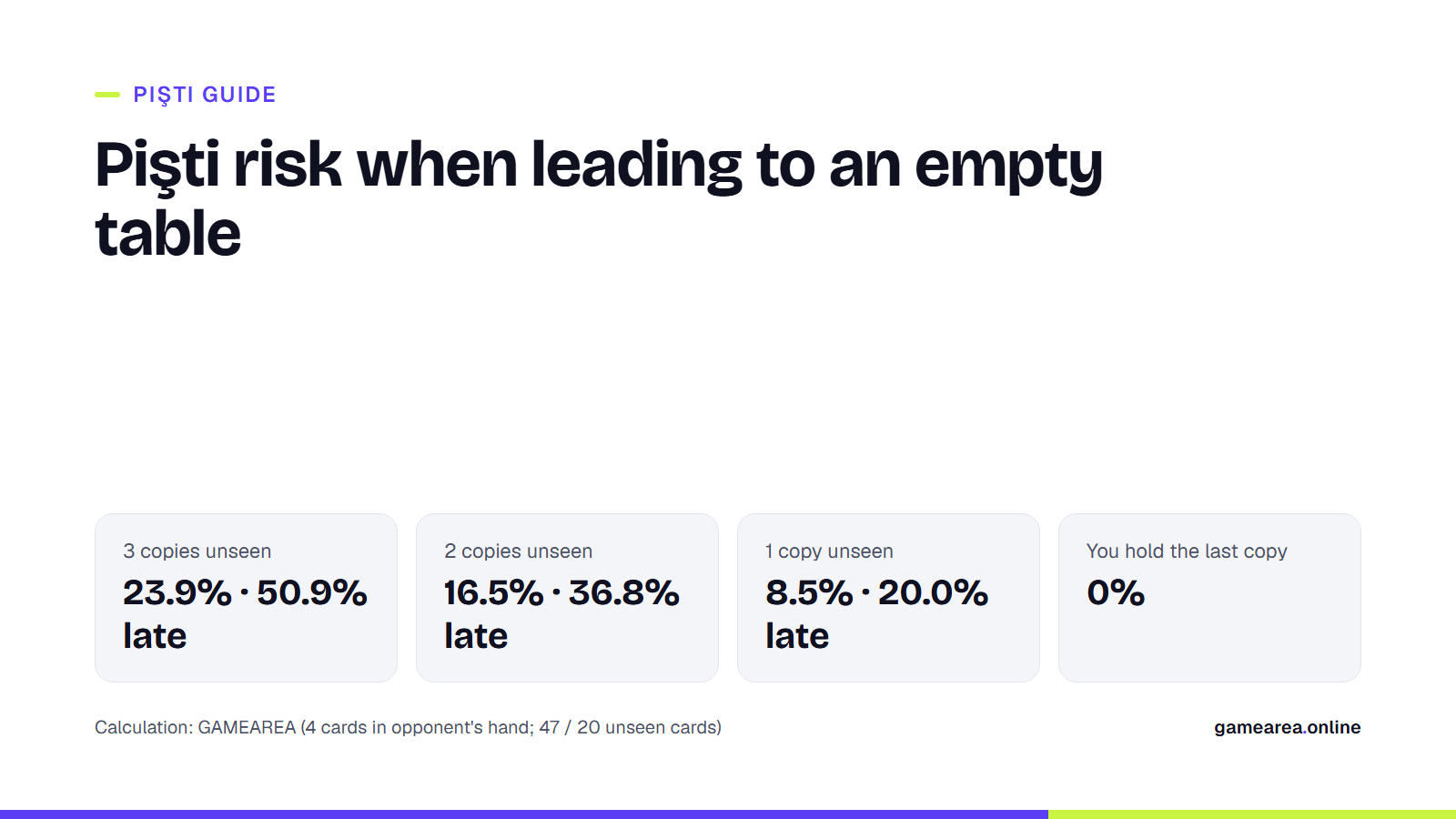
Pişti risk only exists for the player who starts a new pile: you leave a single card on the table, and if your opponent plays the same rank, they score 10 points. In a two-player game, with four cards in your opponent's hand, the risk depends on how many cards of that rank remain among the 47 you haven't seen:
| Unseen cards of the same rank | Start of the deal (47 unseen cards) | Near the end (20 unseen cards) |
|---|---|---|
| 3 | 23.9% | 50.9% |
| 2 | 16.5% | 36.8% |
| 1 | 8.5% | 20.0% |
| 0 | 0% | 0% |
| Hypergeometric probability, assuming four cards in the opponent's hand. Calculation: GAMEAREA. | ||
The practical rule from the table is simple: lead a card whose other three copies have already been played. If you hold the last card of that rank, the chance of conceding a pişti is zero. If you hold two cards of the same rank, leading one of them is also a reasonable choice: the unseen copies drop to two, and if your opponent plays something else on top, you take the pile with your second card. Avoid leading point cards to an empty table, especially the ten of diamonds: you could lose a pişti and a 3-point card at the same time.
When should you play a jack?
A jack takes the pile unconditionally, which makes it your most valuable card. A few principles:
- Don't waste it on a small pile. Throwing a jack on a pile of two or three ordinary cards can cost you a big pile or the ten of diamonds later.
- Its value grows with the pile. Because the 3-point majority depends on card count, taking a large pile pays off twice.
- If a lone jack is on the table, hold on to yours. A jack on a jack is worth 20 points; if you know how many of the four have been played, you can calculate that chance.
- Save a jack for the last round. At the end of the game, the cards left on the table go to the last player to capture. Holding a jack in the final round guarantees you that leftover pile.
What changes in the final round?
At a two-player table, 48 cards are dealt over six rounds of four cards each. On the last deal the stock is empty, so if you have counted every card and also took the three face-down cards from the first pile, you know your opponent's four cards exactly. If the face-down cards went to your opponent, you are looking for four cards among seven candidates; even so, the field has narrowed a lot. At this point the game becomes calculation rather than guesswork: you can see what your opponent can capture with which card and plan your order of play around it. In the four-player partnership game there are three deals, and you also need to account for your partner's hand; counting is harder, but the same logic applies.
If you'd like to try card counting in another card game, the card counting in Batak guide, which covers tracking trumps, uses the same way of thinking.
Frequently asked questions
How many points are there in a deal of Pişti?
13 points in cards (4 aces, 4 jacks, the two of clubs worth 2 and the ten of diamonds worth 3) and 3 points for the card majority, for 16 in total. Piştis are added on top.
Does taking a single card with a jack count as a pişti?
No. A pişti means playing the same rank onto a single card. A jack on a lone jack, however, counts as a 20-point pişti.
What is the safest card to lead to an empty table?
A card whose other three copies have already been played. If you hold the last copy, your opponent cannot make a pişti with that rank.
Who gets the cards left on the table at the end?
At the end of the game, any cards left on the table go to the last player to capture a pile.
Sources
- GAMEAREA — Pişti Oyna Official source
- GAMEAREA — Pişti Nasıl Oynanır: Yakalama, Vale ve Puanlama Official source
- Pagat.com — Pişti - card game rules
How this content was prepared
Prepared with AI assistance from the sources listed, key facts checked against official sources, not copied verbatim. Our AI principles
GAMEAREA Editörlüğü