Pip counting in backgammon: Who is ahead in the race, and when should you hit or run?
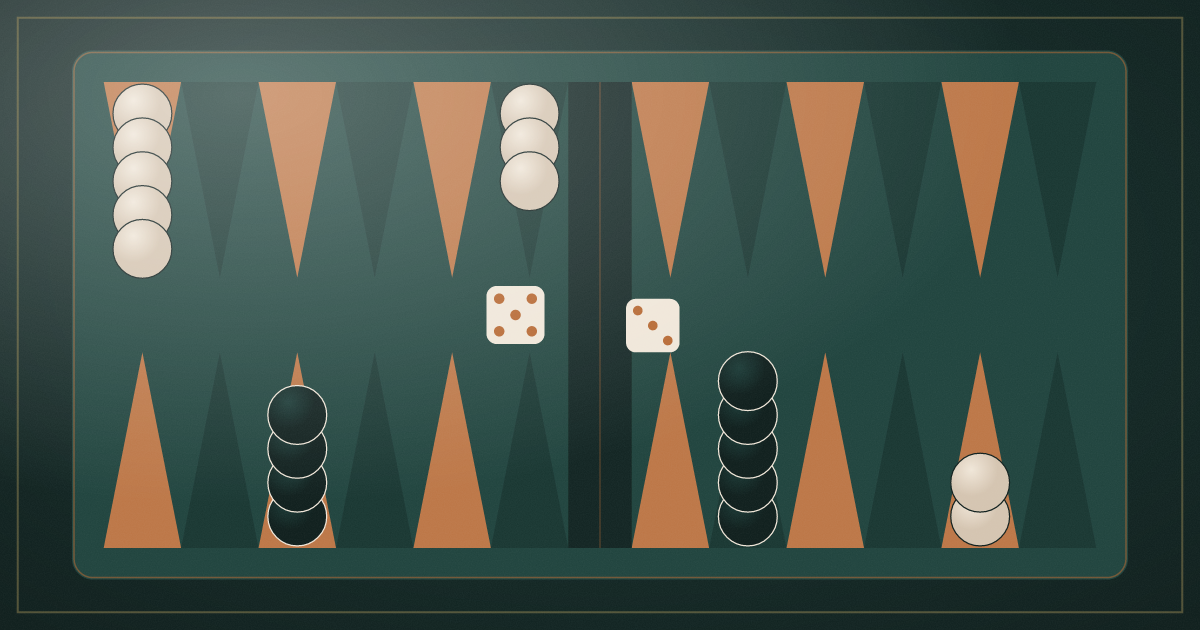
Once contact between the checkers is broken, backgammon becomes a pure race, and a single number tells you who is ahead: the pip count. A player who learns to work it out in a few seconds decides whether to hit, run or hang back and wait for a shot by calculation, not guesswork.
In short
- The pip count is the total number of points you have to cover with the dice to bear off all your checkers; both sides start at 167.
- A roll of the dice moves you 8 1/6 pips on average, because doubles are played four times.
- The basic strategy is to break contact and run when you are ahead in the race, and to hold back and wait for a shot when you are behind.
- The raw count doesn't tell the whole story: checkers piled on the low points waste pips during the bear-off.
What is the pip count, and why is it 167 at the start?
Each point is worth one pip. A checker on the 6-point in your home board needs 6 pips to leave the board; a checker at the back of your opponent's home board, on your 24-point, needs 24. Add up these values for all your checkers and you have your pip count. The smaller the number, the closer you are to finishing.
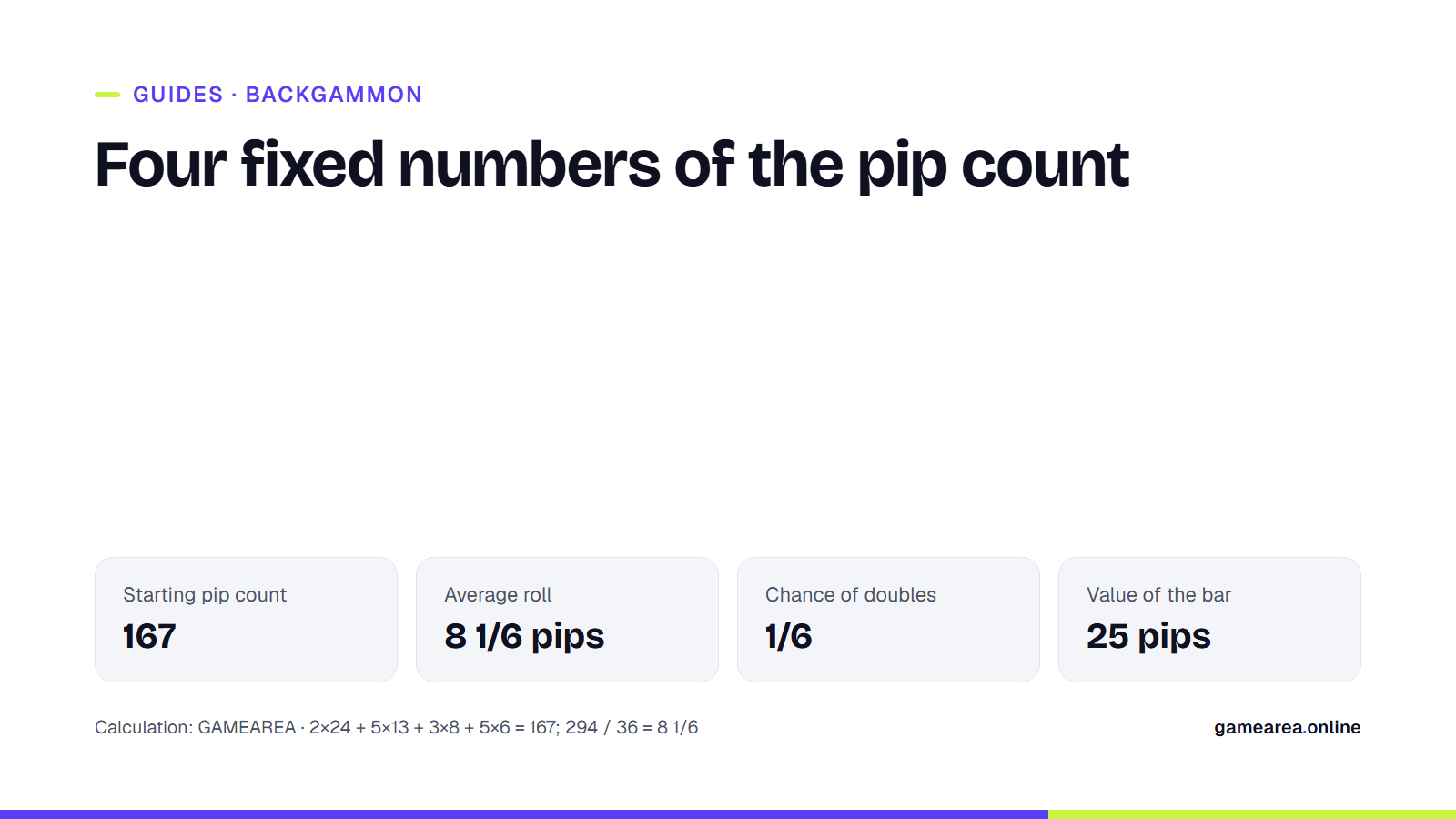
The starting position is the same for both sides, so the game starts even: 2 checkers on the 24-point (48), 5 on the 13-point (65), 3 on the 8-point (24) and 5 on the 6-point (30). Total: 48 + 65 + 24 + 30 = 167. Memorizing this number pays off: instead of recounting the board every turn, you can start from 167 and subtract the dice you play to keep track of your count.
How many pips does a roll move on average?
Two dice have 36 equally likely outcomes. Thirty of them are non-doubles, which average 7, for 210 pips in total. The remaining 6 outcomes are doubles; because doubles are played four times in backgammon, 1-1 is worth four pips and 6-6 is worth twenty-four. The calculation:
| Type of roll | Possible outcomes | Pip value | Total contribution |
|---|---|---|---|
| Non-doubles | 30 | 7 on average | 210 |
| 1-1, 2-2, 3-3 | 3 | 4, 8, 12 | 24 |
| 4-4, 5-5, 6-6 | 3 | 16, 20, 24 | 60 |
| Total | 36 | 294 | |
| 294 / 36 = 8 1/6 ≈ 8.17 pips. Calculation: GAMEAREA. | |||
This average lets you read a pip difference as a number of rolls. Being 8 pips ahead is roughly a one-roll advantage. Whose turn it is also counts: if the pip counts are equal, the side that rolls first is ahead in the race, because it starts a roll up. For the details of the dice distribution, how often each number comes up and the odds of a blot being hit, see our article on backgammon dice odds.
How do you count pips quickly?
Adding up the checkers one by one is accurate but slow. A few shortcuts work at the table:
- Count in clusters. Multiply the checkers on the same point: 4 checkers on the 6-point make 24. Mentally shifting checkers on neighboring points onto a shared point and multiplying works too. You can treat one checker on the 8-point and one on the 10-point as two checkers × 9 = 18 without changing the total.
- Count only the difference. To find out who is ahead, you don't have to add up both sides separately. Cancel out checkers in matching positions, such as a checker on your 6-point and one on your opponent's 6-point, and count only the checkers that have no match.
- Keep a running count. Start from 167 and subtract every roll you play. During the bear-off, if a die is higher than the point the checker is on, subtract only the value of the point.
- Add the hits. The bar is worth 25 pips; a checker that is hit goes back 25 minus the point it was on. A checker hit on your 3-point, in your home board, loses 22 pips; one hit in your opponent's home board, on your 20-point, loses only 5.
The last point also explains why hitting changes the race so quickly: hitting a checker that is close to home costs your opponent nearly three rolls' worth of pips.
What should you do when you are ahead in the race?
The principle backgammon coaches repeat most often is simple: if you are ahead in the race, race. The side that is ahead is the favorite once contact is fully broken and only the dice totals decide. So when you are ahead, the aim is to bring your back checkers out as safely as you can, avoid leaving blots and break contact. When a big double comes, using it to run is usually the best use of that roll.
When judging the size of the lead, think in proportions rather than raw pips. International backgammon sources read the difference as a percentage of your own pip count. A simple calculation shows why: a 10-pip lead is about 7% with 150 pips to go, with dozens of rolls still ahead; with 50 pips left, the same 10 pips is 20%, and your opponent has very few rolls left to close the gap. The shorter the race, the more the same lead is worth.
When should you go for a hit when you are behind?
If you are clearly behind in the pip count, running home is usually a losing strategy; catching up on the dice alone would take clearly better rolls than your opponent's. In that case the plan changes: hold a point in or near your opponent's home board, wait for a blot they leave on the way home, and keep that checker trapped behind your points once you hit it. Our backgammon prime strategy guide explains how to line up your points and trap a checker.
Don't let a big double mislead you when you are behind. For the side trailing in the race, running all the checkers and breaking contact, even with a good roll, often just seals the loss. It makes more sense to use the roll to strengthen your home board while keeping the point you hold.
When does the raw count mislead you?
The pip count can't see how the checkers are arranged. During the bear-off, checkers piled on the low points, the 1-, 2- and 3-points, waste part of each roll: when you bear off a checker from the 2-point with a 6, four pips are wasted. An extreme example makes this clear. If all fifteen checkers are on the 1-point, the raw count is only 15, but since a roll can bear off at most two checkers, or four with doubles, the bear-off takes at least four rolls. So when the pip counts are close, the side that has spread its checkers more evenly across the 4-, 5- and 6-points is actually ahead. Gaps cause a similar loss: if there are no checkers on the 5-point of your home board, the 5s you roll can't be used at full value.
To try these calculations in practice, the next time you reach a racing position at the GAMEAREA Tavla table, work out both sides' pip counts and base your decision on them.
Frequently asked questions
What is the starting pip count in backgammon?
167. The calculation: 2×24 + 5×13 + 3×8 + 5×6 = 48 + 65 + 24 + 30.
How many pips is a roll worth on average?
8 1/6, or about 8.17 pips. Because doubles are played four times, the average is above 7.
How many pips does a hit checker lose?
The bar counts as 25 pips; the checker loses 25 minus the value of the point it was on. A checker hit close to home loses the most.
Should I run when I am behind in the pip count?
Usually not. When you are clearly behind, holding a point and waiting for a shot gives you better winning chances than entering a race.
Sources
- GAMEAREA — Tavla Oyna — Çevrimiçi Tavla Official source
- Backgammon.com — Backgammon Pip Counting
- Backgammon Galaxy — Pips and Race
- Wikipedia — Backgammon
How this content was prepared
Prepared with AI assistance from the sources listed, key facts checked against official sources, not copied verbatim. Our AI principles
GAMEAREA Editörlüğü