Düz Okey strategy: Tracking discards, going for pairs and when to use the okey
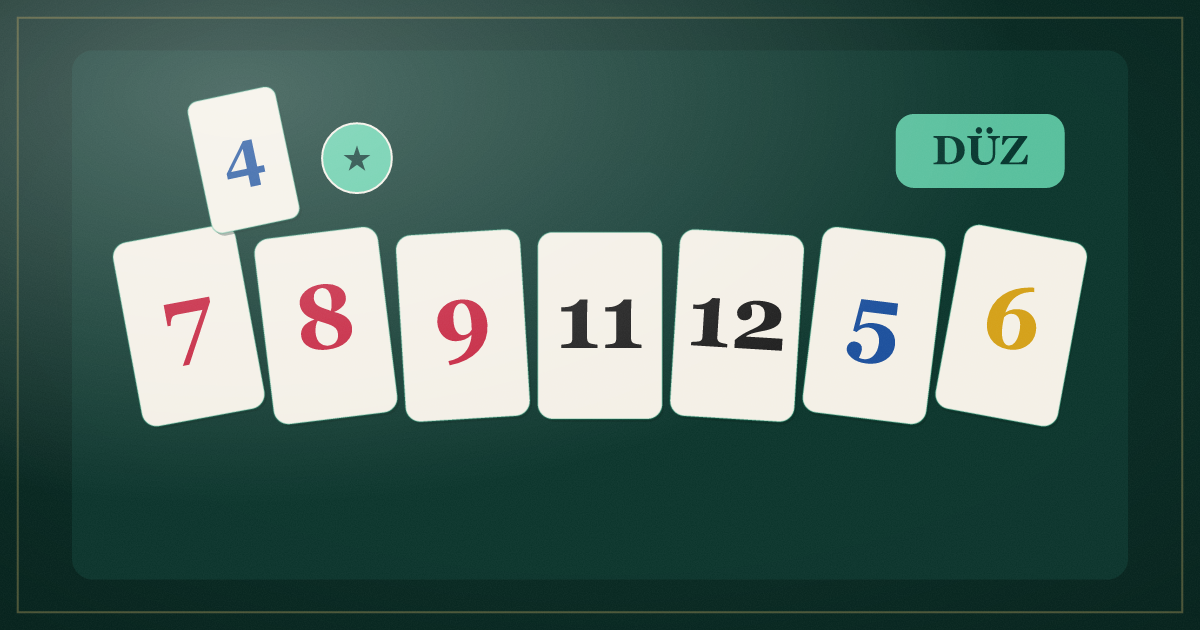
In Düz Okey, a hand is won not by whoever draws the luckiest tiles but by whoever counts the tiles on the table best. The player who knows how many copies of each tile are left, what the two players on either side are waiting for and how expensive the okey can turn out to be on the rack finishes more often with the same tiles.
In short
- There are 106 tiles on the table, two of each numbered tile, but only one copy of the indicator's twin stays in play.
- An open-ended run can be completed by at most 6 tiles; a single tile waiting for a pair, by at most 3.
- On GAMEAREA, finishing with pairs and finishing by discarding the okey both double the other players' penalty points.
- A real okey left on your rack when someone else finishes counts as 101 penalty points.
How many tiles are on the table, and how many of each are left?
Tracking starts with a simple count. The set has 52 different faces, 1 to 13 in four colours, with two tiles of each face; add the two fake jokers and you get 106. In the deal, three players get 14 tiles and the player who starts the hand gets 15; add the face-up indicator to those 57 tiles and 48 remain in the wall in the middle. In GAMEAREA's Düz Okey engine the hand ends with no winner the moment the wall runs out, so the number of draws from the wall in a hand is capped at 48.
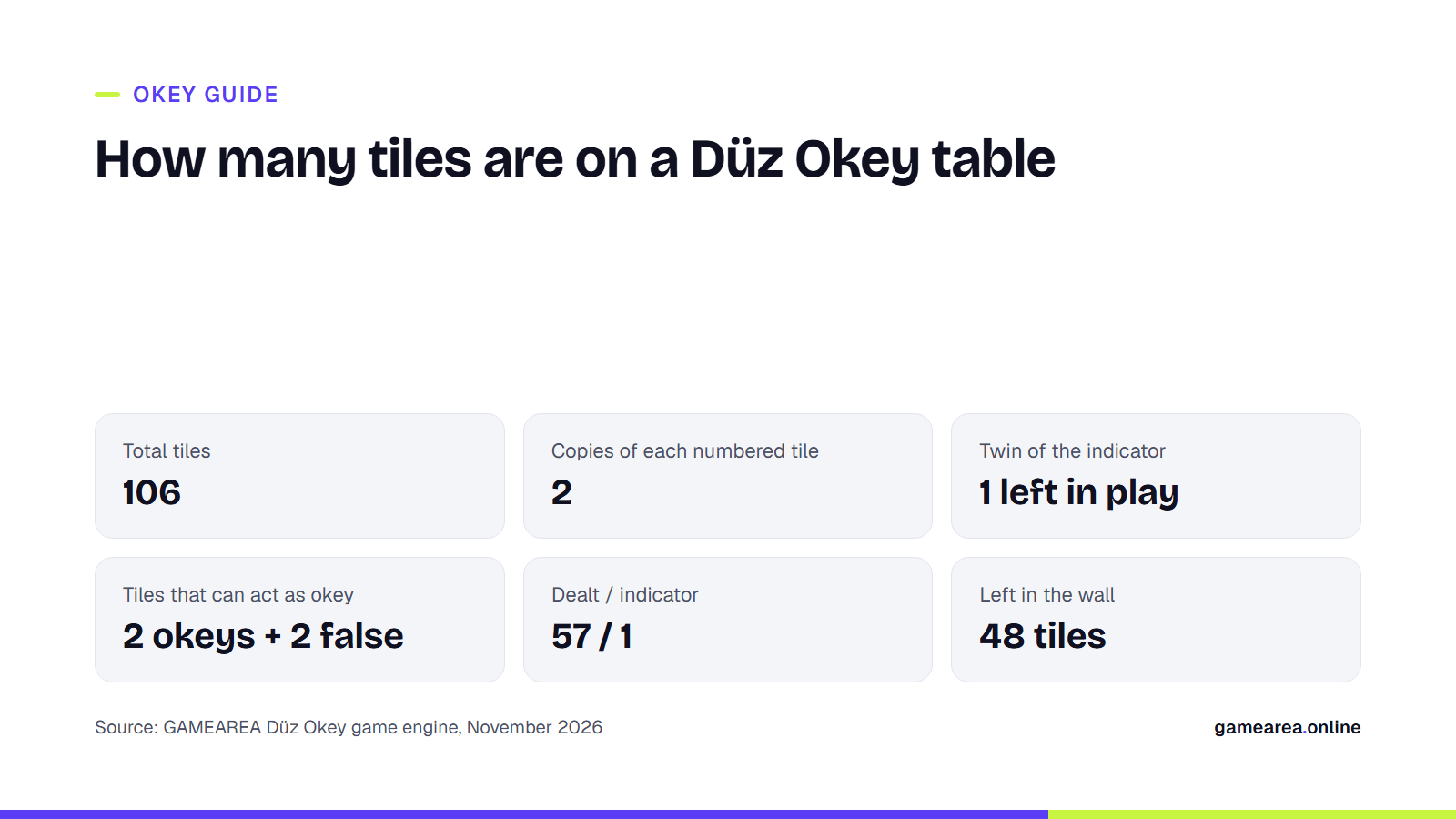
These numbers give meaning to every tile you discard and every tile you see. If you are waiting for a red 8 and you have seen a red 8 on the table, at most one copy of that tile is left in play. If you have seen both, the tile is dead; breaking up the combination that waits for it is usually better than hoping for the okey.
What does the indicator tell you?
The indicator does more than decide the okey. The okey is the tile one number higher in the indicator's colour; after 13 comes the 1 of the same colour. But the indicator also takes a tile off the table: because the second copy of that face is lying face up, only one twin of it is left in play. If you hold the same tile as the indicator, there is no natural twin to complete a pair with it; only the okey can help. For runs and sets, too, that face gives you half the chances of the others.
The okey face works the other way round. Four tiles can stand for that number: the two real okeys and the two fake jokers. A fake joker is not a wild card; it only takes the place of the okey's number and colour. If the okey face sits at the end of a run on your rack, more tiles than usual can complete that end.
How many tiles can complete a tile you are waiting for?
When deciding which combination to keep and which to break up, the most reliable measure is the number of tiles that could complete it. The values below assume that no copy has been seen yet and that the indicator and the okey face are not involved.
| Combination on your rack | Example | Natural matches | Real okey | Maximum |
|---|---|---|---|---|
| Open-ended two-tile run | Red 4-5 | 4 | 2 | 6 |
| Two-colour set | Red 9, blue 9 | 4 | 2 | 6 |
| Run with a gap in the middle | Red 4-6 | 2 | 2 | 4 |
| Edge run | Red 12-13 | 2 | 2 | 4 |
| Single tile waiting for a pair | Red 7 | 1 | 2 | 3 |
| Twin of the indicator | Indicator tile | 0 | 2 | 2 |
| Subtract every copy you have seen from these numbers. 1 does not follow 12-13. Calculation: GAMEAREA game engine. | ||||
The table makes Düz Okey's basic priority clear: runs open at both ends and two-colour sets have roughly one and a half times the chances of gapped or edge pairs. When you have to let go of a tile, start with the combination that has the fewest chances left.
What are the players before and after you waiting for?
Each turn you can draw from the wall or take the top discard. That tile is always the one discarded by the player before you, and the tile you discard only goes to the player after you. That makes your two neighbours two different questions.
The player before you feeds you tiles. If you watch which colours and numbers they let go, you will see early which of your combinations can use the chance to pick up a discard. If they keep throwing the same colour, they are almost certainly not building a run in it, which makes investing in that colour more sensible.
The player after you is the one waiting for your discards. Remember what they pick up: if they took a blue 6, then blue 5 and 7, or 6s in other colours, are live for them. Giving them tiles close to the ones they have discarded themselves is relatively safe. The most dangerous discard is the direct neighbour of a tile they picked up. If, as the hand goes on, you run out of completely dead tiles, prefer a tile far from the colour they took over the neighbour of a tile whose two copies have both been seen.
Runs or pairs: When does going for pairs make sense?
Finishing with seven pairs, known as going for pairs, is a tempting route: on GAMEAREA, a pairs finish doubles the other players' penalty points. But the math shows why it should rarely be your plan from the start. Every tile has only one natural twin, so a single tile waiting for a pair can be completed by at most three tiles. An open-ended run is completed by six.
The deal isn't generous with pairs either. In a simulation of 200,000 hands with the GAMEAREA engine, a 14-tile hand held 1.1 pairs on average, okeys included. A hand starting with at least three pairs came up 7.2% of the time, and one with at least four pairs only 0.9%. So the decision to go for pairs is usually made not at the deal but as the hand develops: if your runs are stuck, the tiles they need have started showing up on the table, and you have collected four or five pairs, count whether the twins of your remaining single tiles are still in play. A single tile whose twin has been seen is a dead tile on the road to pairs.
In pairs, too, the okey matches any tile, and the two fake jokers count as a pair with each other. Spending the real okey on a pairs finish is no more expensive than using it in a run, because the hardest thing to find is a twin for a tile that has none left.
When should you hold the okey, and when should you use it?
The real okey is the most flexible tile in Düz Okey, but in GAMEAREA's scoring it is also the riskiest. When an opponent finishes, every tile left on your rack scores penalty points equal to its face value; the real okey counts as 101. A fake joker carries only the value of the number it stands for.
Two practical consequences follow. First, using the okey in a run or set does not save it from the penalty; in Düz Okey no tiles are laid down on the table, so the okey stays on your rack until you finish. The okey's value is that it brings you closer to finishing. Second, finishing by discarding the okey also doubles the penalty points. If your other 14 tiles are complete without the okey, discarding the okey as your finishing tile is worth more than finishing with an ordinary tile. When you hold a hand that finishes with the okey, look at how many tiles are left in the wall to weigh whether it's worth waiting one more turn for a natural tile to do the okey's job.
Which decisions matter at the end of a hand?
As the wall shrinks, the question changes. If the wall runs out, the hand ends with no winner and everyone takes the sum of the tiles on their rack as a penalty. If you are one or two tiles from finishing, count how many copies of the tiles you need are still unseen. If you are further away, getting rid of high numbers reduces the penalty you will pay when an opponent finishes. When you are torn between a 13 and a 2 and neither is useful, discard the 13.
For the okey this calculation is harsher: holding a 101-point tile in a hand you can't finish produces the biggest loss on the results screen. But discarding it hands the player after you the best tile on the table. So only consider letting the okey go when you really have no chance of finishing left and the next player doesn't look close to finishing either.
For the full rules, see our Düz Okey rules guide, and try these calculations against bots at the GAMEAREA Düz Okey table.
Frequently asked questions
How many tiles are in an okey set?
106 tiles: two of each number from 1 to 13 in four colours, plus two fake jokers.
Why does the indicator's twin need special attention?
Because the second copy of the indicator is lying face up, only one tile of that face is left in play. It can't make a pair naturally, and its chances in runs and sets are halved.
What does a pairs finish earn you on GAMEAREA?
Finishing with pairs and finishing by discarding the okey both double the other players' penalty points.
How many penalty points does an okey left on my rack cost?
When an opponent finishes, a real okey left on your rack counts as 101 points; a fake joker counts only as the value of the number it stands for.
Sources
- GAMEAREA — Düz Okey Oyna — Kapalı El 4 Kişilik Official source
- GAMEAREA — Düz Okey Kuralları: Kapalı El Rehberi Official source
- Pagat.com — Okey - tile game rules
- Vikipedi — Okey
How this content was prepared
Prepared with AI assistance from the sources listed, key facts checked against official sources, not copied verbatim. Our AI principles
GAMEAREA Editörlüğü